What California Trespass Law Requires
It's a common frustration for California hunters: you've spent months scouting, planned your hunt, and then you're out in the field, staring at a fence line or a faded sign, wondering if you're truly on public land or if that prime-looking ridge across the canyon is off-limits. The anxiety of accidentally stepping onto private property, even with the best intentions, can be enough to ruin a hunt. This guide will walk you through California's trespass laws as they apply to hunting, helping you understand your responsibilities and how to confidently navigate the complex patchwork of public and private lands.
The Basics of California Trespass Law for Hunters
Understanding the foundational principles of trespass law in California is your first line of defense against inadvertently breaking the rules and potentially facing serious consequences. It's not just about avoiding trouble; it's about respecting landowners and maintaining the privilege of hunting in our beautiful state. The law is designed to protect private property rights, and hunters, by nature, are often in situations where these boundaries can be unclear or tempting to cross.
Defining "Private Land" and "Posted"
In California, "private land" is any property that is not owned by a governmental entity and is not specifically designated for public access. This seems straightforward, but the nuances are where hunters often run into trouble. Private land can range from sprawling cattle ranches with clear fencing to small, remote parcels nestled within a national forest boundary. The key is that the owner has the right to exclude others, and you, as a hunter, must respect that right.
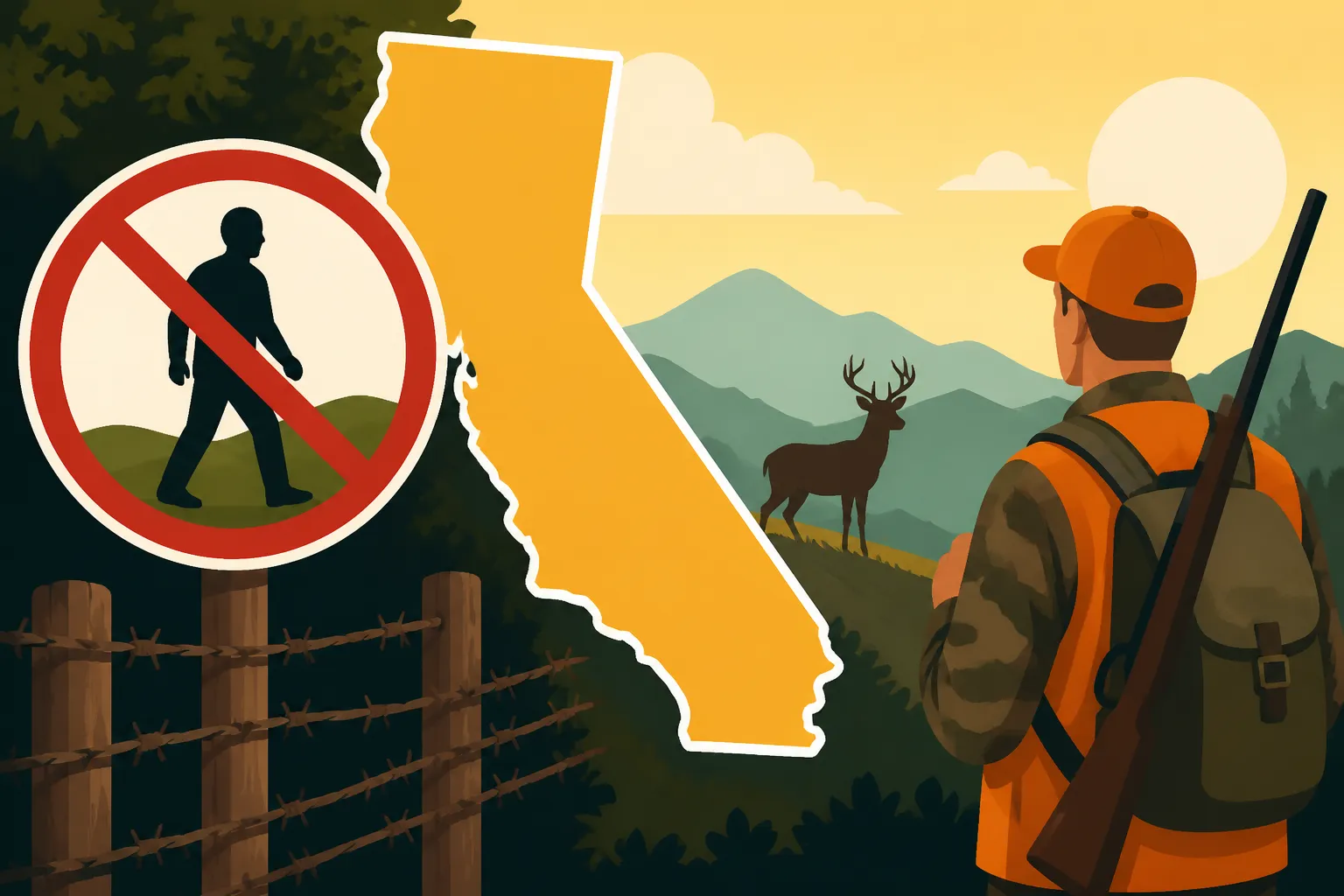
The concept of "posted" land is crucial. Posting typically involves signs that explicitly state "No Trespassing" or "Private Property," often accompanied by the landowner's name or contact information. These signs must be placed at intervals no greater than 500 feet along property boundaries and at all roads and trails entering the land. While obvious, sometimes these signs can be old, faded, or even shot up, making them less visible. Beyond signs, a substantial enclosure, like a solid fence, can also signify private property, even without explicit posting. California Posted Land Rules can provide more detail on these requirements.
A lesser-known but equally valid form of posting in California is the use of purple paint. Yes, a specific shade of purple paint on trees or posts can legally mark a property line as "No Trespassing." This method is becoming more common, especially in timbered areas where signs might be harder to maintain or are more prone to vandalism. It's subtle, so hunters need to be extra vigilant and recognize this visual cue. If you see purple paint, consider that land off-limits unless you have explicit permission.
It's tempting to think that if land isn't clearly posted, it's fair game, but this is a dangerous assumption. While clearly marked signs provide explicit notice, the absence of signs doesn't automatically grant permission. The law generally places the onus on the individual to know whether they are on private property. Imagine you're still-hunting along what seems like endless forest and suddenly stumble upon an old cabin with a well-maintained garden. Even if there are no signs, the presence of these indicators strongly suggests private ownership, and you should immediately retreat to where you know you have legal access.
The Absolute Need for Permission
This is perhaps the most fundamental rule of hunting on private land in California: you must have permission from the landowner. No ifs, ands, or buts. This isn't a suggestion; it's a legal requirement. Whether the land is posted or unposted, fenced or unfenced, if it's privately owned, you need explicit permission to be there for hunting purposes. Getting Private Land Permission in California is an art form in itself, requiring respect and good communication.
For hunting, verbal permission can sometimes be sufficient, but it's highly advisable to obtain written permission. A simple written note, signed by the landowner, stating the date, the specific area, and the activity (hunting deer, for example) can save you a world of trouble. This documentation acts as proof that you were legally authorized to be on the property, protecting you from misunderstandings or accusations of trespass, especially if you encounter law enforcement or another individual claiming to represent the landowner. Imagine you're granted verbal permission to hunt a small parcel behind someone's house, but later, their neighbor calls the game warden. Written permission makes your case undeniable.
The reason written permission is so critical boils down to proof and clarity. Memories can fade, landowners can forget, or circumstances can change. If a landowner sells their property or passes away, verbal agreements can become meaningless. A new owner will likely not honor a verbal agreement made with the previous owner. Having a signed document, especially one that specifies dates of access, game species allowed, and any other conditions, removes all ambiguity. It creates a clear record for both you and the landowner, fostering a relationship built on trust and mutual understanding.
Seeking permission can be intimidating, but a respectful approach often yields positive results. Start by identifying the landowner (often via county assessor records, or through tools like the onX Hunt app which shows property boundaries and owner names). Then, craft a polite letter or make a personal visit, explaining your intentions, demonstrating your commitment to ethical hunting, and offering to share some of your harvest. Many landowners, especially those dealing with nuisance animals like wild pigs, might be open to the idea, particularly if you come across as responsible and courteous. Remember, a landowner is doing you a favor, not the other way around.
Navigating Boundaries and Avoiding Accidental Trespass
California's landscape is a patchwork quilt of public and private holdings. What looks like one continuous stretch of forest could easily be broken up by numerous private inholdings. This complexity means that even the most diligent hunter can find themselves teetering on a boundary line. Knowing how to prepare and react is paramount.
Technology as Your First Line of Defense
In today's hunting world, advanced mapping applications are truly game-changers for navigating complex land ownership. Tools like onX Hunt and GoHunt have revolutionized how hunters understand and respect property lines. These apps utilize GPS technology and overlay public and private land boundaries directly onto detailed topographical maps, satellite imagery, and even parcel data. This means you can see exactly where you are in relation to property lines in real-time, right on your phone or GPS device. Finding California Property Lines has never been easier.
Before you even step foot in the field, you should be using these apps to thoroughly scout your hunting area. Identify potential access points, pinpoint public land corridors, and mark any private parcels that you absolutely must avoid. Many hunters use the "onX Layers for California Land Status" to get a comprehensive view, allowing them to download maps for offline use, which is critical in remote areas without cell service. This pre-scouting minimizes surprises and allows you to plan your hunt route to stay strictly on public land or authorized private property.
While these tools are incredibly powerful, they are not foolproof. GPS signals can be lost, batteries can die, and map data, though regularly updated, might have minor discrepancies. Always carry a physical map and compass as a backup, and don't rely solely on your phone's battery life. Furthermore, remember that the "line" on your screen might have a slight margin of error in the real world. When you're approaching a boundary, err on the side of caution. Give private property a wide berth, especially when visibility is poor or the terrain is rugged. Using an app for California BLM Land Status can be invaluable, but always cross-reference with visual cues like fencing or monuments if available.
Think of these mapping apps as an extension of your traditional scouting. You wouldn't go into an unknown area without studying a topo map first, right? Modern apps just give you a much more dynamic and accurate version of that. They allow you to mentally prepare for the terrain and the boundaries, visualizing your hunt before you've even packed your truck. This level of preparation is not only smart but also a sign of a responsible hunter.
What to Do If You Realize You've Trespassed
Even with the best preparation and the most advanced mapping tools, it's possible to accidentally trespass. Maybe you were focused on tracking a game animal, or perhaps a boundary marker was unclear. If you realize you've crossed onto private property without permission, the absolute first and most critical step is to immediately stop and reverse course. Do not continue deeper into the property, and do not attempt to justify your presence.
Your next step should be to exit the private property as directly and quickly as possible, backtracking your steps if you can. While doing so, remain calm and maintain a respectful demeanor. If you encounter a landowner or their representative, be polite, apologetic, and explain that it was an honest mistake. State your intention to leave immediately and offer your contact information if they wish to follow up. Do not argue or become defensive; this will only escalate the situation and potentially lead to more serious repercussions.
The distinction between accidental trespass and intentional trespass is significant in the eyes of the law. Accidental trespass might result in a warning, or at most, a minor civil infraction. Intentional trespass, especially if you continue to hunt after realizing your error or refuse to leave, can lead to criminal charges, significant fines, confiscation of gear, and even loss of hunting privileges. The best thing you can do is demonstrate good faith and a clear intent to rectify your mistake. Remember, a simple "I'm so sorry, I must have gotten turned around, and I'm leaving right now" goes a long way.
This proactive and respectful approach not only protects you legally but also helps maintain a positive image for hunters as a whole. A bad encounter between a landowner and a hunter can sour relations for everyone else hoping to gain access in the future. By handling accidental trespass gracefully, you uphold the hunting community's reputation and hopefully prevent further animosity.
Legal Consequences of Trespass for Hunters
The legal ramifications of trespassing in California, especially while hunting, can range from a stern warning to severe penalties. Ignorance of the law is generally not a valid defense, and the consequences can be both financial and impact your ability to hunt in the future. Understanding these potential outcomes can reinforce the importance of meticulous planning and strict adherence to property boundaries.
In California, trespass can be categorized as either an infraction, a misdemeanor, or, in more egregious cases, even a felony, depending on the circumstances. Simple trespass (e.g., entering private land without permission) is often a misdemeanor, carrying fines and potentially jail time. However, if the trespass involves hunting, the penalties often increase significantly. You could face additional fines specific to game violations, and potentially have your hunting license suspended or revoked. This can be a devastating blow to any passionate hunter. California Wildlife Violation Penalties can be substantial.
Beyond fines and license issues, there's the possibility of property damage charges if you inadvertently cause harm while on private land. This could include cutting fences, damaging crops, or disturbing livestock. In such cases, you might be held liable for civil damages, meaning the landowner can sue you to recover costs associated with the damage. Imagine the financial hit from having to pay for a new fence line and a civil suit on top of hunting fines.
Furthermore, any equipment used during a trespass while hunting could potentially be confiscated. This includes your firearm, archery equipment, or even your vehicle if it was used to access the private property. Recovering confiscated gear can be a lengthy and expensive legal process, if it's even possible. The risk simply isn't worth it. Always remember the broader implications of your actions; a momentary lapse in judgment can have long-lasting effects on your hunting career and personal finances.
Specific Scenarios and Hunter Responsibilities
While the general rules of trespass are clear, hunting often presents unique situations that require a deeper understanding of California's specific laws and expectations. Two common areas of confusion for hunters involve retrieving downed game and understanding access along roads and easements.
Retrieving Downed Game on Private Property
This is arguably one of the most agonizing situations a hunter can face: you make a perfect shot on a deer or pig, only for the animal to run a short distance and expire just over a fence line onto private property. Your heart sinks, knowing that getting to your hard-earned game isn't as simple as hopping the fence. In California, you absolutely still need permission from the landowner to enter their property to retrieve downed game.
The law is unequivocal on this point: killing an animal on public land does not grant you the right to trespass onto private land to retrieve it. This can feel incredibly frustrating, especially with the urgency of recovering game, but landowner rights take precedence. Your first action should be to attempt to contact the landowner immediately. Explain the situation calmly, provide details of where the animal is located, and politely request permission to enter their property for recovery. Offer to meet them at a convenient time or location.
What if you can't reach the landowner? This is a tough spot. You cannot simply enter the property. If it's safe to do so and you can visually confirm the animal's location from public land without crossing the boundary, you might consider reaching out to local law enforcement or a game warden. They might be able to assist in contacting the landowner or mediating the retrieval, but this is not guaranteed and often depends on their availability and local protocols. Do not expect them to grant you permission to trespass; they are there to uphold the law.
In the worst-case scenario, if you cannot obtain permission to retrieve your game, you may have to accept the loss. It's a bitter pill to swallow, but it's far better than facing trespass charges. This underscores the importance of hunting with awareness of nearby property lines. Before you take a shot, always consider the trajectory and the likely travel path of the animal after the shot, keeping private boundaries in mind. Always check Retrieving Game From Private Land in California rules before you head out.
Understanding Access on Roads and Easements
Another area of confusion stems from roads and easements that traverse private land. Just because a public road cuts through a vast private ranch doesn't mean you can step off the road and begin hunting. Public roads and rights-of-way generally only grant you the right to pass through the private property, not to hunt on it or even walk adjacent to it.
Imagine a county road winding through rolling hills, with a clear property line running right along the shoulder. Even if you see a beautiful buck just twenty yards off the pavement on the private side, you cannot legally shoot it from the public road, nor can you step onto the private land to pursue it without permission. The "right-of-way" for a public road is typically limited to the road itself and a narrow strip immediately alongside it, and it does not confer hunting privileges on the adjoining private property.
Easements present another layer of complexity. An easement grants a specific right to use someone else's land for a particular purpose, such as access for utilities or a private driveway for a neighboring parcel. However, an easement for vehicle access does not automatically grant hunting rights. For example, a power line easement might run for miles across private land, but you cannot assume you can hunt along that easement unless the easement's terms specifically allow it, or you have separate permission from the underlying landowner. Always clarify the scope of any easement.
Complicating matters further are "landlocked" public parcels – tracts of public land that are entirely surrounded by private property, with no public road or trail leading to them. Simply because the land is public doesn't mean you have a legal right to cross private land to get to it. Access to such parcels usually requires obtaining an access easement from the surrounding landowners or utilizing a public access point if one exists. This is where detailed scouting and mapping with tools like onX Hunt or GoHunt become incredibly important, allowing you to identify these landlocked areas and plan alternative approaches or secure permission ahead of time. Don't risk trespassing to access public ground.
| Scenario | Action Required | Potential Consequence of Non-Compliance |
|---|---|---|
| Private land, clearly posted | Do not enter without explicit, preferably written, permission. | Misdemeanor trespass, fines, license suspension, confiscation of gear |
| Private land, unposted | Assume private; do not enter without explicit permission. | Misdemeanor trespass, fines, license suspension, confiscation of gear |
| Game animal crosses private | Immediately stop. Contact landowner for permission to retrieve. | Criminal trespass if you enter without permission; loss of game |
| Public road through private | Stay on the road. Do not step off or hunt adjacent private land. | Trespass charges if you leave the public right-of-way |
| Landlocked public parcel | Obtain permission from surrounding landowners to cross. | Trespass charges if you cross private land to access |
| Purple paint markers | Treat as "No Trespassing" signs. | Misdemeanor trespass, fines |
Disclaimer
This article is for general informational purposes only and does not constitute professional advice. Laws, prices and regulations vary by location and change over time. Consult a qualified professional for guidance on your specific situation.