California Legal Firearms for Deer Hunting
Navigating the ever-evolving landscape of California's hunting regulations can feel like trying to hit a moving target, especially when it comes to legal firearms for deer hunting. Many hunters, both seasoned and new, get tripped up by the specific rules surrounding ammunition, rifle types, and even how to transport their gear legally. This comprehensive guide aims to cut through the confusion, providing clear, in-depth information on what you can and cannot use when pursuing deer across California's diverse landscapes.
Navigating California's General Firearm Regulations for Deer
California stands out with some of the most stringent and specific firearm regulations in the nation, and these absolutely extend to hunting. For deer hunters, understanding these foundational rules is not just good practice, it's essential for staying legal and avoiding costly penalties. It’s not enough to just own a rifle; you need to know if that specific rifle, loaded with specific ammunition, is legal for hunting in the exact spot you plan to be.
The All-Important Non-Lead Ammunition Mandate
Let's get this out of the way first: California implemented a statewide ban on lead ammunition for all hunting in 2019. This wasn't a gradual rollout; it's a hard and fast rule. If you're heading out for deer, your rifle, shotgun, or handgun must be loaded with certified non-lead ammunition. There are no exceptions for specific zones or private land anymore. This rule directly addresses concerns about lead fragmentation in gut piles and its impact on scavenging wildlife, particularly the California condor.
This mandate means that your trusted box of lead-core hunting rounds, which might be perfectly legal in other states, is now strictly off-limits in California. It’s a significant shift that requires every hunter to adapt their gear. You can find extensive details on this topic in our guide, "California's Non-Lead Ammunition Requirement," which breaks down the reasons and specifics behind this crucial regulation. When you are looking for new ammunition, look for terms like "copper solid," "monolithic copper," or "non-toxic" on the box. Brands like Barnes, Hornady, Nosler, and Federal all offer excellent non-lead options specifically designed for hunting big game.
The transition to non-lead can sometimes mean adjusting your rifle's zero, as these bullets often have different ballistic characteristics compared to their lead counterparts. It's always a smart move to purchase your non-lead ammunition well in advance of the season and spend some quality time at the range ensuring your rifle is dialed in. Don't wait until opening morning to discover your point of impact has shifted; that's a recipe for frustration and potentially a missed opportunity on a hard-earned buck.
Understanding Minimum Caliber and Bullet Energy Requirements
Beyond the lead-free mandate, California also has general guidelines regarding the types of firearms suitable for big game, which includes deer. While specific minimum calibers aren't explicitly written into the Fish and Game Code for all deer hunting, the spirit of the law and ethical hunting practices dictate using an adequate caliber to ensure a humane kill. The Department of Fish and Wildlife (CDFW) generally recommends centerfire rifles with at least a .22 caliber and above, using expanding bullets.
For larger big game like deer, most experienced California hunters will gravitate towards calibers in the .243 Winchester, .270 Winchester, .308 Winchester, or .30-06 Springfield range. These cartridges, when loaded with appropriate non-lead expanding bullets, deliver more than enough energy to ethically take a deer. Our "Rifles and Calibers for California Big Game" guide delves deeper into popular choices and their effectiveness. Using anything smaller, especially for larger mule deer found in the eastern Sierra, could be considered unethical by many.
The primary goal is sufficient energy transfer and penetration to dispatch the animal quickly. A fast, clean kill is not only humane but also reduces the chance of losing a wounded animal. While a .223 Remington can be used for deer with specific non-lead loads, many hunters prefer something with a bit more punch, especially when hunting larger-bodied deer in dense cover or at longer ranges. It’s always best to err on the side of using a cartridge with a bit more power rather than less.
General Safety and Legal Carrying Considerations
Carrying your firearm in the field, whether loaded or unloaded, also falls under specific regulations. While hunting, it's generally permissible to carry a loaded firearm, but always be mindful of where you are. Certain designated safe zones, campgrounds, or administrative sites within public lands may require unloaded firearms. It's crucial to always know your target and what's beyond it, adhering to the fundamental rules of firearm safety.
When transporting your firearm to and from the hunting grounds in a vehicle, California law requires rifles and shotguns to be unloaded and stored in a locked container, which can include the trunk of a car. Handguns must also be unloaded and stored in a locked container, separate from the ammunition. This applies even if you have a concealed carry permit; the specific transport rules for hunting apply.
Furthermore, always have your hunting license, deer tags, and any necessary permits readily available. The CDFW hunting app can often display digital copies of your licenses, but having physical tags is still a requirement for validation. Ensure you've completed your "California Hunter Education Requirements" as this is mandatory for all first-time resident hunters and certain non-residents.
Permitted Firearm Types for California Deer Hunting
California offers hunters a variety of options when it comes to taking deer, but each type of firearm comes with its own set of rules and considerations, especially in the era of non-lead ammunition. Understanding these specifics is key to making sure you're properly equipped for your hunt.
Legal Rifles and Preferred Calibers
For most deer hunters in California, a centerfire rifle is the go-to choice, and for good reason. They offer precision, range, and the necessary power for an ethical harvest. As mentioned, the absolute critical factor here is the use of non-lead ammunition. This means rounds with all-copper, copper-alloy, or other approved non-toxic projectiles. When looking for the "Minimum Bullet Diameter for California Rifles," remember that while .22 centerfire is technically legal, most deer hunters prefer something larger for better terminal performance.
Common calibers like .243 Winchester, 6.5 Creedmoor, .270 Winchester, .30-06 Springfield, and .308 Winchester are perennial favorites. These calibers offer a great balance of manageable recoil, good ballistics, and proven effectiveness on deer. For hunters pursuing mule deer in the open country of the Eastern Sierra or parts of the Mojave Desert, calibers with a flatter trajectory, such as a 7mm Remington Magnum or a .300 Winchester Magnum, might be considered, though they are certainly not necessary for most blacktail hunting.
When selecting a rifle, consider the terrain you'll be hunting. A lightweight mountain rifle might be ideal for steep, high-country X-zones, while a slightly heavier, more stable rifle might be preferred for still-hunting through coastal oak woodlands. No matter your choice, ensure it's chambered for a cartridge compatible with readily available non-lead ammunition. It's becoming easier to find popular non-lead loads from manufacturers like Barnes VOR-TX, Federal Premium Trophy Copper, and Hornady GMX, but always confirm availability well before your season. Our guide, "Choosing Non-Lead Rifle Ammunition in California," offers an in-depth look at making the right selection.
Shotguns for Deer: When and How
While rifles dominate the deer hunting scene, shotguns can also be legal and effective, particularly in areas where rifle hunting might be restricted or less practical. If you're using a shotgun for deer in California, it must be a 12-gauge or 20-gauge, and it absolutely must be loaded with non-lead slugs. Buckshot is not legal for deer hunting in California.
Shotguns are most commonly employed in areas with dense brush, where shots are typically close-range, or in regions with specific regulations that prohibit or limit rifle use due to population density or safety zones. A shotgun loaded with a modern non-lead slug, such as a copper solid slug, can be incredibly effective out to 100-150 yards, especially when paired with a rifled barrel and a low-power scope or red dot sight. This setup greatly enhances accuracy over a smoothbore barrel.
For example, if you're hunting deer in certain D-zones or wildlife areas where the cover is thick and shot distances are short, a shotgun might even offer an advantage in quick handling. Just like with rifles, it’s critical to pattern your shotgun with your chosen non-lead slugs to ensure accuracy and confidence in your shot. Don't assume all slugs will shoot the same from your barrel. You might also want to consult "Non-Lead Shotgun Loads for Upland Birds" if you hunt other species, but remember the slug requirement is specific for deer.
Handguns in the Deer Woods: Rules and Limitations
Hunting deer with a handgun in California is permitted, but it comes with its own strict set of rules, particularly regarding caliber, ammunition, and barrel length. Just like rifles and shotguns, any handgun used for deer must be loaded with non-lead ammunition. This is non-negotiable. Additionally, the handgun must be a centerfire pistol or revolver, and it needs to have a minimum barrel length of 6 inches.
Regarding caliber, similar to rifles, there's no exact minimum listed for deer, but ethical considerations apply. Handgun hunters typically opt for powerful magnum cartridges like .357 Magnum, .41 Magnum, .44 Magnum, or .45 Colt when loaded with suitable non-lead expanding bullets. These calibers deliver the necessary energy for a humane kill within responsible handgun ranges. Trying to hunt deer with a 9mm or .40 S&W, even with non-lead, would generally be considered insufficient and unethical. Our guide, "Non-Lead Handgun Ammunition Options," explores the choices available for those pursuing this challenging method.
Handgun hunting requires a higher degree of skill and discipline than rifle hunting, as the effective range is significantly shorter and shot placement is even more critical. It’s not for the faint of heart and should only be attempted by highly proficient handgun shooters who have spent considerable time practicing from field positions. Many handgun hunters prefer a scope or red dot sight on their hunting handgun to improve accuracy at typical hunting distances, which are often 50 yards or less for deer.
Ammunition Specifics Beyond Lead-Free: Bullet Types and Storage
Beyond the core requirement of non-lead, hunters need to understand the nuances of bullet construction, magazine capacity, and safe transport to ensure full compliance with California law. These details can often be overlooked but are just as critical as the main firearm choice itself.
Certified Non-Lead Projectiles: What to Look For
The term "non-lead" isn't just about the absence of lead; it implies a specific type of bullet construction designed to perform reliably on game without fragmentation. When you're standing in front of the ammunition shelf (or, more likely, browsing online given current availability challenges), you need to know "Which Non-Lead Bullets California Approves." The CDFW generally accepts commercially manufactured projectiles that do not contain lead.
The most common and effective non-lead bullets for deer hunting are monolithic copper projectiles. These bullets are typically machined from a single piece of copper or copper alloy. Upon impact, they are designed to expand reliably, retaining nearly 100% of their weight, which leads to excellent penetration and energy transfer. Examples include Barnes TTSX, Hornady GMX/CX, Nosler E-Tip, and Federal Trophy Copper. These bullets are engineered for deep penetration and controlled expansion, vital for ethical harvesting.
Some manufacturers also produce bonded core bullets that encase a lead-free core in a copper jacket, or frangible copper bullets designed to break apart. While these might be legal in some contexts, for big game like deer, monolithic copper is generally the preferred choice due to its consistent performance and deep penetration. Always check product descriptions carefully to ensure the bullet is explicitly listed as "non-lead" or "lead-free" and suitable for big game. It can be a challenge to find specific loads, and platforms like GoHunt often have forums and resources where hunters share their experiences with finding and using various non-lead options, helping you navigate the market.
Magazine Capacity and Other Firearm Features
California has strict laws regarding magazine capacity, even for hunting. For rifles, shotguns, and handguns used for hunting, you generally cannot use a magazine that holds more than 10 rounds. This rule applies to all firearms, regardless of when they were manufactured or acquired. Even if your firearm could accept a larger capacity magazine, it's illegal to use one while hunting in California.
Beyond magazine capacity, certain firearm configurations are also restricted. For instance, rifles generally must meet minimum overall length requirements and cannot have features considered "assault weapon" characteristics under California law. This typically means no pistol grips on semi-automatic rifles combined with detachable magazines, adjustable stocks, or flash hiders. While most traditional bolt-action or lever-action hunting rifles are not impacted by these "assault weapon" bans, it's something to be aware of, especially if you're considering a modern sporting rifle platform.
It's always a good idea to verify your specific firearm configuration against current California firearm laws, especially if you're new to the state or are modifying an existing firearm. The rules can be intricate and subject to change. For deer hunting, most hunters stick to classic bolt-action, lever-action, or pump-action rifles and shotguns, which typically do not fall under these more restrictive categories and are simple to keep compliant.
Transporting Firearms and Ammunition Safely
Proper transportation of your firearms and ammunition isn't just a recommendation; it's a legal requirement designed for public safety. When driving to and from your hunting grounds, all firearms, whether rifles, shotguns, or handguns, must be unloaded. An "unloaded" firearm means no ammunition in the chamber or attached magazine. The ammunition must be stored separately from the firearm.
Furthermore, all firearms must be in a locked container. This doesn't necessarily mean a custom gun safe; a hard-sided case with a lock, or even a soft case that can be locked, will suffice. If your vehicle has a trunk, that typically qualifies as a locked container, provided the firearm itself is also unloaded. Handguns, in particular, must be stored in a locked container and kept separate from ammunition.
This means you can't just throw your rifle in the back seat, even if it's unloaded, unless it's in a locked case. The idea is to prevent immediate access to a loaded firearm. Failure to properly transport firearms can lead to serious legal consequences, including fines and potential loss of hunting privileges. Always take the extra minute to secure your firearms properly before hitting the road.
Common Pitfalls and Staying Compliant
California's hunting regulations are complex, and even experienced hunters can inadvertently find themselves on the wrong side of the law. Knowing the common pitfalls and how to proactively address them is essential for a stress-free and legal hunt.
Avoiding Prohibited Areas and Discharge Rules
One of the easiest ways to get into trouble is by hunting or discharging a firearm in a prohibited area. This includes private property without permission, certain wildlife refuges or ecological reserves that are closed to hunting, and within specific distances of occupied dwellings or public roads. Our guide on "California Firearms Discharge Setback Rules" provides specific distances you need to maintain from buildings and roads when discharging a firearm. Ignorance of these boundaries is not an excuse.
California has a vast network of public lands, including National Forests, BLM lands, and CDFW Wildlife Areas, many of which are open to hunting. However, even within these areas, there can be localized restrictions. For example, some campsites, picnic areas, or specific trails might have "no shooting" zones. It is your responsibility to know the specific rules for the area you are hunting. Utilizing mapping apps like onX Hunt or GoHunt, which often show public land boundaries, private property lines, and sometimes even specific land use restrictions, can be incredibly helpful. Always cross-reference with official maps and regulations from the managing agency (e.g., US Forest Service, BLM, CDFW).
The terrain itself can also create challenges. When hunting in steep canyons or heavily timbered areas, it can be hard to be certain of your backdrop. Always assume there's something beyond your target, and never take a shot unless you have a clear, safe shooting lane and a positive identification of your target. Misidentification, especially in areas where different deer species overlap, or where deer and other protected animals might be present, can lead to severe penalties. Knowing the difference between a blacktail's fork versus a forked horn, for instance, can be critical in specific zones with antler point restrictions.
Keeping Up with Regulatory Changes
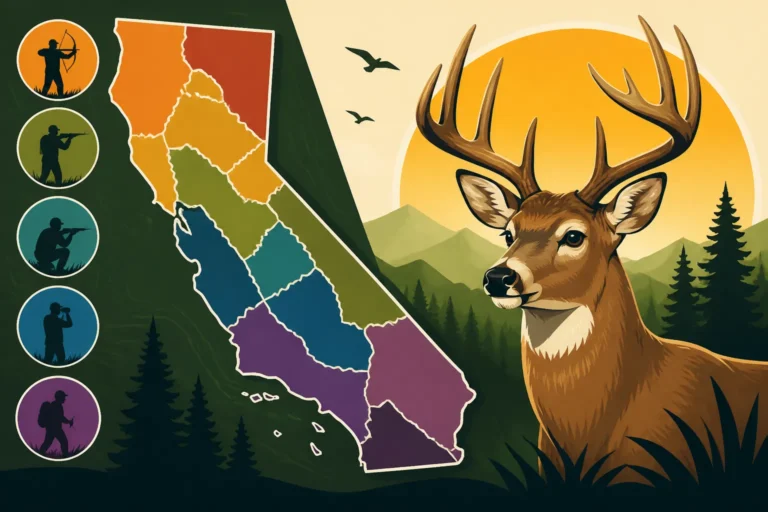
California's hunting and firearm laws are not static; they are subject to change, sometimes with little warning. New legislation, adjustments to season dates, or changes in designated hunt zones can all impact how and where you can hunt. For instance, the "California's Multi-Zone Deer Season System" is a good example of how complex zones and varying dates require constant vigilance from hunters.
It's imperative to stay informed. The CDFW website is the official source for regulations, and every hunter should download and thoroughly read the current year's Big Game Hunting Regulations. Subscribing to CDFW newsletters or following reputable hunting news sources that focus on California regulations can also help keep you updated. Organizations like GoHunt are excellent resources, often providing detailed summaries and analyses of rule changes, helping hunters navigate complex legal shifts and plan their seasons more effectively. Their community forums can also be a good place to ask questions and learn from others' experiences with specific regulations.
Never rely solely on information from a few years ago or anecdotes from other hunters. Always verify directly with the CDFW or official publications. A simple oversight due to outdated information can lead to a ruined hunt and legal trouble. This includes things like checking for emergency fire closures on public lands, which can appear suddenly and close vast areas to hunting.
The Role of Hunter Education and Licensing
Finally, foundational knowledge gained through hunter education and proper licensing underpins all legal and ethical hunting in California. Before you even pick up a firearm, you need to ensure you have the correct licenses and tags. Our "California Resident License Options" guide is a good starting point for understanding what permits you need.
Everyone born after January 1, 1972, must complete a "California Hunter Education Requirements" course. This course covers firearm safety, wildlife identification, conservation ethics, and a comprehensive overview of hunting laws and regulations. It’s designed to create responsible, knowledgeable hunters, and it’s a critical first step. For youth hunters, the "California Apprentice Hunter License Rules" offer a pathway to learning under a mentor.
Beyond the initial hunter education, responsible hunting is a continuous learning process. Regularly reviewing the regulations, participating in hunting safety refreshers, and staying current on species identification and ethical shot placement are all part of being a good steward of the resource. Understanding the "California Buck Bag Limit" for your specific zone, for instance, is not just about counting deer, but about managing local populations responsibly. A well-informed hunter is a safe and legal hunter.
Disclaimer
The information provided in this guide is for general informational purposes only and is not intended as legal advice. Hunting regulations in California are complex and subject to change. Always consult the most current California Department of Fish and Wildlife (CDFW) regulations and, if necessary, seek legal counsel to ensure compliance with all applicable laws. The author and publisher are not responsible for any errors or omissions, or for the results obtained from the use of this information.