Hunting Roosevelt Elk in Redwood Country
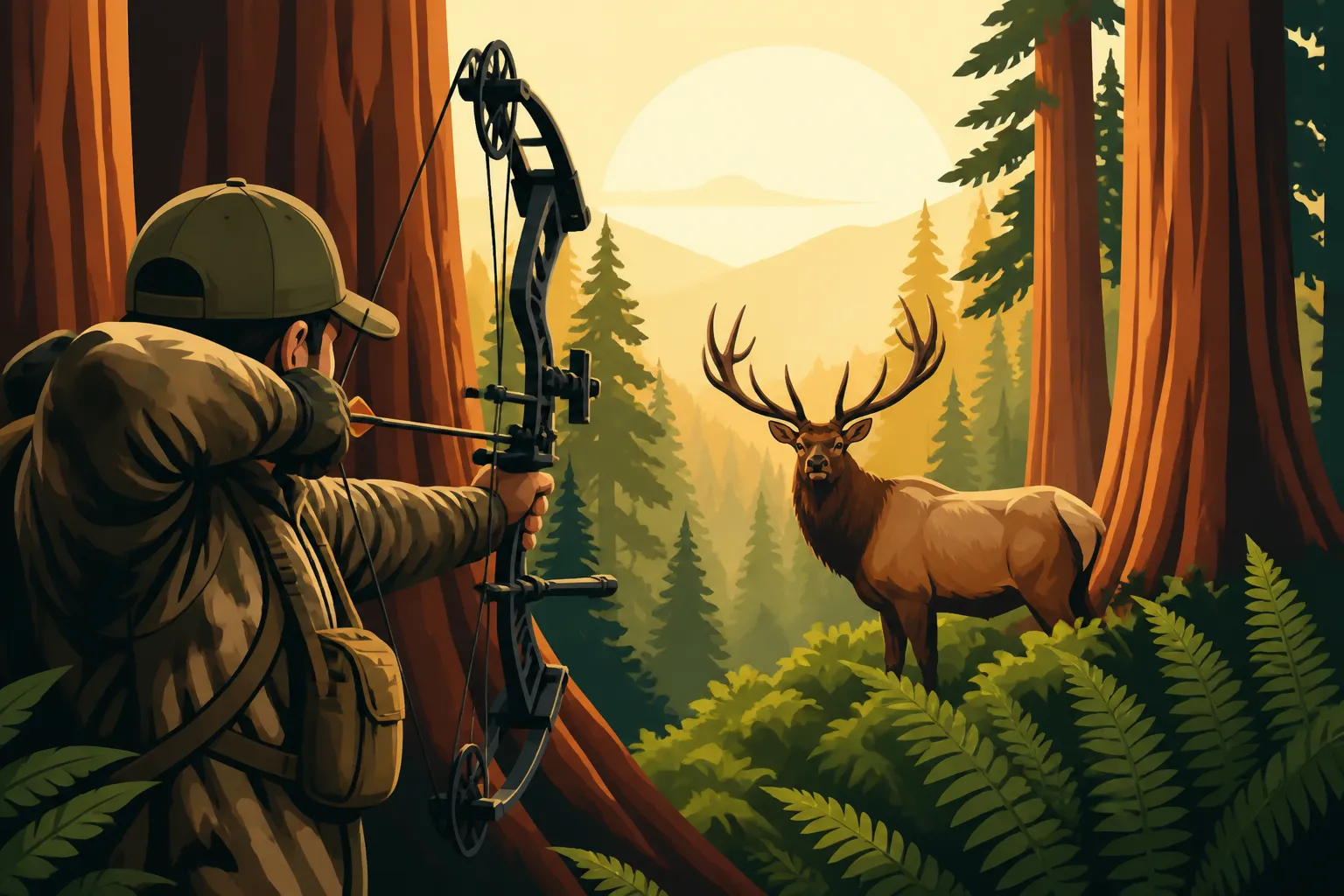
Hunting Roosevelt elk in California's dense redwood country is an experience that can feel almost mythical, yet it presents some of the most daunting challenges a hunter can face. Forget the wide-open spaces of the Rocky Mountains; here, you're dealing with towering trees, relentless undergrowth, and a game animal that seems tailor-made to vanish into the emerald shadows. Many hunters get overwhelmed by the sheer scale and thickness of the habitat, struggling to even locate a herd, let alone get within range. This guide is dedicated to equipping you with the knowledge and strategies to navigate these unique obstacles and vastly improve your chances of a successful Roosevelt elk hunt in California's breathtaking redwood forests.
Understanding the Redwood Habitat and Roosevelt Elk Behavior
When you step into the redwood forest, you're not just entering a woodlot; you're entering an ecosystem unlike almost any other. This unique environment dictates how Roosevelt elk live, move, and react, and understanding these nuances is the first critical step to finding success.
The Unique Challenges of Redwood Terrain
The redwood forests of California, particularly in the northwestern regions, are defined by their incredible density and verticality. Imagine trees that dwarf anything you've ever seen, often reaching over 300 feet, creating a perpetual twilight on the forest floor. Below this canopy, you'll find an incredibly thick understory of ferns, rhododendrons, salmonberry, and tangled vine maple. This isn't just a picturesque backdrop; it's a navigational nightmare for hunters. Visibility often drops to mere yards, making spotting game at any distance virtually impossible. The ground itself can be soft with decades of duff, then suddenly give way to steep, slick ravines carved by seasonal rains.
This dense cover works both for and against the elk. It provides unparalleled security, allowing them to disappear with remarkable ease even when you're incredibly close. It also means they don't have to travel far to feel safe. For hunters, it means every step must be deliberate, every sound amplified, and patience must be your absolute best friend. Unlike Glassing Mule Deer in Open California Country, you're not going to be sitting on a ridge with a spotting scope here. You'll be deep in the thick stuff, often only able to see 20-30 yards at best, relying more on sound and scent than sight. This intimate, close-quarters hunting is thrilling but demands a completely different approach.
Roosevelt Elk Movement and Feeding Patterns
Roosevelt elk are creatures of routine, especially when it comes to their food sources. While they prefer the security of dense timber, they need to graze, often frequenting the edges of clearings, logging cuts, and riparian zones. In the redwoods, these "edges" might not be as obvious as a vast meadow. Look for areas where the forest transitions into younger growth, or where the canopy opens up slightly to allow sunlight to reach the forest floor, promoting herbaceous plants. They are primarily browsers and grazers, and their diet shifts with the seasons. In the spring and summer, they'll favor lush green growth, but come fall, they might be found browsing on the leaves and twigs of shrubs, or even acorns if they're available, though acorns are less prevalent in true redwood stands.
Understanding their daily cycle is key. Elk typically feed during the cooler parts of the day – early morning and late evening – and bed down in dense cover during midday. However, in the perpetually shaded redwood forests, their activity patterns can be less rigid. They might feed at any time of day in areas where light barely penetrates, moving slowly through the undergrowth. Their bedding areas will almost always be in the thickest, most impenetrable parts of the forest, often on north-facing slopes or in deep ravines where they feel secure and can easily detect approaching predators. Pinpointing these core areas and understanding how elk navigate between them is vital.
Scouting and Locating Elk in Dense Timber
Finding Roosevelt elk in the redwood curtain can feel like searching for a needle in a haystack. Traditional scouting methods used in open country are often useless here. Instead, you need to adapt to the terrain, focusing on specific signs and leveraging technology to your advantage.
Interpreting Elk Sign in the Redwoods
Because visual encounters are so rare, becoming an expert at reading elk sign is paramount. Fresh tracks, especially those of a herd, can tell you direction and recent activity. Look for the distinct, heart-shaped prints, often larger than deer tracks. Fresh droppings, particularly those that are still soft and shiny, indicate elk have been through recently. Rubs on saplings, where bulls have scraped their antlers, and wallows, muddy depressions where elk roll to cool off and remove parasites, are also strong indicators of their presence. Wallows are particularly valuable as they are often used repeatedly and can be prime ambush spots or give you an idea of a bull's size.
Beyond these obvious signs, pay attention to less direct indicators. Heavily browsed vegetation, broken branches from elk pushing through thickets, or even a faint but musky elk odor, especially around bedding areas or rutting sites, can lead you to them. Elk trails, which are often well-worn paths through the dense undergrowth, are highways you want to be on. They connect feeding areas, bedding areas, and water sources. Learning to differentiate fresh sign from old, and interpreting the direction and urgency of their movement, will be your most valuable skill. Tools like Scouting California Public Land Before Season can help you identify potential travel corridors and water sources from aerial maps before you even step foot in the woods.
Using Technology and Aerial Maps
While the redwoods are dense, technology can still play a crucial role. Satellite imagery and topographic maps, especially those found on platforms like GoHunt, can reveal subtle terrain features that might concentrate elk. Look for saddles, benches, ridge lines, and natural funnels within the timber. These are spots where elk movement might be restricted or funneled. You might not see elk, but you can see changes in elevation, streams, or slightly less dense areas that could be advantageous for their travel. Identify potential clearings, even small ones, or areas of younger growth that might provide forage.
GPS units or mapping apps on your phone (with downloaded offline maps!) are non-negotiable. It's incredibly easy to get disoriented in the homogenous redwood forest. Mark every piece of fresh sign you find, potential bedding areas, or travel corridors. Over time, these data points will build a picture of elk movement patterns. When looking for potential areas, particularly during the application process, GoHunt's detailed unit maps and draw odds information for specific zones can be invaluable for pinpointing areas with good success rates. Remember, while technology helps with macro-scouting, the real work of finding elk happens on the ground, patiently sifting through the dense cover for fresh clues.
Effective Hunting Strategies for Redwood Country
Hunting Roosevelt elk in the redwoods demands a specific set of strategies. Forget long-range shots; this is primarily a close-quarters game where stealth, patience, and adapting to the elk's behavior are paramount.
Still-Hunting the Dense Timber
Still-hunting is perhaps the most effective method for pursuing Roosevelt elk in the thick redwood forests. This isn't about sitting in a stand; it's about moving incredibly slowly, pausing often, and using your senses to detect elk before they detect you. Think of it as a silent, continuous stalk. Take one or two steps, then stop for several minutes, scanning every shadow, listening intently, and smelling the air. The key is to cover ground at a snail's pace, constantly evaluating your surroundings. In this dense environment, a still hunter will rarely see an entire elk, but rather a flicker of movement, a dark patch that doesn't quite look like a tree, or the horizontal line of a back or belly through the vertical chaos of trunks and ferns.
Pay close attention to wind direction and thermals. In steep, broken terrain, thermals can be tricky, often rising in the morning and falling in the evening. Always try to approach with the wind in your favor. When you encounter fresh sign, slow down even further. This is where elk often bed or feed. Focus on areas with slightly more open understory or areas where game trails converge. This method requires immense patience and mental discipline, but it’s how many successful hunters find bulls in these challenging woods. You might walk all day and only cover a mile or two, but that mile could hold the elk you're looking for. This is often far more effective than trying to cover vast distances, especially for methods like Still-Hunting California's Sierra Nevada Timber which also emphasize slow, deliberate movement.
Calling and Decoying in Close Quarters
Calling can be highly effective for Roosevelt elk, especially during the rut, but it’s used differently than in open country. Here, subtle, realistic calls are often more effective than aggressive, loud bugles. Because visibility is so limited, elk often come into calls cautiously, trying to pinpoint the source. A soft cow call or a modest bugle can pique their interest without immediately signaling "hunter." If you get a response, resist the urge to immediately charge in. Instead, try to set up quickly, ensuring you have clear shooting lanes (as clear as they get in the redwoods, anyway) and an escape route if the elk decides to circle downwind.
Decoys are rarely practical in the extremely dense cover of the redwoods, as they're unlikely to be seen, and carrying one through that thicket is a nightmare. However, if you find a rare, small opening or a logging deck, a simple cow decoy could potentially draw a curious bull into the open. More often, calling in the redwoods is about drawing an elk a few extra yards through the brush to present a shot, rather than bringing them across a field. Using a small, portable blind or simply setting up against a large redwood can provide some concealment. Remember to practice your calls year-round to be proficient when the moment arises in the field.
The Spot-and-Stalk Paradox
The term "spot-and-stalk" might seem contradictory in the redwoods, where spotting is almost impossible. However, a modified version can be employed. This involves finding an elevated position overlooking a slightly more open area—perhaps an old logging road, a clear-cut edge, or a less dense basin—and spending time glassing with binoculars. This isn't long-range glassing, but rather methodical scanning of small pockets of visibility. Once you "spot" an elk (or more likely, a part of one, or fresh sign indicating recent presence), the stalk begins immediately.
The stalk itself will be more like a slow crawl or a deliberate still-hunt through the dense understory. Every broken twig, every rustle of leaves, can give you away. This is where Packs and Gear for a Backcountry Elk Hunt becomes critical – you need a quiet pack that doesn't snag on branches and allows for silent movement. Focus on using terrain features, fallen logs, and thick vegetation for concealment. The goal is to close the distance to bow range or a very short rifle shot, typically well within 100 yards, often much closer. This requires exceptional woodsmanship and the ability to move through difficult terrain with the utmost stealth.
| Elk Sign | Description | Significance in Redwoods |
|---|---|---|
| Tracks | Large, heart-shaped, often deeply impressed. | Fresh tracks (sharp edges) indicate very recent presence, guiding your still-hunt direction. |
| Droppings | Ovoid pellets, clumped when fresh and green, individual and dry when older. | Fresh, dark, moist droppings mean elk were here hours ago, or very recently. |
| Rubs | Antler scrapes on small trees or saplings. | Primarily made by bulls during the rut, indicating active bull presence. |
| Wallows | Muddy, trampled depressions where elk roll. | Used repeatedly, especially during warmer months or rut. Excellent ambush spots. |
| Trails | Well-worn paths through dense brush. | Elk highways connecting feeding, bedding, and water. Follow them slowly, but expect elk to step off. |
| Beds | Depressions in dense cover where elk have laid. | Fresh beds (still warm or matted down) mean elk are likely nearby. |
Essential Gear and Preparation for the Hunt
Hunting in redwood country isn't just physically demanding; it requires specialized gear to keep you comfortable, safe, and effective in a notoriously unforgiving environment.
Clothing and Footwear for Wet, Rugged Terrain
Your clothing strategy needs to prioritize layering, durability, and moisture management. The redwood coast is famously damp, often shrouded in fog, and prone to rain. Waterproof yet breathable outerwear is non-negotiable. Think tough rain gear that can withstand pushing through thorny brush without tearing. Underneath, synthetic or wool base layers are crucial for wicking away moisture and retaining warmth even when wet. Cotton is your enemy here. Camouflage patterns that blend with dark timber and deep greens, like those specifically designed for dense forests, will give you an advantage, particularly for Camo Patterns for California Oak Woodland Cover in similar, albeit slightly different, dense environments.
Footwear is arguably the most critical piece of gear. You need sturdy, waterproof boots with excellent ankle support and aggressive tread. The terrain can be steep, slick, and uneven, often with hidden roots and slippery mud. Look for boots that are broken in but still have plenty of life left. Brands like Kenetrek or Schnee's are popular for a reason—they offer the ruggedness and support needed for such demanding conditions. Pack extra socks made of wool or synthetic material, as wet feet are a fast track to misery and blisters. Gaiters are also highly recommended to keep debris and moisture out of your boots and protect your lower pant legs.
Optics and Navigation Tools
While long-range glassing isn't the primary method, quality optics are still important for scrutinizing dense cover at closer ranges. A good pair of 8x or 10x binoculars will help you pick apart shadows and identify shapes in the dim light. Look for models with excellent low-light performance. A rangefinder is also essential for confirming distances in the dense timber, where judging yardage can be deceiving due to the lack of clear landmarks. Remember, you're not planning a 400-yard shot; you're confirming if that elk is at 30 or 60 yards.
For navigation, a reliable GPS unit or a smartphone with a robust mapping app (like onX Hunt, which GoHunt also integrates with) loaded with offline maps is an absolute necessity. Cell service is virtually non-existent in much of the redwood country. Mark your vehicle, your camp, points of interest (wallows, tracks, rubs), and any notable terrain features. A physical compass and map should always be carried as a backup, and you should know how to use them. A headlamp with a red light option is also crucial for pre-dawn hikes or packing out game after dark. Don't forget extra batteries for all your electronics.
Weapon Choice and Non-Lead Ammunition
California has strict regulations regarding ammunition, requiring the use of non-lead bullets for all hunting statewide. For Roosevelt elk, a powerful, accurate rifle chambered in a cartridge suitable for large game is essential. Calibers like .30-06 Springfield, .300 Winchester Magnum, .338 Winchester Magnum, or a 7mm Remington Magnum are all excellent choices. Regardless of caliber, the key is to use premium, non-lead bullets designed for deep penetration and controlled expansion, such as Barnes TSX, Hornady GMX, or Nosler E-Tip. These bullets retain their weight well and deliver devastating terminal performance on thick-skinned animals like elk. Be sure to test your rifle thoroughly with your chosen non-lead ammunition to ensure accuracy. You can read more about Choosing Non-Lead Rifle Ammunition in California to make an informed decision.
For archery hunters, a powerful bow (60+ pounds draw weight) paired with heavy, well-tuned arrows and durable broadheads (fixed blade often preferred in thick cover) is crucial. A Best Broadhead for California Blacktail might be a good starting point, but consider something heavier duty for elk. Ensure your setup can deliver enough kinetic energy and momentum to achieve pass-throughs on an animal as tough as a Roosevelt elk. Whether rifle or bow, practice shooting in positions you might encounter in the field – kneeling, off-hand, or from a crouch – as stable shooting benches are a luxury you won't have in the redwoods.
Disclaimer
Hunting carries inherent risks, including injury and death. Always prioritize safety, understand and follow all California Department of Fish and Wildlife regulations, and obtain proper licenses and tags. This guide provides general information and recommendations; it is not a substitute for professional instruction, thorough personal preparation, or adherence to all applicable laws. Conditions in the field can change rapidly, and hunters should always be prepared for emergencies.