How Far to Walk From a Forest Road
We've all been there: driving down a dusty Forest Service road in California, feeling a mix of excitement and dread. Excitement because you're finally out in the deer woods, but dread because every pull-out has a truck, and every bend seems to reveal another hunter crashing through the brush just off the pavement. The common frustration is that most hunters don't venture far from the easily accessible routes, making it feel like all the "good" spots are taken. This guide is dedicated to helping you understand how far you really need to walk from a forest road to find less-pressured game and improve your hunting success in the diverse landscapes of California.
The "Road Hunter" Mentality and Why It Fails (or Sometimes Succeeds, But Not Really)
There's a reason those Forest Service roads exist: access. They crisscross our public lands, providing a network for logging, fire suppression, and yes, for hunters to get into the backcountry. But this convenience comes at a significant cost, especially during open seasons.
The Lure of Easy Access (and the Crowds it Brings)
Think about it: after a long week of work, rolling out of bed, grabbing your gear, and parking right next to a promising-looking ridge line is incredibly appealing. For many, it's a matter of physical limitation, time constraint, or simply a lack of experience venturing deeper into true wilderness. These roads, from the well-graded main arteries in the Sierra National Forest to the rough, two-track spurs winding through the Mendocino National Forest, are heavily used. And where there are people, especially during hunting season, deer and other game animals change their behavior dramatically.
It’s a cycle: the easier the access, the more hunters will be present. More hunters mean more scent, more noise, more visual disturbance. What was once a good bedding area or feeding flat close to a road can quickly become a ghost town once opening weekend hits. I've personally seen areas that are absolutely crawling with deer during pre-season scouting become completely devoid of game come legal shooting light, simply because the pressure pushed them out. You might occasionally get lucky catching a deer crossing a road early or late, but consistently finding animals that are undisturbed and acting naturally requires a different approach. The sheer volume of foot traffic and vehicles creates a constant disturbance that intelligent game animals learn to avoid. It’s important to understand the concept of Hunting Pressure on California Public Land and how it directly impacts game movement and availability near roads.
Deer Behavior Near Roadsides
Deer are incredibly adaptable creatures, and their survival often depends on their ability to learn and react to threats. In areas with significant human presence, especially from vehicles and hunters, deer develop specific patterns to minimize encounters. They quickly learn to associate the sound of an approaching truck or a slamming car door with danger.
Because of this learned behavior, deer rarely bed down directly adjacent to well-used forest roads during daylight hours. They might cross a road, particularly under the cover of darkness or during low-light conditions like dawn and dusk, to move between bedding and feeding areas. However, lingering or extensive daytime activity right off a beaten path is usually limited to extremely remote areas or during seasons with minimal hunting pressure. If you're hunting along a popular road, any deer you do see during shooting hours are often just passing through quickly, making for a challenging, fleeting shot opportunity, or they are less wary younger animals. The mature bucks and does have typically already moved on to thicker cover, steeper slopes, or simply deeper into the woods where the human footprint is less constant. They become nocturnal near roads, making daytime encounters rare.
Understanding Hunter Pressure and Deer Sanctuary
The idea that you need to get away from roads isn't new, but how far is often misunderstood. Many hunters cling to a mental rule of thumb that just isn't effective in California's diverse and often heavily-hunted public lands.
The "Half-Mile Rule" and Its Flaws
I've heard it a thousand times: "Just walk a half-mile off the road, and you'll be fine." While taking any steps off the pavement is a good start, in many areas, a half-mile is barely scratching the surface of true sanctuary for a pressured deer. Especially in areas with relatively flat or open terrain, a half-mile is easily traversed by an enthusiastic hunter, and with modern tools like electric mountain bikes on legal trails or even ATVs on designated routes, that "half-mile" feels a lot closer than it used to.
Furthermore, deer aren't stupid. They understand the cone of human activity. If a half-mile off the main road is still within earshot of vehicle noise, or if that half-mile still funnels them into another area of human activity, it's not a true sanctuary. In many popular D-zones or even A-zones with good road networks, that half-mile is often still within range of multiple hunters. You're simply in an area where deer might occasionally pass through, but probably not where they feel secure enough to live. The real secret is Finding Ground That Sees Fewer Hunters, and that usually means pushing past the common comfort zone.
Identifying Natural and Man-Made Sanctuaries
So, if a half-mile isn't enough, what is a true sanctuary, and how do you find it? A deer sanctuary is essentially an area where game animals feel safe from human disturbance. These spots often possess a combination of:
- Thick Cover: Dense brush, dark timber stands, or rugged terrain that makes movement difficult for predators (including humans).
- Steep Terrain: Areas with significant elevation changes, deep canyons, or rocky outcroppings that deter casual hikers and hunters.
- Water Access: Especially crucial in California's arid regions, a reliable water source tucked away from easy access makes a spot much more attractive.
- Lack of Human Presence: This is the key. The area feels untouched, with minimal signs of trails, trash, or other human activity.
You can often identify these potential sanctuaries by meticulously studying topographic maps and aerial imagery. Brands like onX Hunt and GoHunt offer invaluable tools for this. Look for areas with dense green canopy (indicating thick timber), tight contour lines (steep slopes), and remote water sources (springs, seeps, small creeks). Cross-reference these with road networks. The goal is to find areas that are challenging to access from any direction, creating a natural deterrent for most hunters. For instance, a steep, north-facing slope covered in dense chaparral that drops into a canyon paralleling a rarely-used spur road might be a prime example. The road provides access to the general vicinity, but the terrain itself ensures most hunters won't push through. Thorough Reading Aerial Photos for Sierra Deer can help uncover these hidden gems.
Here's a quick look at factors that influence how far deer might be from a road:
| Factor | Effect on Distance from Road (General Tendency) | Notes |
|---|---|---|
| Hunting Pressure | Increases (Further) | More pressure pushes deer deeper into cover. |
| Terrain Ruggedness | Increases (Further) | Steep, broken ground deters hunters, providing sanctuary. |
| Cover Density | Decreases (Closer) | Thick cover makes deer feel safe, even if closer to a road. |
| Water Availability | Varies | Deer need water; if scarce, they may risk roads for remote sources. |
| Food Availability | Varies | Good food might draw them closer, but pressure will push them back. |
| Time of Day | Decreases (Closer at Night) | Deer are more likely to be near roads during nocturnal hours. |
| Road Usage | Increases (Further) | Seldom-used roads cause less disturbance than main thoroughfares. |
| Season Length | Increases (Further later in season) | Deer become warier as the season progresses. |
Strategies for Deeper Penetration and Success
Once you understand why you need to get away from the roads, the next step is planning how to do it effectively and safely. This isn't just about busting brush; it's about smart hunting.
Leveraging Topography and Natural Barriers
California's landscape is incredibly varied, from the steep, timbered slopes of the Sierra Nevada to the rolling, brushy coastal ranges and the stark, open desert. Each offers unique opportunities to use topography and natural barriers to your advantage. A deep canyon, for example, might run parallel to a well-traveled forest road. Most hunters will stay on their side of the canyon, not wanting to deal with the exhausting climb down and back up. But if you're willing to make that effort, the far side of the canyon could hold undisturbed deer.
Similarly, dense patches of chaparral, manzanita, or buckbrush, while notoriously difficult to traverse, often hold deer that seek refuge from easy access. These areas might be only a half-mile from a road as the crow flies, but require a significant physical effort to penetrate. Look for fingers of dense cover that extend deeper into canyons or up secluded drainages. These natural funnels can be excellent travel corridors for deer feeling the pressure. Don't forget to factor in Wind and Thermals in Steep Sierra Country when planning your approach, as scent control becomes even more critical when pushing into deep cover.
The Role of Mapping Apps and Scouting
In today's hunting world, mapping applications are not just a convenience; they are an essential tool for effective public land hunting. Services like onX Hunt and GoHunt allow you to scrutinize terrain from your couch, identifying potential sanctuaries, plotting routes, and marking waypoints for glassing points or water sources. You can layer public and private land boundaries, pinpoint hidden springs, and even see historical burn scars that might be regenerating with new forage, drawing deer in. Using an App for California BLM Land Status can be a game-changer for navigating vast tracts of desert land.
Pre-season scouting is the vital next step. Maps are fantastic, but nothing beats boots on the ground to confirm what you've seen digitally. Walk those access roads, find those steep trails, and see where other hunters are parking. More importantly, push past those common spots. Look for tracks, scat, rubs, and beds in areas that look difficult to reach. This confirms your map-based intel and gives you a real-world understanding of how far you need to go. You can also strategically place trail cameras in these deeper areas. While Where to Hang a Camera on a Forest Road is helpful, consider hanging them much further back on faint game trails leading into dense pockets of cover to truly capture undisturbed activity. Don't underestimate the power of Scouting With the CDFW Hunting App to find general hunting areas and regulations before diving into specific spots.
Planning for the Pack Out
This is the big one, the reality check that often dictates how far someone is willing to go. The further you penetrate into the backcountry, the more challenging the pack out becomes, especially if you're lucky enough to harvest an animal. California's terrain is unforgiving, and a downed deer in a steep canyon two miles from the nearest road can quickly turn a celebratory moment into a grueling ordeal.
Always, always have a plan for meat care and extraction. This might involve:
- Quartering: Knowing how to field dress and quarter an animal is essential for breaking it down into manageable loads. This is especially true for larger game like elk, but even a good-sized blacktail can feel heavy after a few miles.
- Game Bags: Quality game bags are crucial for keeping meat clean and cool, especially during California's often warm early seasons.
- Pack Frame: A dedicated pack frame or a sturdy hunting backpack designed to carry heavy loads will save your back and energy. Don't rely on a daypack for packing out an entire deer. Consider the Best Backpack Frame for Quartered Elk even if you're hunting deer; versatility is key.
- Game Carts: While not suitable for all terrain, a good game cart can be a lifesaver on flatter, less rocky trails. However, for a steep, brushy canyon, you'll be relying on your own strength and pack. Knowing how to manage Packing Meat Out of a Steep Canyon is a skill every deep-woods hunter should master.
- Water and Food: Carry ample water and high-energy snacks. The pack out often takes longer than the hike in, and you'll burn significant calories.
A good rule of thumb: before you decide to hike in a certain distance, mentally (or physically) simulate packing out an animal from that spot. If it seems impossible or dangerously difficult, reconsider your penetration strategy.
When Roads Can Be Your Friend (Tactical Use)
While the general advice is to get away from roads, there are specific tactical situations where a forest road can actually be an asset, not just a liability. It's all about how you use them.
Utilizing Roads for Access to Remote Trailheads
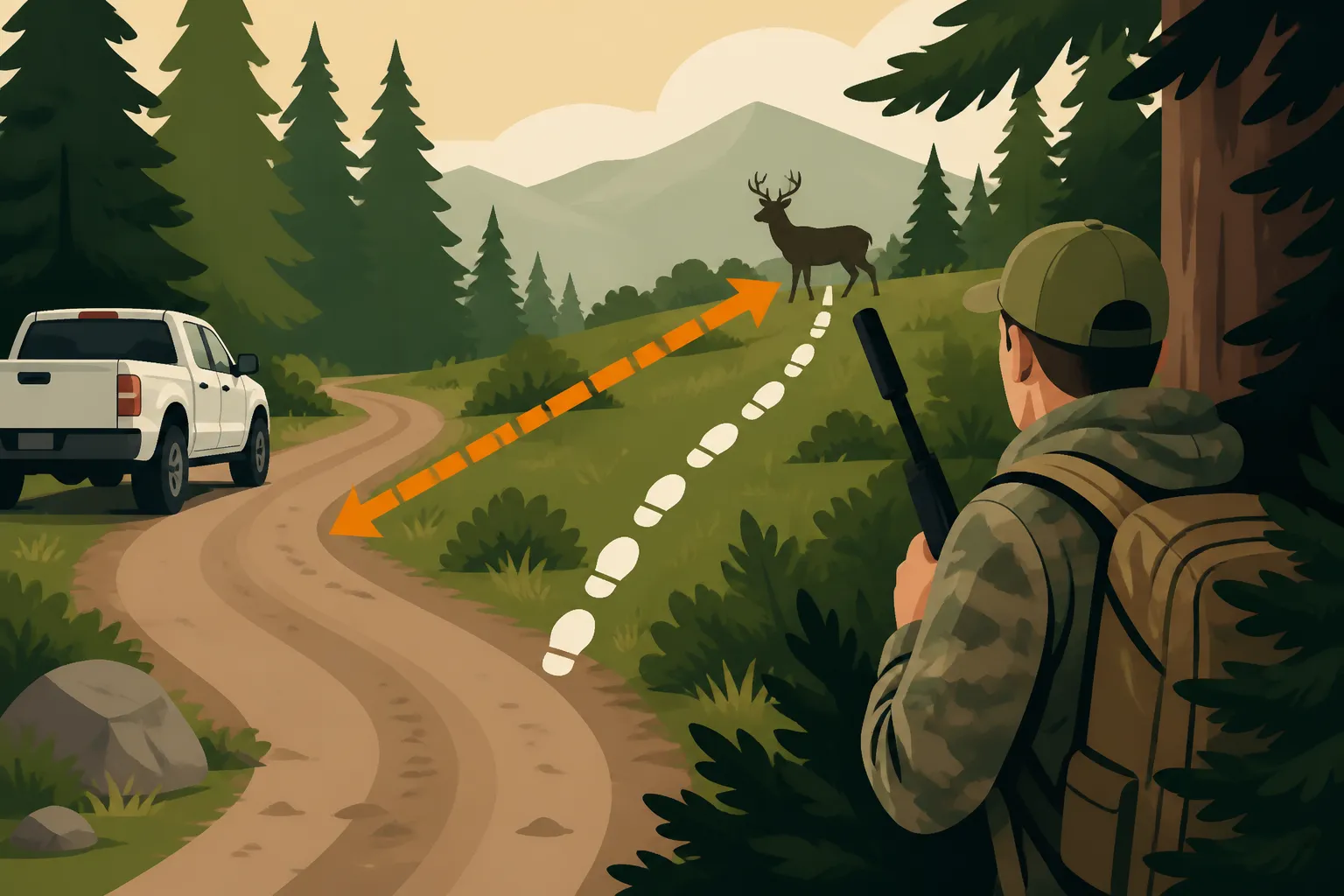
Sometimes, a forest road isn't a place to hunt from, but a necessary means to get to the real hunting grounds. Many deep wilderness areas, high-country X-zones, or remote sections of national forests are only accessible by driving miles down a rough forest road to a designated trailhead. From there, you ditch the vehicle and start your true backcountry trek.
For example, when targeting deer in certain Hunting California's High-Country X-Zones or Hunting California's Sierra Nevada Backcountry, you might spend an hour bouncing down a dirt road to reach a specific wilderness boundary. Your hunt doesn't begin until you've hiked another two, three, or even five miles past that trailhead, leaving the road hunters far behind. In these scenarios, the road serves as your transportation corridor, not your hunting zone. You're using it to launch your deep-woods adventure.
Early Morning or Late Evening Crossings
While deer generally avoid bedding near roads, they often use them as easy travel corridors during low-light hours. This is especially true if a road separates a bedding area from a preferred feeding ground or a water source. A well-placed ambush during legal shooting light, just before dawn or right at dusk, can intercept deer moving between these areas.
Look for natural pinch points, saddles, or drainages that cross or funnel animals toward a road. A ridge-top saddle at first light, for instance, might be a common crossing point for deer moving between two drainages, one of which has good cover near a road. Similarly, deer might cross a road to access a lush Hunting a Green Field Planted for Deer or a water seep. The key here is not to hunt on the road or even right next to it for extended periods, but to position yourself strategically a short distance away, concealed, to catch animals that are actively moving across or along the road's edges. Your focus isn't on the road itself as habitat, but as a temporary travel lane for game.
By understanding deer behavior, leveraging modern mapping tools, and preparing for the physical demands of backcountry hunting, you can move beyond the road hunters and consistently find those less-pressured, often larger, deer that California's public lands hold.
Disclaimer
This article is for general informational purposes only and does not constitute professional advice. Laws, prices and regulations vary by location and change over time. Consult a qualified professional for guidance on your specific situation.