Hunting Mojave Desert Fringe Country
The vast, sun-baked expanses of California's Mojave Desert fringe can feel like an impossible puzzle for hunters. Its arid landscape, relentless heat, and often-sparse game populations lead to immense frustration for those accustomed to more traditional hunting grounds, making success seem elusive. This guide is here to demystify hunting in this rugged, beautiful region, offering practical, in-depth strategies to help you navigate its unique challenges and find success in the Mojave's harsh, yet rewarding, environment.
The Mojave Fringe: A Land of Extremes and Opportunities
Hunting in the Mojave Desert fringe isn't like hunting anywhere else in California. You won't find the dense timber of the Sierra Nevada or the lush oak woodlands of the coast. Instead, you'll be met with vast, open landscapes, punctuated by jagged mountain ranges, dry washes, and hardy, low-lying vegetation. This extreme environment presents its own set of challenges, but also unique opportunities for those willing to adapt and learn.
Understanding the Unique Desert Ecosystem
The Mojave Desert fringe, particularly the transition zones where it meets the higher elevations or other ecosystems, is a land defined by its extremes. Daytime temperatures can soar well into the triple digits during early seasons, while nights can drop significantly, especially at higher elevations or in late fall. Water is a precious commodity, dictating where life can thrive. The vegetation here is tough and tenacious—think creosote bush, Joshua trees, sagebrush, and various cacti—offering limited cover but providing essential forage and shade for desert dwellers.
Understanding these microclimates and vegetation changes is paramount. A dry wash might funnel cooler air and hold more moisture, leading to denser cover and game sign, while an exposed ridge might be barren save for the hardiest plants. Animals here are incredibly adapted to these conditions, moving often at dawn and dusk, or retreating to shaded, cooler areas during the heat of the day. Recognizing these patterns and reading the subtle cues of the landscape will be your most important skill.
Key Game Species of the Mojave Fringe
While the Mojave might not boast the same density of game as other parts of California, it holds some truly remarkable species. The primary target for many big game hunters in this region is the desert mule deer. These deer are a subspecies known for their lighter coloration, larger ears, and incredible ability to survive in harsh conditions. They tend to be leaner than their mountain cousins, but what they lack in sheer bulk, they often make up for in the size and character of their antlers.
Beyond deer, the Mojave is also home to healthy populations of coyotes, which offer year-round hunting opportunities and are a fantastic way to sharpen your calling and predator hunting skills. You'll also find various small game like cottontail rabbits and jackrabbits, providing additional quarry. For bird hunters, several species of quail, including Gambel's quail in some areas, can be found around reliable water sources. While not huntable, it's worth noting that desert bighorn sheep also call parts of the Mojave home, and their presence indicates prime, remote, and rugged habitat you might encounter.
Overcoming the Challenges of Vastness and Climate
The sheer scale of the Mojave Desert fringe is often the biggest hurdle for hunters. You're dealing with vast stretches of public land, primarily managed by the Bureau of Land Management (BLM), where game can be incredibly spread out. This isn't a place for short walks from the truck. You'll need to cover serious ground, often miles, on foot, navigating steep, rocky terrain and thick, thorny brush. The relentless sun and extreme heat during early seasons (like the August opening for some D-zones) demand peak physical condition and meticulous hydration planning.
Another significant challenge is the lack of visible game. Unlike timber hunting where you might jump deer in thickets, desert deer are masters of camouflage and often bed in exposed, yet surprisingly hard-to-spot locations. This necessitates a shift in strategy from tracking and still-hunting to extensive glassing. Furthermore, the absence of widespread cell service means self-reliance and proper navigation tools are non-negotiable. Forget rushing; a successful Mojave hunt is a test of patience, endurance, and strategic thinking.
Essential Preparations for a Successful Mojave Hunt
Successfully hunting the Mojave Desert fringe isn't just about finding game; it's about being prepared for the environment itself. This means carefully selecting and testing your gear long before you ever set foot in the desert. The wrong equipment, or a lack of crucial supplies, can quickly turn an exciting hunt into a dangerous ordeal.
Optics: Your Lifeline in Open Country
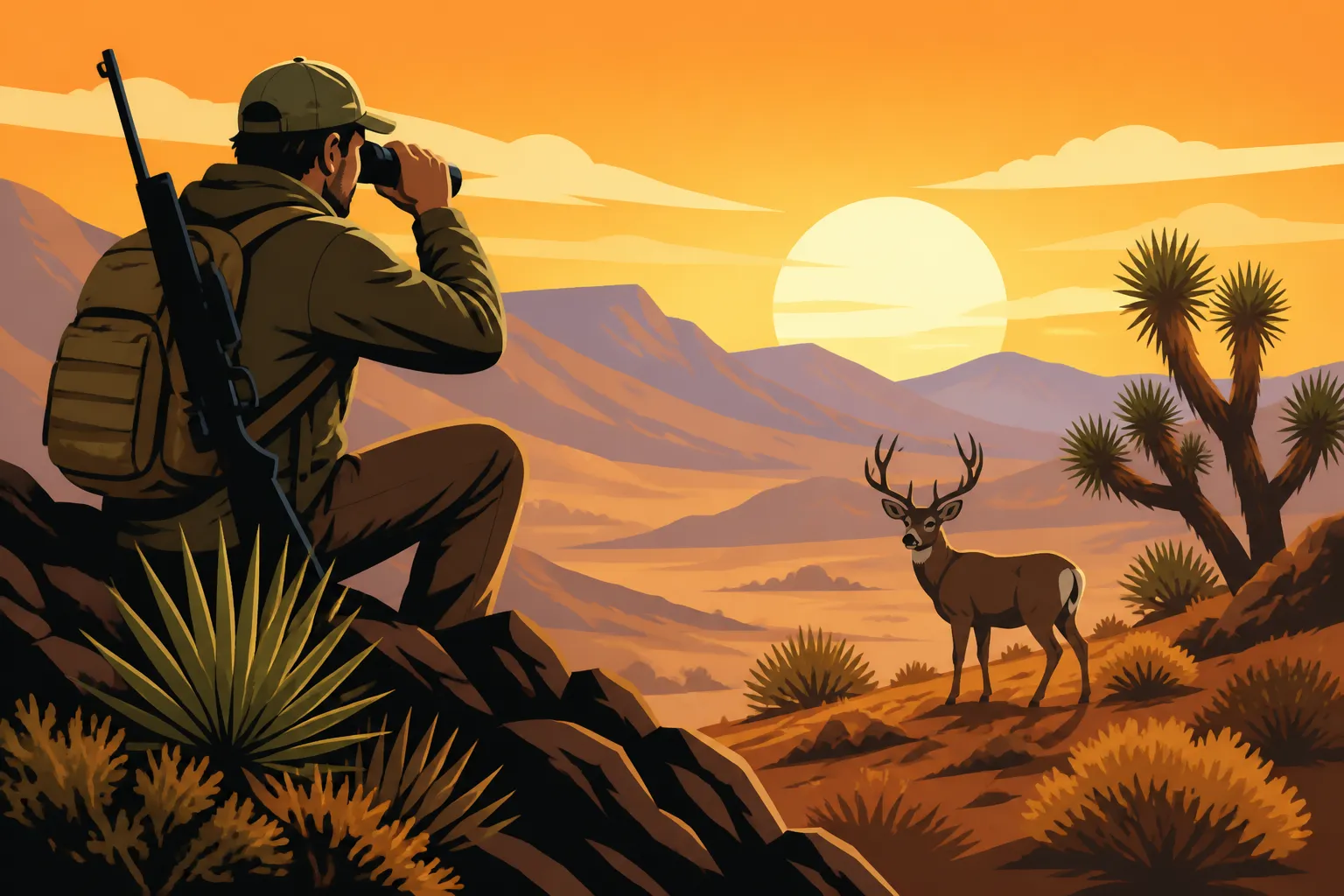
In the vast, open landscapes of the Mojave, your optics are arguably more important than your rifle. You're not going to stumble upon a deer at 50 yards very often. Instead, you'll be spending hours, perhaps days, perched on a vantage point, systematically dissecting the landscape for any sign of movement, any irregular shape that might betray a bedded buck. A high-quality set of binoculars, preferably 10×42 or 12×50, is non-negotiable for general scanning. You'll also want a reliable spotting scope, 60-80mm, paired with a sturdy tripod. This combination will allow you to pick apart distant hillsides, identify specific animals, and accurately judge their size and antlers from a mile or more away.
Investing in top-tier optics like those from Kowa, Swarovski, or Vortex, and learning how to use them effectively, will dramatically increase your success rate. Practice glassing at home, learning to hold steady and identify subtle forms. Remember, a cheap pair of binoculars will only give you a headache; clarity, light transmission, and field of view are paramount when every detail matters against a mottled, mirage-filled backdrop. For more specific advice on gear, consider looking into guides like "Best Optics Harness for a Spot-and-Stalk Hunt" which discusses how to keep your essential glass readily accessible.
Hydration and Survival: Non-Negotiables
This isn't a suggestion; it's a mandate. You will need more water than you think in the desert. During warm early seasons, plan for at least a gallon of water per person, per day, for consumption, plus extra for cooking or emergencies. Carry multiple water bottles and a hydration bladder, and consider bringing a portable water filter or purification tablets as a backup, even if you don't plan on using natural sources. Dehydration can set in rapidly, leading to disorientation and heatstroke. Electrolytes are also critical to replenish salts lost through sweating.
Beyond water, a comprehensive survival kit is essential. This should include a first-aid kit, emergency shelter (even just a space blanket or lightweight tarp), a fire starter, a signaling mirror, and a headlamp with extra batteries. Temperatures can plummet at night, and an unexpected breakdown or injury could leave you stranded in cold conditions. A satellite messenger or personal locator beacon (PLB) is also a wise investment, as cell service is often non-existent in remote Mojave areas. Do not underestimate the desert's ability to turn on you.
Clothing, Footwear, and Packs for Rugged Terrain
Your clothing needs to be lightweight, breathable, and provide excellent sun protection. Long sleeves and pants, even in scorching heat, are often preferable to shorts and t-shirts, offering protection from the sun, thorns, and sharp rocks. Light-colored fabrics can reflect heat better than dark ones. A wide-brimmed hat is also crucial. When it comes to footwear, invest in high-quality, sturdy hiking boots with excellent ankle support and durable soles that can withstand sharp rocks and uneven ground. Consider options designed for desert use to ensure they breathe well and prevent blisters over long distances. Read up on "Best Boots for Dry Desert Wash Hunting" for specific recommendations that hold up to the abuse.
Your pack needs to be comfortable for heavy loads and long treks. A day pack of 2,000-3,000 cubic inches is often sufficient, but ensure it has good organization for water, optics, and other essentials. If you plan on a multi-day backcountry hunt, a larger expedition pack with a sturdy frame will be necessary to carry additional water, food, and camping gear. Look for features like external pockets for quick access to water bottles and a durable, abrasion-resistant fabric. Remember, if you get a deer, you'll be packing out meat, often over challenging terrain, so comfort and capacity are key.
Firearms and Non-Lead Ammunition Considerations
California's statewide non-lead ammunition requirement means you'll need to use copper or other approved non-lead projectiles for all hunting in the Mojave. This is not optional. Ensure your rifle is sighted in with your chosen non-lead load well before your hunt. Many hunters find that copper bullets perform exceptionally well on game, retaining weight and penetrating deep. Given the potential for longer shots in the open desert, choosing a flat-shooting caliber like a .270, .30-06, .300 Win Mag, or 6.5 Creedmoor, paired with a quality non-lead bullet, makes sense.
Accuracy is paramount. Practice shooting from various field positions—prone, kneeling, using your pack as a rest—as you won't always have a bench-rest scenario in the field. Understand your rifle's ballistic performance with your chosen ammunition out to ethical shooting distances. For detailed information on these regulations, refer to our comprehensive guide on "California's Non-Lead Ammunition Requirement".
| Gear Category | Essential Items | Key Considerations |
|---|---|---|
| Optics | 10-12x Binoculars, 60-80mm Spotting Scope, Tripod | Clarity, Light Transmission, Sturdy Tripod |
| Hydration/Survival | 1 gallon water/person/day, Water Filter, Electrolytes | Emergency Shelter, First Aid Kit, PLB/Satellite Messenger |
| Clothing | Long-sleeved shirts/pants, Wide-brimmed hat, Layers | Breathable, Sun Protection, Thorn Resistant |
| Footwear | Sturdy Hiking Boots, Gaiters | Ankle Support, Durable Soles, Blister Prevention |
| Pack | 2000-3000 cu. in. Daypack (or larger expedition pack) | Comfortable, Durable, Good Hydration Compatibility |
| Navigation | GPS device/App, Paper map, Compass | Offline Maps, Battery Life, Redundancy |
| Firearm | Rifle (e.g., .270, 6.5 CM), Non-lead Ammo | Sighted-in, Accurate, Ethical Range |
Strategies for Locating and Harvesting Desert Game
Hunting the Mojave Desert fringe demands a fundamentally different approach than hunting timber or agricultural lands. Your success hinges on patience, keen observation, and an understanding of how desert animals utilize their environment. Forget crashing through brush; this is a game of calculated moves and long-distance detection.
Mastering the Art of Long-Range Glassing
This is the quintessential desert hunting strategy. You will spend far more time looking through your optics than walking. Find a high vantage point, preferably with a good view of several drainages, benches, or hillsides. Set up your spotting scope and systematically break down the landscape, section by section. Start from the closest areas and work your way out, then back again. Look for anything that seems out of place: a horizontal line in a vertical world, a patch of different color, a flicker of an ear.
Desert mule deer often bed in relatively exposed areas, but their camouflage is incredible. They'll use the subtle shade of a creosote bush, a small rock outcrop, or even just the shadow cast by a minor change in elevation. Glass slowly, giving your eyes time to adjust and pick out detail. Don't just scan; truly study the terrain. Many deer are found because a hunter saw a small detail and then pieced together the animal. This technique is extensively covered in resources like "Glassing Mule Deer in Open California Country."
Spot-and-Stalk in Sparse Cover
Once you've spotted a deer, the real challenge begins: the spot-and-stalk. In the open, sparse cover of the Mojave, this is incredibly difficult. Every movement you make, every piece of crunching gravel, can be detected by keen desert senses. Plan your approach carefully. Use topography to your advantage, staying below ridge lines, utilizing dry washes for cover, and moving slowly. Wind direction is critical; even in what feels like still air, thermals can shift, carrying your scent to the animal.
Patience is your best friend. Take 15 minutes to move 15 yards if that's what the terrain demands. If the deer is bedded, don't rush. Wait for it to stand or feed, which might offer a better shot or a chance to close the distance. Be prepared for a long crawl or a careful belly-stalk. This kind of hunting is mentally and physically taxing, but the rewards of a successful desert stalk are immense.
Prioritizing Water Sources and Travel Corridors
In an arid environment like the Mojave, water is life. Animals, especially in warmer months, will congregate around natural springs, seeps, and man-made guzzlers. Identifying these water sources on maps, or through scouting, can be incredibly valuable. However, approach these areas with extreme caution. Animals are often wary around water, and consistent hunting pressure can push them away.
Beyond water, look for natural travel corridors. Dry washes (arroyos) often serve as highways for deer, providing both cover and easier travel through the rough terrain. Ridgelines and saddles between mountains are also common travel routes, especially during cooler parts of the day. Using mapping tools like GoHunt can help you identify these features from your home, allowing you to scout effectively before you even leave. Pay attention to fresh tracks, droppings, and rub lines along these corridors. Early mornings and late evenings are prime times to observe game moving along these routes.
Leveraging Technology for Scouting and Navigation
Modern technology is an invaluable asset in the vastness of the Mojave. A reliable GPS device or a robust mapping app on your phone, such as Gaia GPS or onX Hunt, is absolutely essential. These tools allow you to pinpoint your location, mark water sources, plan routes, and identify property boundaries (crucial for distinguishing public from private land, which can be intermingled). Make sure to download offline maps, as cell service will be spotty at best. Our guide on "Best GPS App for California Public Land" can help you choose the right tool.
Beyond navigation, satellite imagery from these apps can be a powerful scouting tool. You can often identify subtle terrain features, vegetation changes, and potential bedding areas that might hold deer. You might even use it to locate game trails or points of ingress and egress. Using these tools in conjunction with your physical presence on the ground will give you a significant advantage in breaking down the immense landscape into manageable hunting units. Remember to carry a portable charger for your phone; batteries die quickly in the desert.
Navigating Regulations and Public Land Access
Hunting in California, especially in unique zones like the Mojave Desert fringe, requires a thorough understanding of regulations and careful navigation of public land access. California has specific rules that apply statewide, and then additional nuances depending on the specific hunting zone or land management agency.
Understanding BLM and National Forest Access
Much of the huntable land in the Mojave Desert fringe is managed by the Bureau of Land Management (BLM) or is part of National Forests, like the Angeles National Forest on its western edge, or the Inyo National Forest further north. These lands are generally open to public hunting, but it's vital to know the specific regulations that apply to each area. BLM lands are often characterized by vast, undeveloped tracts, while National Forests might have more defined road systems and recreational areas.
Always double-check the specific rules for the area you plan to hunt. Some areas might have seasonal closures due to fire danger or other land management activities. Vehicle access might be restricted to established roads, and cross-country travel could be prohibited in certain locations. Many of these details can be found on the respective agency websites, and mapping apps like GoHunt often include land ownership layers. Getting familiar with "Hunting California's BLM Desert Land" will provide a good foundation for understanding how to use these areas.
Tag Allocation and Draw Considerations for Desert Zones
Deer hunting in the Mojave Desert fringe typically falls under California's D-zones or specific X-zones, which are part of the state's multi-zone system for deer. D-zones are generally more numerous and often have better drawing odds than the highly coveted X-zones, which are often in the high country. However, some desert D-zones can be incredibly challenging to draw, or if they are over-the-counter, they can see significant hunting pressure.
The California Big Game Drawing is how most premium tags are allocated. For desert mule deer, you'll need to apply for the specific deer zone you wish to hunt. Understanding the draw odds and application process is crucial. If you're targeting a specific Mojave zone, research its historical success rates and draw statistics. Some D-zones open in August, meaning you'll be hunting in significant heat, while others might open later in the fall. Make sure to check the California Department of Fish and Wildlife (CDFW) regulations booklet each year, as season dates and tag allocations can change.
Adhering to California's Lead-Free Ammunition Mandate
As reiterated earlier, California has a statewide ban on lead ammunition for all hunting. This means that when you're pursuing deer, coyotes, or any other game in the Mojave, your rifle, shotgun, and handgun ammunition must be non-lead. This regulation is strictly enforced and is in place to protect wildlife, particularly California condors, from lead poisoning.
Familiarize yourself with approved non-lead options for your chosen caliber. Major manufacturers like Barnes, Hornady, Federal, and Winchester all produce excellent non-lead hunting rounds, typically made from copper. It's always a good idea to purchase and test your non-lead ammunition well in advance of the season, as different bullets can affect your rifle's point of impact. Ensure you carry proof of your hunter education if asked by game wardens, and be prepared to show your non-lead ammunition. Compliance is not just a legal requirement; it's part of being a responsible hunter in California.
Disclaimer
Hunting is an inherently risky activity. The information provided in this guide is for informational purposes only and is not a substitute for professional instruction, thorough research, or adherence to all applicable laws and regulations. Always prioritize safety, understand local regulations, and be prepared for changing conditions. The author and publisher are not responsible for any incidents, accidents, or legal ramifications that may arise from the use of this information.