Hunting Coastal Range Chaparral
Hunting California's coastal range chaparral can feel like navigating a thorny, impenetrable maze, leaving many hunters frustrated and questioning if a buck even lives in such thick cover. We’ve all been there, pushing through seemingly endless walls of brush, only to feel like we’re making more noise than a stampeding elk herd. But don't let the dense brush and steep canyons deter you; this habitat is prime territory for some of California's most resilient game, offering an incredibly rewarding challenge for those willing to adapt. This guide will dive deep into the specific challenges and proven strategies for successfully hunting the demanding, yet incredibly productive, coastal chaparral.
Understanding the Coastal Range Chaparral Environment
Before you can effectively hunt the chaparral, you really need to understand what you're up against. It’s not just "thick brush"; it's a unique ecosystem that demands respect and a specific approach.
What is Chaparral and Why is it So Tough?
Chaparral is a dense shrubland habitat found predominantly in California and Baja California. Imagine a plant community dominated by tough, drought-resistant evergreen shrubs with stiff branches that interlock, forming nearly impenetrable thickets. Think of species like chamise, various manzanitas, ceanothus, and scrub oaks. These plants are often armed with thorns, stiff leaves, and branches that scratch, poke, and tear at anything that tries to pass through.
The terrain where chaparral thrives typically consists of steep, often south-facing slopes, deeply cut canyons, and rolling hills. The soil can be loose and rocky, making footing precarious, especially when wet. Add to that the typically hot and dry conditions during much of the hunting season, and you've got a recipe for extreme physical exertion and low visibility. It’s easy to feel defeated by it, but this density is precisely why it holds so much game. Animals use it for cover, thermal regulation, and a sense of security from predators—including us.
Game Species That Call Chaparral Home
While the chaparral might seem inhospitable, it's actually teeming with life. The primary big game species you'll encounter here are the wary Columbia Blacktail deer and, in many areas, abundant wild pigs. These animals are perfectly adapted to the environment. Blacktails are known for their ability to ghost through the thickest cover, using every available advantage to avoid detection. They're masters of silent movement and will often lie tight in a bed until you're practically on top of them before exploding out.
Wild pigs, on the other hand, often live in the chaparral. They root through it for bulbs and tubers, create wallows in the shaded bottoms, and rely on the dense cover for protection. You might also find other game, like California Valley Quail and Mountain Quail, which dart through the underbrush, and even black bears, especially in areas where chaparral transitions into oak woodlands or pine forests. If you're looking for a year-round challenge, wild pig hunting in California's coastal chaparral is definitely something to consider.
Seasonal Changes and Their Impact on Chaparral Hunting
The chaparral changes with the seasons, and understanding these shifts is critical for planning your hunt.
- Summer/Early Fall (August-October): This is often when California's deer seasons kick off. The chaparral is typically at its driest and most brittle. Every step can sound like crunching cornflakes, making silent movement nearly impossible. Temperatures can soar, leading to a focus on hunting early mornings and late evenings. Deer and pigs will be highly concentrated near reliable water sources—seeps, springs, and shaded creek bottoms—and will bed deep in the coolest, densest cover during the heat of the day. Fire danger is also extreme during this period, and hunters must be acutely aware of any fire restrictions or closures.
- Late Fall/Winter (November-January): With the arrival of cooler temperatures and rain, the chaparral transforms. The brush becomes softer, greener, and quieter to move through. This is often when the blacktail rut peaks in many coastal areas, leading to increased deer movement and vulnerability. Rain can make the steep slopes incredibly slick, but it also washes away scent and quiets your approach. Wild pigs will also be more active, and their rooting sign will be much fresher. When planning your hunting excursions, it's wise to consider the varied conditions and plan your approach for the specific season. For instance, understanding the nuances of how wind and thermals in steep Sierra country affect game movement is equally applicable to the coastal ranges, dictating how and when you make your move.
Effective Strategies for Navigating and Hunting Chaparral
Hunting chaparral isn't about covering miles; it's about covering inches with purpose. You need to adopt a slow, methodical approach and truly become part of the landscape.
The Art of Still-Hunting and Glassing in Thick Cover
Still-hunting in chaparral is a slow dance, a deliberate crawl. You're not walking; you're placing each foot, checking for noise, scanning for gaps, and pausing for long periods to listen and look. The key is to move at a snail's pace—take five minutes to move fifty feet. Look for horizontal lines (the back of a deer, the top of a pig's head) in a vertical world, or subtle movements, ear flicks, or a patch of hair that doesn't quite blend in.
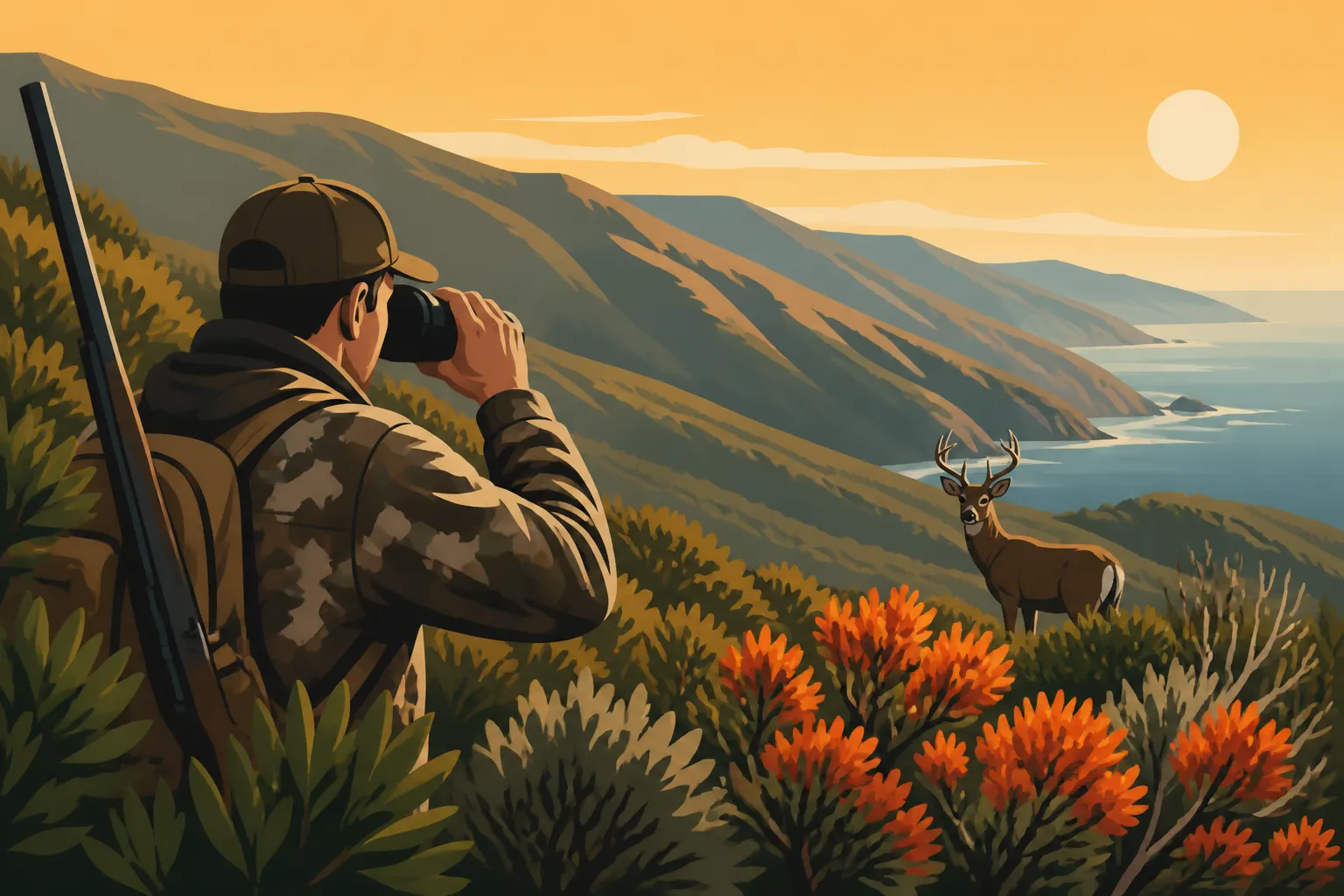
While deep inside the thick stuff, still-hunting is your primary method. However, the most successful chaparral hunters also utilize glassing from elevated vantage points. Before plunging into the brush, take the time to climb to a ridgeline or prominent knob that offers a wide view of surrounding canyons and slopes. Use good binoculars, like a pair of 10x42s, and meticulously pick apart the cover, looking for any sign of movement or a bedded animal. Early mornings and late evenings are prime times for this, as animals move between bedding and feeding areas. I personally use mapping tools like GoHunt to scout these potential glassing points from home, identifying natural breaks, game trails, and saddles that might concentrate animal movement. This is similar to glassing a canyon for a bedded buck in more open country, but here you're looking for those tiny windows.
Identifying Key Deer and Pig Movement Corridors
Animals in chaparral are masters of efficiency. They don't just bash through the thickest stuff unless they absolutely have to. Instead, they find or create subtle pathways. Your job is to find these "highways" and "byways."
- Game Trails: These are often not the obvious, worn paths you see in open timber. In chaparral, game trails are typically tunnels through the brush, sometimes only visible for a few feet before disappearing again. Look for clipped branches, fresh droppings, and tracks, especially where the brush is slightly less dense. Focus on saddles between ridges, creek bottoms, and the edges where chaparral meets a patch of oak woodlands or a firebreak. These transition zones, like those found when hunting coastal range oak woodlands, are goldmines for intercepting moving animals.
- Water Sources: In hot weather, water is the lifeblood of the chaparral. Bucks and pigs will visit seeps, springs, and shaded creek bottoms, particularly during the hottest parts of the season. Identifying these critical areas on a map, and then scouting them for fresh sign, can significantly increase your odds.
- Bedding Areas: These are almost always found in the thickest, nastiest cover, often on north-facing slopes for coolness or south-facing slopes with good sun exposure in cooler weather. They'll also pick areas with good visibility downhill to spot predators approaching. Finding a good bedding area isn't easy, but the fresh sign around it can confirm animal presence.
Using Ambush Tactics and Elevated Positions
Given the difficulty of moving silently through chaparral, ambush tactics are highly effective. Once you've identified key movement corridors, game trails, or water sources, set up and wait. Patience is your most powerful weapon here.
- Natural Funnels and Saddles: Animals will naturally gravitate to the path of least resistance. A saddle between two ridges, a narrow neck of land, or a bench system leading around a steep drop-off will concentrate movement. These are prime spots for a quiet sit.
- Ground Blinds: While treestands are rarely practical in chaparral due to the shrubby growth, a well-placed ground blind can be incredibly effective. Find a natural break in the brush, a downed log, or a large rock that offers cover. Then, use natural vegetation to brush in your position. Remember that animals in thick cover are often closer than you think, so scent control and stillness are paramount.
- Elevated Shooting Positions: Sometimes the best "ambush" is simply finding a spot above the chaparral on a rock outcropping or a small knoll that offers a clear view into a feeding area or a likely travel route. The higher angle can give you a crucial advantage, allowing you to see over or into the tops of the brush where animals might be moving. Always consider the wind direction when choosing your setup, as it carries your scent right to the game.
Essential Gear and Preparation for Chaparral Hunts
Your gear choices for chaparral hunting are absolutely critical. This isn't a place for flimsy, lightweight clothing or gear that can't take a beating.
Durable Clothing and Footwear
Forget your quiet, soft fleece for this environment. You need armor.
- Clothing: Think rugged, tear-resistant materials. Heavy-duty ripstop nylon, canvas, or specialized brush pants and jackets are your best friends. Look for reinforced knees, elbows, and seat. Layering is also key, as coastal mornings can be chilly, but the midday sun quickly turns into a sweat-fest, especially when you're exerting yourself. A good base layer to wick sweat, a sturdy mid-layer, and a tough outer shell are essential. Camo patterns that blend with the specific greens and browns of chaparral and oak woodlands, like those discussed in "Best Camo for Oak Woodland in August," will help you disappear into the shadows.
- Footwear: Your boots will take a pounding. You need stiff, supportive boots with excellent ankle support to navigate steep, uneven, and often slippery terrain. A waterproof membrane is a bonus for dew-soaked mornings or unexpected rain. Good traction is non-negotiable. I can't stress enough the importance of sturdy boots; they are your foundation for safety and comfort in this unforgiving environment. "Best Boots for Steep Wet-Season Sierra Trails" offers great advice that translates well to the coastal ranges.
Optics and Navigation Tools
Even though you're in thick cover, optics are vital for maximizing your narrow windows of opportunity and ensuring safety.
- Binoculars and Rangefinder: A good pair of 8x or 10x binoculars are indispensable for picking apart small openings, identifying game through brush, and confirming legal antlers. A rangefinder is also extremely useful, even for what seem like short shots. The dense brush can play tricks on your depth perception, and knowing the exact distance is crucial for ethical shooting.
- GPS and Mapping Apps: This is not optional. Chaparral can be disorienting, with constant twists and turns. A reliable GPS unit or a smartphone with a robust mapping app like onX Hunt or GoHunt is your lifeline. Download offline maps before you go, mark your truck, potential water sources, and any key sign you find. These apps can also show you property lines, which is crucial given California trespass and permission law. Always carry a traditional compass and paper map as a backup, just in case your electronics fail.
- Headlamp: For early morning hikes in or late evening hikes out, a powerful headlamp is non-negotiable. The chaparral gets dark under its canopy.
Weapons and Ammunition Considerations
California's unique regulations and the chaparral environment itself dictate specific weapon and ammo choices.
- Rifles: For rifle hunters, a shorter barrel (20-22 inches) is often preferred for easier maneuverability in tight quarters. Calibers that deliver good energy at closer ranges are excellent. The most crucial factor, however, is California's non-lead ammunition requirement. All hunting of big game and small game with a firearm must use non-lead projectiles. This means you need to choose from certified non-lead bullets for California, like Barnes TSX, Hornady GMX, or similar copper alloy bullets. Always zero your rifle with your chosen non-lead load before hunting season. For a deeper dive into this, check out "Choosing Non-Lead Rifle Ammunition in California".
- Archery: For bowhunters, durable broadheads are paramount. Fixed-blade broadheads often perform better than mechanicals when encountering small twigs or brush before impact. A heavier arrow setup can also help with penetration through tough hide and bone. Ensure your broadheads are razor sharp.
- Shotguns: For wild pigs, a shotgun loaded with non-lead slugs is a potent option, especially at closer ranges in thick cover where quick target acquisition is important.
| Gear Category | Recommended Item | Why it's Important in Chaparral |
|---|---|---|
| Outerwear | Heavy-duty Ripstop Nylon Pants/Jacket | Resists tears and thorns; crucial for durability. |
| Footwear | Stiff, High-Ankle Support Waterproof Boots | Protects ankles on uneven terrain, provides traction, stays dry. |
| Navigation | GPS/Mapping App (e.g., GoHunt) with Offline Maps | Essential for staying oriented in disorienting dense brush. |
| Optics | 8x-10x Binoculars & Rangefinder | Identifies game in small openings, confirms distances accurately. |
| Weapon (Rifle) | Shorter Barrel (20-22") with Non-Lead Ammunition | Easier maneuverability, compliance with CA law. |
| Weapon (Archery) | Durable Fixed-Blade Broadheads, Heavier Arrows | Better penetration through brush and game; reliable performance. |
| Hydration | Hydration Pack (3+ liters) & Water Filter | Prevents dehydration; chaparral is hot, water access can be limited. |
| First Aid | Comprehensive Kit with Trauma Dressing | Inevitable scrapes and cuts; possibility of more serious injury. |
| Pack | Durable Frame Pack or Daypack with Load Shelf | Carries essentials in, meat out; brush can destroy lesser packs. |
Safety and Contingency Planning
Hunting the chaparral is physically demanding and inherently risky. Prioritizing safety and planning for contingencies is not just smart; it's essential.
Managing Dehydration and Heat Exhaustion
The most common threat in California's chaparral, especially during early seasons, is the heat. Dehydration and heat exhaustion can creep up on you quickly. Always carry more water than you think you'll need—at least 3 liters for a full day's hunt, plus electrolytes. Start hydrating days before your hunt. Know the signs of heat exhaustion (dizziness, nausea, headache, heavy sweating) and heatstroke (hot, red, dry skin; rapid pulse; confusion), and don't push through them. If you feel symptoms, stop, find shade, cool down, and rehydrate immediately. Consider carrying a small water filter or purification tablets as a backup if you know there are water sources available.
Fire Danger and Regulations
California's chaparral is highly susceptible to wildfires. During peak season, fire danger is often extreme. This means:
- Awareness: Always check fire restrictions before heading out. Some areas may be closed to public access during Red Flag warnings.
- Prevention: Be incredibly careful with anything that can cause a spark. Vehicle exhaust systems, chainsaws, even metal-on-rock from a boot can start a fire. Carry a small shovel and fire extinguisher in your vehicle.
- Compliance: Certain areas, especially in national forests like Los Padres National Forest, may have specific restrictions on firearms or activities during high fire danger. Always adhere to these rules.
Retrieval Challenges in Steep, Brushy Terrain
One of the biggest realities of hunting in chaparral is the difficulty of game retrieval. If you're fortunate enough to harvest a deer or pig, the work has just begun.
- Quartering is Key: Unless you're very close to a road or a flat, open area, expect to quarter your animal on the spot. This significantly reduces the weight and bulk you have to carry. Having sturdy game bags and a sharp processing knife is non-negotiable. Learning how to field dress a deer in hot weather is a crucial skill here, as meat can spoil rapidly.
- Pack Frames: A quality external frame pack or a durable internal frame pack with a load shelf is indispensable for hauling meat out of steep, brushy terrain. You won't be dragging a whole deer through chaparral; it's simply not feasible. Consider the advice found in "Packs and Gear for a Backcountry Elk Hunt" and adapt it for deer or pigs—the principles of moving heavy weight through tough country are the same.
- Buddy System: Hunting with a partner not only increases safety but also makes game retrieval significantly easier. Having two sets of hands to quarter, load, and pack out an animal can turn a multi-hour solo ordeal into a manageable team effort.
Hunting coastal range chaparral is tough, no doubt about it. But with the right mindset, proper preparation, and a deep understanding of this unique environment, it offers an incredibly rewarding experience and the chance to hunt some truly challenging game.
Disclaimer
Please remember that hunting regulations, seasons, and access can change. Always consult the latest California Department of Fish and Wildlife (CDFW) regulations and local land management agency rules before planning any hunting trip. Safety should always be your top priority in the field.