California Squirrel Nest Counts and Mast Crops
Hunting California's bushytail tree squirrels can be an incredibly rewarding experience, offering fast-paced action and delicious table fare, but it's also true that some years feel like feast or famine. Many hunters get out there wondering why one season is brimming with squirrels and the next feels empty, leading to frustration and fewer successful outings. This guide will walk you through the crucial, yet often overlooked, factors of squirrel nest counts and mast crops, helping you decode these natural signals to significantly improve your hunting success in California's diverse landscapes.
Understanding California Squirrel Ecology and Behavior
Before we even talk about hunting, it’s essential to appreciate the life of a squirrel in California. They're far more than just bushy-tailed critters scampering up trees; they are integral parts of our ecosystems, and their survival hinges on very specific environmental conditions. Understanding their natural history is the foundation of becoming a more effective hunter.
Key Squirrel Species and Their Habitats
California is primarily home to two main tree squirrel species relevant to hunters: the native Western Gray Squirrel ( Sciurus griseus) and the introduced Eastern Fox Squirrel ( Sciurus niger). There are also Eastern Gray Squirrels (Sciurus carolinensis) in some urbanized areas, but they are less frequently encountered by most hunters in wilder settings. Each species has its preferred habitat, which is often dictated by the availability of food and suitable nesting sites.
The Western Gray Squirrel, often called "silver gray" or "pine squirrel," is California's largest native tree squirrel. You'll typically find them in our beautiful oak woodlands, mixed conifer forests, and even riparian corridors with mature trees. They thrive where there's a good mix of hardwoods and conifers, providing a diverse diet and plenty of cover. They're often shy and alert, making them a challenging quarry. On the other hand, the Eastern Fox Squirrel is generally larger and more reddish or yellowish-brown. They are highly adaptable and have successfully established themselves in many parts of California, particularly in urban and suburban parks, agricultural areas, and valley oak woodlands. They're often a bit more robust and less timid than their gray counterparts. Understanding these differences, as detailed in our guide Gray Versus Fox Squirrels in California, is vital for effective scouting.
Seasonal Behaviors and Reproduction Cycles
Squirrel behavior shifts dramatically with the seasons, largely in response to food availability and breeding cycles. In spring, after the lean winter months, squirrels are actively foraging for emerging buds, berries, and early green mast. This is also a primary breeding season for both Western Gray and Eastern Fox squirrels, with females typically producing litters of 2-5 young. These young squirrels will grow quickly, and if food is abundant, a second litter might even occur in late summer.
As summer progresses into fall, squirrels become incredibly active, driven by an instinct to gather and cache food for the upcoming winter. This period, coinciding with the peak mast crop production, is when they are most visible and vulnerable to hunters. They'll be out from dawn till dusk, cutting acorns, pine nuts, or walnuts and burying them, providing critical opportunities for hunters. Knowing when these behavioral patterns align with peak mast can make all the difference, as we discuss in Hunting Small Game and Predator Hunting in California.
The Critical Role of Mast Crops for Squirrels
When we talk about "mast crops," we're referring to the fruits, nuts, and seeds of forest trees and shrubs that serve as food for wildlife. For squirrels in California, mast crops are not just a food source; they are the very foundation of their survival, reproduction, and ultimately, their population numbers.
Understanding "Mast" and Its Varieties
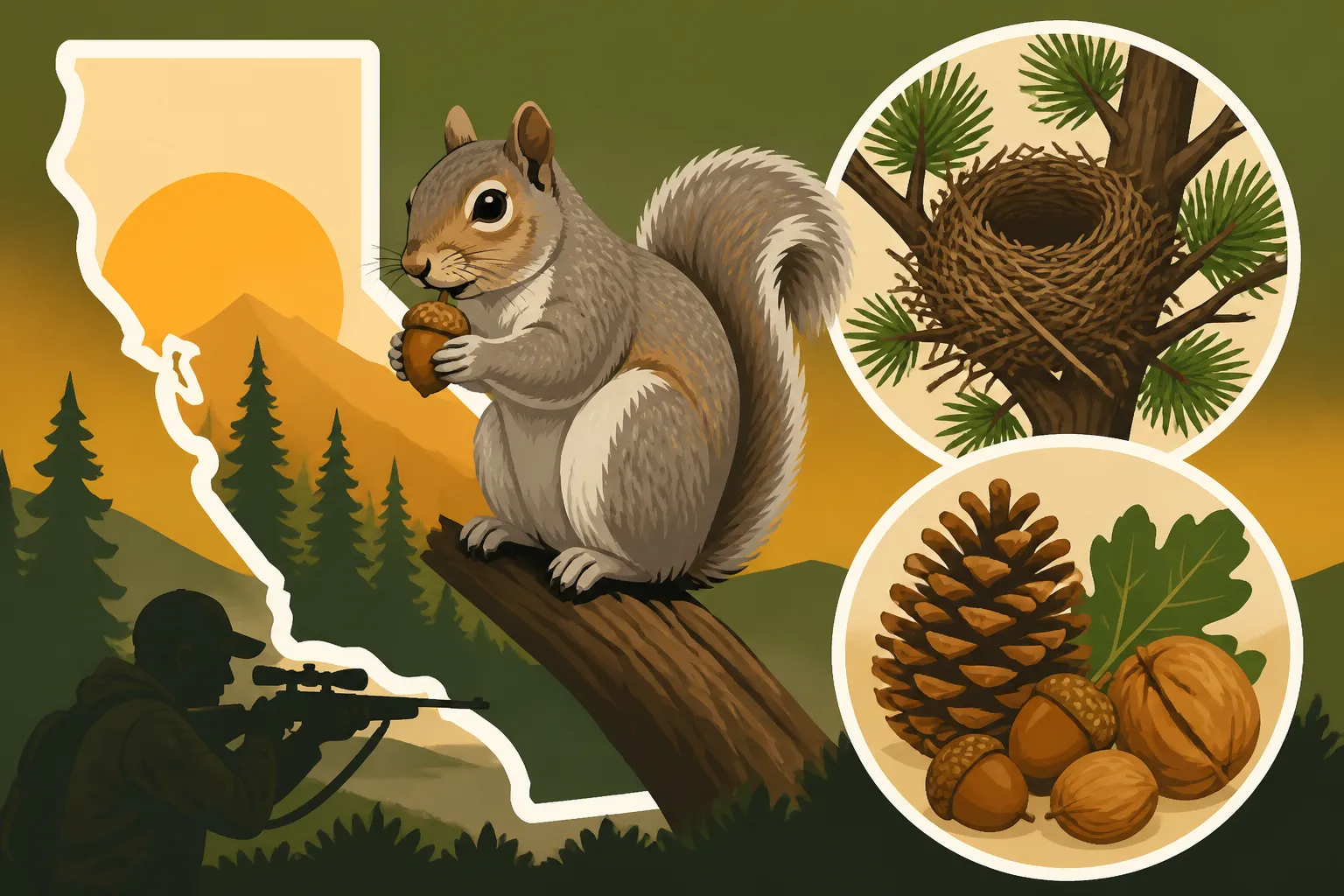
In California, the term "mast" primarily brings to mind acorns. Our diverse oak species – live oaks, black oaks, blue oaks, valley oaks, and more – produce a staggering variety of acorns, each with different nutritional profiles and ripening times. For instance, the acorns of the Black Oak are high in fat and protein but also high in tannins, requiring squirrels to process them differently or cache them for later leaching. Valley Oak acorns are large and less tannic, making them a preferred immediate food source. But it’s not just acorns. Pine nuts from various conifer species, buckeyes (though squirrels often avoid these due to toxicity unless desperate), madrone berries, and even the seeds from manzanita can contribute to the overall mast crop picture. Each of these plays a role in sustaining squirrel populations, especially when one specific mast crop fails.
The availability and quality of these mast crops fluctuate wildly year to year, depending on rainfall, temperature, and even late frosts during the flowering season. A bumper crop of acorns one year can lead to a boom in squirrel populations the next, as females are able to successfully raise larger, healthier litters. Conversely, a poor mast year means fewer calories, higher competition, and often, reduced reproductive success and higher overwinter mortality. This direct link between food and population health is why understanding the mast crop outlook is paramount for a squirrel hunter.
Mast Crop Fluctuations and Their Impact
Imagine a drought year in California’s Central Coast oak woodlands. The trees are stressed, and the acorn crop is sparse. Squirrels have to work harder to find food, expanding their foraging ranges, which exposes them more to predators. Females may not have enough energy reserves to breed, or they might abandon litters if food becomes too scarce. The result? Fewer squirrels surviving into the next season. Now, picture a year with ample winter rains followed by a mild spring – the oaks are lush, and the ground is littered with acorns. This provides an abundance of easily accessible, calorie-rich food. Squirrels are able to store more, reproduce more successfully, and have higher survival rates over winter.
This natural cycle of boom and bust is a fundamental aspect of wildlife management and hunting success. A veteran hunter knows that scouting for game isn't just about looking for the animals themselves, but also about assessing their primary food sources. Tools like GoHunt can help identify areas with high concentrations of specific oak species, allowing you to narrow down your scouting efforts to areas likely to have better mast production. When a particular area, perhaps in the Sierra foothills, experiences a strong pine nut crop, you can bet that squirrels will be drawn to it, even if the acorns in nearby oak stands are scarce. Paying attention to these subtle shifts can give you a significant advantage.
Here's a quick look at some common mast crops and the squirrels that love them:
| Mast Crop Type | Primary Trees/Plants | Squirrel Species Preference | Ripening Period (General) | Nutritional Value |
|---|---|---|---|---|
| Acorns | Various Oak species (Black, Blue, Valley, Live) | Western Gray, Eastern Fox | Late Summer – Fall | High Fat, Protein |
| Pine Nuts | Ponderosa, Sugar, Digger Pines | Western Gray | Late Summer – Fall | High Fat, Calories |
| Walnuts | Black Walnut, English Walnut (cultivated) | Eastern Fox | Fall | High Fat, Protein |
| Madrone Berries | Pacific Madrone | Western Gray, some Eastern Fox | Late Fall – Winter | High Sugar, some Fat |
| Manzanita Berries | Various Manzanita species | Western Gray (opportunistic) | Spring – Summer | Sugars |
| Conifer Seeds | Douglas Fir, Redwood | Western Gray (less common for hunter) | Fall | Moderate Fat |
How Squirrel Nest Counts Inform Hunting Strategy
Beyond simply observing individual squirrels, taking the time to conduct "nest counts" can offer a deeper, more predictive insight into local squirrel populations. These nests, known as dreys, are visible indicators of squirrel activity and density, especially when combined with mast crop observations.
What are Squirrel Dreys and Why Count Them?
Squirrel dreys are those messy-looking, basketball-sized nests of leaves, twigs, and bark often spotted high in the branches of deciduous or conifer trees. Unlike bird nests, which are typically smaller and more tightly woven, dreys are robust structures designed to withstand weather and provide shelter. Squirrels use dreys for sleeping, raising young, and escaping predators. A single squirrel might have several dreys within its home range, but the sheer number of visible dreys in a given area can be a strong indicator of population density.
Counting dreys, especially in late winter or early spring when leaves are off the deciduous trees, allows you to get a baseline idea of how many squirrels might be inhabiting a particular woodland. A high number of dreys suggests a healthy, established population, likely sustained by consistent food sources. Conversely, a scarcity of dreys could signal a sparse population, perhaps due to a previous poor mast crop, increased predation, or other environmental factors. This information, combined with real-time mast crop scouting, provides a powerful predictive tool. You can even overlay this data with public land maps on your GoHunt app to mark high-potential areas.
Conducting Your Own Nest Counts and Interpreting Results
To conduct a nest count, choose a specific area you plan to hunt, like a section of Hunting Coastal Range Oak Woodlands or a particular canyon in a National Forest. Systematically walk through the area, looking up into the canopy, and tally every drey you see. It's best to do this when leaves are down to maximize visibility. Don't just count the nests; note their condition. Are they old and dilapidated, or do they look fresh and well-maintained? Fresh dreys with recent additions of leaves and twigs indicate current or very recent occupancy.
While counting, be mindful of "false positives" – old bird nests or even clumps of mistletoe can sometimes be mistaken for dreys from a distance. Use binoculars to confirm. Once you have a count, interpret it in context. A dense stand of oak trees with 15-20 active-looking dreys per acre is likely to hold a robust squirrel population. If you return to that same area during the hunting season and find a bumper crop of acorns on the ground, your chances of success are excellent. However, if the dreys are numerous but the mast crop has failed, those squirrels might have dispersed to find food elsewhere, or their numbers may have declined. Scouting California Public Land Before Season isn't just for deer; it's invaluable for small game too!
Applying This Knowledge to Your California Squirrel Hunt
Now that you understand the interconnectedness of squirrel ecology, mast crops, and nest counts, let’s talk about how to translate this theoretical knowledge into practical, boots-on-the-ground hunting success. This approach will make you a more adaptable and efficient squirrel hunter.
Scouting for Success: Combining Mast and Dreys
Effective squirrel hunting starts long before opening day. Your scouting efforts should actively combine mast crop assessment with drey counts. Begin in late summer or early fall, focusing on areas known for good oak or pine stands. Look for signs of mast production: are the branches laden with acorns or cones? Is there fresh "cutting" on the ground – the tell-tale shredded remnants of nuts where squirrels have been feeding? A healthy mast crop is your first green light.
Next, combine this with your drey counts. If you’ve identified an area with plentiful fresh mast and a high concentration of active-looking dreys, you’ve hit a jackpot. This spot is likely to hold a strong, localized squirrel population that is well-fed and less likely to disperse. Remember to use mapping tools like GoHunt to identify these oak woodlands and potential funnel points between feeding and bedding areas. You can mark specific productive trees or drey clusters directly on your map, creating a custom scouting overlay that gives you an edge. Checking for Finding Sign in a Coastal Oak Woodland is crucial, and that includes squirrel activity.
Timing Your Hunt with Mast Availability
The timing of your hunt in relation to mast crop availability is perhaps the most critical factor. Squirrels are creatures of habit, and their habits revolve around food. The period when a particular mast crop is ripe and falling is often the prime time to hunt that area. For instance, if you've scouted a stand of Black Oaks and notice the acorns are starting to drop in mid-September, plan your hunt around that window. Squirrels will be frantically feeding and caching, making them highly active and predictable.
If the acorns are abundant, squirrels might not have to travel far from their nests, so focusing your efforts on specific groves of productive trees can be highly effective. They'll also be less wary, as their primary focus is on gathering food. Conversely, if a mast crop is poor, squirrels will be more spread out, constantly searching for alternative food sources, making them harder to pinpoint. In such years, you might need to cover more ground or shift your focus to areas with different mast crops, like a stand of pines if the oaks are barren. Understanding California Squirrel Harvest Numbers over time can also offer general trends on successful seasons.
Hunting Strategies Based on Mast Crop Intel
Once you’ve identified a promising area based on mast and drey intel, tailor your hunting strategy. For areas with abundant dropping acorns, consider still-hunting or sitting patiently near a cluster of productive trees. Squirrels will eventually show themselves, often announcing their presence with the distinct sound of gnawing or falling acorn caps. Look for Hunting a Funnel Between Two Oak Ridges where squirrels might travel between different feeding areas.
If you find an area with good drey counts but a sparse mast crop, you might need a more active approach, such as still-hunting through the timber, moving slowly and scanning the tree trunks and branches. In these lean years, squirrels might be more reliant on cached food or less preferred mast, and a more aggressive hunting style could be necessary. Always remember that squirrels will congregate where the food is, so let your scouting, informed by nest counts and mast crop conditions, be your guide. For more general advice, consider our piece on California Valley Quail Population Trends, as quail also depend heavily on mast crops in similar habitats.
Disclaimer
This article is for general informational purposes only and does not constitute professional advice. Laws, prices and regulations vary by location and change over time. Consult a qualified professional for guidance on your specific situation.