Hunting Coastal Range Oak Woodlands
Hunting California's coastal oak woodlands is a whole different beast compared to glassing wide-open sagebrush flats or still-hunting dense Sierra timber. If you've ever tried to sneak through that crunchy leaf litter only to have every deer in a half-mile radius blow out on you, or struggled to even see more than 20 yards, you know the frustration. This guide is all about navigating those unique challenges, helping you understand the terrain, the blacktail deer that call it home, and the specific strategies and gear you'll need to fill your tag in these beautiful, yet demanding, environments.
The Unique World of Coastal Oak Woodlands
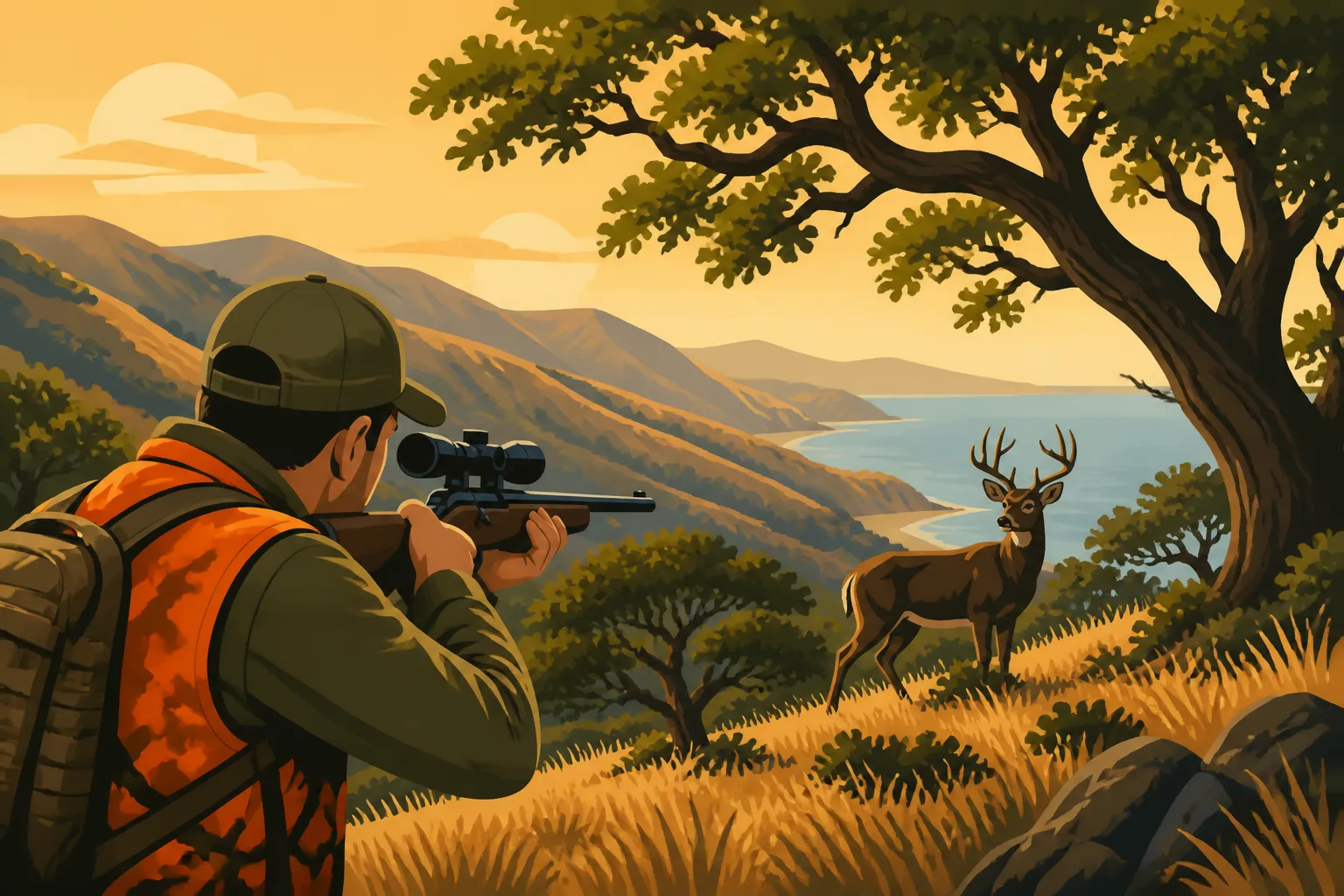
California's coastal oak woodlands are a stunning mosaic of rolling hills, deep canyons, and towering oaks, but they present a formidable challenge to hunters. This isn't your grandfather's open Midwest woodlot; these are often steep, brushy, and incredibly dense areas where deer seem to materialize and disappear like ghosts.
Habitat Characteristics and Challenges
When you step into a coastal oak woodland, you're immediately struck by the sheer diversity and density of vegetation. You'll encounter majestic live oaks, black oaks, and canyon oaks, often intertwined with thick undergrowth like chaparral, poison oak, manzanita, and ceanothus. This creates an almost impenetrable jungle in places, making visibility extremely limited, sometimes down to just a few yards. The terrain itself can be relentless, with steep, broken ground, deep ravines, and eroded creek beds that are tough on the ankles and lungs.
One of the biggest frustrations here is simply seeing the deer. Blacktail deer are masters of this environment, using the dense cover to their advantage. They'll often bed down in the thickest brush imaginable, seemingly invisible until you're practically on top of them. This means traditional glassing methods common in more open terrain are often less effective. Instead, you're relying on your ears, your nose, and the subtle flick of a tail or an antler tip to give them away. Water sources, especially during dry years, become critical pinch points. Look for springs, seeps, and even small puddles in shaded canyons, as these can draw deer in from miles around. The ground itself can be noisy, with dry leaves and twigs crunching underfoot, making a quiet approach an art form that takes years to master.
Understanding Coastal Weather and Thermals
The coastal influence brings a unique set of weather patterns that significantly impact deer behavior and your hunting approach. Early mornings often greet you with dense fog, especially closer to the ocean. While this can limit visibility initially, it also dampens sound, making for an incredibly quiet approach through the woods once it starts to lift. However, the fog can also make it difficult to determine wind direction until it burns off. As the sun climbs, that fog often gives way to clear skies and rapidly warming temperatures, especially during early season hunts in August and September.
Thermals are an absolute game-changer in this environment, and if you don't play them right, you'll be smelling deer before you see them. As the ground warms with the rising sun, air begins to move uphill. This "updraft" can carry your scent directly to deer bedded high on a ridge. Conversely, as the sun sets and the air cools, thermals reverse, creating a "downdraft" that carries scent downhill into the canyons. Understanding this daily cycle is paramount. You want to hunt into the wind and thermals, meaning an uphill approach in the morning and a downhill approach in the evening, or positioning yourself cross-slope to catch shifting breezes. A small wind checker, often just a squeeze bottle of powder, is an indispensable tool here, letting you constantly monitor the subtle shifts that can make or break your hunt. In some of the deeper, shaded canyons, cool air can linger for much of the day, creating unpredictable swirls that demand constant vigilance.
Deciphering Blacktail Behavior
Hunting blacktail deer in the coastal oak woodlands means understanding their unique adaptations to this challenging environment. They aren't mule deer or whitetails; they have their own rhythm and preferences shaped by the dense cover and often rugged terrain.
Bedding and Movement Patterns
Coastal blacktail bucks are notorious for their reclusive nature, especially the mature ones. Unlike their mule deer cousins who might bed in more open areas, blacktails in the oak woodlands will almost always seek out the thickest, nastiest cover they can find for bedding. This could be a dense stand of chaparral on a steep hillside, a jumble of downed logs, or a pocket of manzanita so thick you can barely crawl through it. They want cover over their backs, often with a good vantage point to watch their backtrail, and ideally downwind from any likely approach. You'll find them on north-facing slopes, in shaded canyons, or deep within the oak canopy where the sun's rays don't penetrate as harshly.
Their movement patterns are highly influenced by hunting pressure and the time of day. In unpressured areas, you might see them moving earlier and later in the day, sometimes even in midday shade. However, once hunting season kicks in, they become much more nocturnal, primarily moving under the cloak of darkness. You'll want to focus your efforts during the crucial "golden hours" – the first two hours after dawn and the last two hours before dusk – when they're most likely to be transitioning between bedding and feeding areas. During the middle of the day, they are often bedded tight, making still-hunting an extremely slow, methodical process where every step counts. Pay close attention to ridge-top saddles, benches along steep slopes, and the edges of dense cover where they might pause before venturing into more open oak groves to feed. For deeper insights into where these elusive bucks prefer to settle in, check out our guide on Where California Blacktail Bucks Bed.
Foraging Habits and Food Sources
Acorns are the undisputed king of food sources for blacktail deer in the coastal oak woodlands. When the acorn crop is good, deer will abandon nearly everything else to gorge themselves on this energy-rich bounty. Different oak species drop their acorns at different times, so knowing your oaks – live oak, black oak, canyon oak – and when they're producing is a huge advantage. Early in the season, you might find deer targeting browse like wild grape, ceanothus, or even poison oak (which they love!). As the season progresses and especially after the first rains, lush green grasses and forbs will sprout, providing another critical food source.
Hunting around these food sources requires careful observation. Look for fresh droppings, tracks, and disturbed leaf litter under acorn-dropping oaks. Pay attention to how deer approach and leave these areas – often using specific trails or funneling through natural openings. If the acorn crop is poor in a particular year, deer will revert to heavy browsing, and you'll need to scout for areas with abundant green forage. This often means focusing on creek bottoms, shaded canyons, and north-facing slopes where moisture persists longer. Understanding the subtle shifts in their diet throughout the season is key to knowing where to focus your efforts. A hunter using advanced mapping tools like GoHunt can overlay vegetation maps with known acorn-producing oak stands to identify potential hotspots even before hitting the field.
Proven Hunting Strategies for Success
The dense, broken terrain of coastal oak woodlands demands a different approach than many other hunting environments. You can't just sit and glass here most of the time; you need to be strategic, patient, and adaptable.
Still-Hunting and Stalking in Tight Quarters
Still-hunting is perhaps the most effective, yet challenging, strategy in the oak woodlands. It's an exercise in extreme patience and stealth. The basic premise is simple: move very slowly, stopping frequently to observe, listen, and scan. Think of it as hunting in slow motion. Take one or two steps, then pause for five minutes, or even ten. Use your binoculars to pick apart every shadow, every clump of brush, looking for horizontal lines in a vertical world – the back of a deer, the curve of an antler, a straight leg. The goal is to move so slowly and deliberately that you detect the deer before it detects you.
Key to this method is scent control and constant wind checks. As mentioned before, thermals are tricky. Always be aware of where your scent is going. If the wind swirls, hold tight, or try to reposition. When stalking, focus on placing your feet down quietly. Avoid stepping on crunchy leaves or snapping twigs. This might mean taking detours or even backing up to find a quieter path. Use the terrain to your advantage: move along ridge lines that offer visual breaks, or drop into creek beds where the natural contours can hide your movement and muffle sound. This method is incredibly demanding mentally, as it requires intense focus for hours on end, but it's often the only way to get close to a wary blacktail buck in his home turf. For those hunting specific dense zones, understanding how to apply these techniques is critical, as detailed in articles like Hunting Coastal Range Chaparral.
Stand Hunting Ambush Points
While still-hunting is productive, strategic stand hunting can also be incredibly effective, especially if you've done your homework. The key is identifying natural funnels and pinch points where deer are forced to travel in predictable ways. This could be a narrow saddle between two ridges that deer use to cross, a game trail leading from a bedding area to a food source, or a well-used route to a water source. Look for rubs and scrapes along these trails, indicating active buck use.
Setting up near a productive oak grove during the acorn drop is another prime ambush strategy. Deer will often visit these areas regularly, particularly in the mornings and evenings. Consider using a portable ground blind, brushed into the natural surroundings, or simply finding a good natural hide with plenty of cover and a clear shooting lane. Always set up downwind of the expected travel path. If you can identify a clear travel corridor, perhaps a natural break in the dense cover or a well-worn trail between two dense patches of oaks, it’s an ideal spot. Our detailed guide on Hunting a Funnel Between Two Oak Ridges offers more strategies for these specific setups. Remember, patience is your best friend when stand hunting. The deer will come if your setup is right and you remain undetected.
Calling Techniques for Blacktail
Calling might not be the first technique you think of for blacktail, but it can be surprisingly effective, especially during the rut. Blacktail bucks are generally less vocal than their whitetail or mule deer cousins, but they do respond to certain calls, particularly grunts and rattles. A soft "social grunt" can sometimes pique a buck's curiosity, especially if he's cruising for does. Don't overdo it; a couple of soft grunts, followed by a long silence, is usually more effective than aggressive calling.
Rattling can also work, particularly during the pre-rut and rut phases when bucks are more actively fighting or establishing dominance. In the dense coastal oak cover, the sound doesn't travel as far, which can be a good thing. You'll want to use smaller, more subtle rattling sequences that mimic two smaller bucks sparring, rather than a full-on clash. Often, a short, sharp rattling sequence followed by a few grunts is enough to draw a curious buck in. The thick cover means they often come in slowly, trying to pinpoint the source of the sound before committing. You need to be ready for a shot at close range. For those hunting in areas with particularly dense vegetation, understanding Rattling Volume in Thick Chaparral can be a useful skill to adapt. A soft fawn bleat can also sometimes stop a buck in its tracks or even bring a cautious doe closer.
Essential Gear and Preparation for Coastal Hunts
The coastal oak woodlands will test your gear as much as your patience. The right equipment won't guarantee a buck, but the wrong gear can definitely send you home early, sore, and frustrated.
Footwear and Clothing for Rugged Terrain
Your feet are your most important asset when still-hunting these hills. Invest in high-quality, comfortable, and supportive hunting boots with good ankle support. The terrain is often steep, rocky, and uneven, and a twisted ankle can end your hunt. Look for boots that are waterproof or at least highly water-resistant, as you'll often encounter morning dew, fog, or even unexpected rain. Many hunters prefer a stiffer sole for stability on sidehills and rocky ascents. Brands like Kenetrek or Crispi are popular among serious mountain hunters for their durability and support. Make sure your boots are well-broken in before the season starts to avoid blisters. Our guide on Best Boots for Steep Wet-Season Sierra Trails offers great insights into footwear that can be adapted to the coastal environment.
Clothing needs to be versatile and durable. Layering is absolutely crucial for coastal hunting. Mornings can be chilly and damp with fog, but as the sun burns off the marine layer, temperatures can soar into the 80s or 90s, especially in the early season. Start with a moisture-wicking base layer, add a mid-layer for insulation, and a durable, breathable outer layer for protection from brush and thorns. Avoid cotton, which holds moisture and will leave you cold when wet. Look for quiet fabrics that won't rustle loudly against brush. Camo patterns that blend with the dappled light and varied greens and browns of the oak woodland and chaparral are ideal. Companies like Kuiu or Sitka offer effective patterns and durable fabrics. Don't forget a good hat and gloves to protect against sun and cold.
Optics and Navigation Tools
In dense coastal oak, your primary optics will be your binoculars, used not for vast distances, but for picking apart the immediate cover. A good pair of 8×42 or 10×42 binoculars will be indispensable for finding that subtle flick of an ear or piece of antler in the shadows. Keep them readily accessible in a chest harness so you can quickly bring them up to scan. A rangefinder is also critical for accurately gauging distances in the varying terrain, especially before taking a shot in broken country where distances can be deceiving.
While you won't be glassing miles, sometimes a small pocket or opening will present itself. A compact spotting scope might be useful for confirming an antler or assessing a deer at moderate distances, but it's less of a primary tool here than in open country. For navigation, a reliable GPS unit or a smartphone with a robust hunting app is non-negotiable. Apps like GoHunt are invaluable for scouting and on-the-ground navigation, allowing you to mark waypoints, track your movement, and verify property boundaries. Download offline maps before you head out, as cell service is often spotty or nonexistent in many coastal hunting areas. Knowing exactly where you are and where you're going is essential for safety and efficiency, especially when trying to pinpoint public land access points or retrieve a downed animal.
Weapon Choices for Close-Range Encounters
Given the close-quarters nature of much of this hunting, you'll want a rifle that's handy and powerful enough for blacktail. Common calibers like .270, .308, 6.5 Creedmoor, and 30-06 are all excellent choices. The most important consideration, though, is California's non-lead ammunition requirement. You must use non-lead bullets for hunting deer in California. Brands like Barnes (TSX, TTSX), Hornady (GMX, CX), and Federal (Trophy Copper) offer excellent non-lead options that perform exceptionally well on deer. Make sure to sight in your rifle with your chosen non-lead ammunition well before the season.
For archery hunters, a reliable compound bow with a good broadhead setup is paramount. Fixed-blade broadheads are often favored by many for their reliability in hitting bone, which can happen in tight quarters, while mechanical broadheads can offer a larger cutting diameter. Regardless, ensure your broadheads are razor-sharp and your bow is perfectly tuned for broadhead flight. Crossbows are also legal in California during general archery seasons and can be a good option for hunters looking for a different challenge or those with physical limitations. The key for any weapon choice in the oak woodlands is precision and shot placement, as opportunities can be fleeting and at very close range.
Scouting and Accessing Coastal Oaks
Successful hunting in the coastal oak woodlands starts long before opening day. Effective scouting and understanding land access are paramount to finding those elusive blacktail bucks.
Pre-Season Scouting and Reading Sign
Pre-season scouting is arguably more important in dense coastal oak woodlands than in many other hunting environments. You simply can't rely on showing up and finding deer; you need to know their habits and preferred areas beforehand. Start by poring over topo maps and aerial imagery, identifying potential bedding areas (thick, north-facing slopes, dense chaparral pockets), feeding areas (oak groves, lush creek bottoms), and travel corridors (saddles, benches, game trails). Tools like GoHunt or onX Hunt are incredibly valuable for this, allowing you to mark points of interest, analyze terrain, and identify potential access routes.
Once on the ground, look for fresh sign. This means tracks, droppings, rubs on small trees (especially by bucks in the pre-rut), and scrapes. Fresh sign tells you deer are actively using the area. Pay attention to how often you find these signs and how fresh they appear. Trail cameras can be incredibly effective here, placed strategically on well-used game trails, near water sources, or overlooking an oak flat. They can give you valuable insight into deer movement patterns, preferred times of day, and even help you identify specific bucks in the area. Remember to check regulations regarding trail camera use on public land, as rules can vary. The more time you spend deciphering the subtle clues the deer leave behind, the better your chances will be when season opens. Learning to interpret these subtle cues is crucial, as highlighted in our guide on Finding Sign in a Coastal Oak Woodland.
Navigating Public and Private Land
California's coastal areas present a complex mix of public and private land. While there are significant tracts of public land, such as portions of Los Padres National Forest and Six Rivers National Forest, much of the prime oak woodland habitat is privately owned ranch or timber land. It's absolutely critical to know where you are at all times and respect property boundaries. Trespassing is not only illegal but also harms the reputation of all hunters.
For public land, research specific areas and their regulations well in advance. Some national forests have large wilderness areas that require significant hiking and present different challenges. Other areas might be more accessible via forest roads. The Bureau of Land Management (BLM) also manages scattered parcels of land in coastal counties, which can offer hunting opportunities, but often require careful navigation to ensure you're on public ground. Always carry physical maps or have offline maps on your GPS device or phone, as cell service is often unreliable.
If you're interested in hunting private land, the best approach is to seek permission from landowners. This often involves politely knocking on doors, introducing yourself, and demonstrating respect for their property. Be prepared to be turned down, but persistence can pay off. Offering to help with chores, offering a portion of your harvest, or building a long-term relationship can sometimes open doors. While this can be a long shot, securing private land access can offer unparalleled hunting opportunities away from public land pressure. For more information on this process, consider reading Knocking on Doors in California Ranch Country. Remember, even on private land, all California hunting regulations still apply.
| Strategy | Best Use Case | Key Considerations | Gear Essentials |
|---|---|---|---|
| Still-Hunting/Stalking | Dense cover, unpressured deer, early morning/late evening | Extreme patience, constant wind checks, quiet foot placement, reading subtle sign | Supportive boots, quiet clothing, binoculars, wind checker |
| Stand Hunting | Identified funnels, food sources (acorns), water holes, high traffic areas | Pre-season scouting, scent control, minimal movement, clear shooting lanes, patience | Ground blind/natural cover, binoculars, rangefinder |
| Calling | During rut, pre-rut, curious bucks, stopping fleeing deer | Subtle grunts, soft rattles, fawn bleats, close-range response, patience | Grunt tube, rattling antlers/bag, fawn bleat call |
| Glassing (Limited) | Openings, small clearings, burn scars, distant ridges | Short-range focus, picking apart shadows, early morning/late evening, high vantage | 8-10x binoculars, tripod (optional) |
Disclaimer
Hunting is an inherently dangerous activity. Always prioritize safety, adhere to all local, state, and federal laws and regulations, and obtain proper licenses and permits before venturing afield. Be aware of your surroundings, carry appropriate safety and first-aid gear, and inform others of your hunting plans. This guide is for informational purposes only and does not replace professional instruction or official hunting regulations.