Binoculars for Glassing Open California Desert Terrain
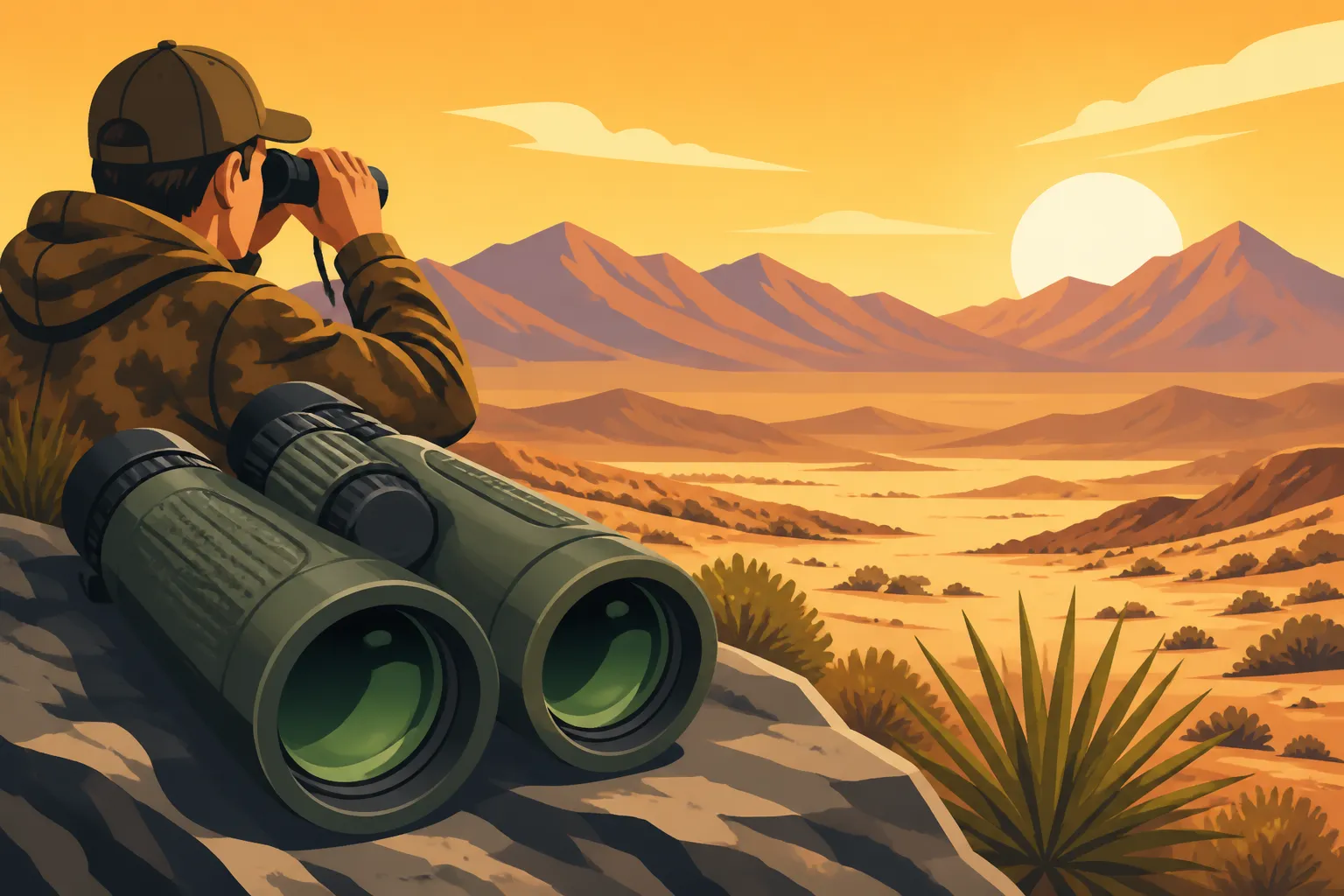
Oh, the vast, shimmering expanse of California's deserts! There's nothing quite like the feeling of the scorching sun on your neck and the endless horizon stretching before you as you try to pick apart the landscape for game. It's an incredible experience, but it also presents a real challenge when it comes to spotting those elusive desert mule deer, bighorn sheep, or even the occasional coyote. Many hunters get frustrated, spending hours hiking only to realize they've walked right past game they never saw. This guide is all about equipping you with the knowledge to choose and use the right binoculars to conquer the open California desert terrain, transforming your hunts from endless walking to intelligent glassing.
The Unique Challenges of Glassing California's Desert Terrain
Hunting in California's deserts isn't like slipping through the timbered Sierra or stalking oak woodlands. The sheer scale, the mirage, and the incredible ability of desert animals to blend in make traditional "still-hunting" incredibly inefficient. You need a dedicated strategy, and that strategy starts with quality optics.
Battling the Mirage and Heat Haze
One of the most maddening aspects of glassing in the desert is the constant battle with mirage and heat haze. You'll set up your binoculars, focus in on a distant ridge, and watch as the heat rising off the ground makes everything ripple and dance. What looks like a rock might be a bedded buck, but the mirage distorts it into an unidentifiable blob. This isn't just a minor annoyance; it can completely obscure game, making confident identification nearly impossible, especially during the warmer parts of the day.
This effect is most pronounced midday and can make early morning and late evening glassing even more critical. The low angle of the sun at these times can actually cut through some of the haze, offering clearer views, but it's still a constant factor. The quality of your binocular lenses and coatings plays a huge role here, as cheaper optics will often amplify the mirage, making your job even harder. You need glass that's designed to transmit light efficiently and minimize distortion, giving you the best chance to see through the "desert soup."
The Sheer Scale and Openness of the Landscape
California's desert regions, from the vast expanses of the Mojave to the rolling hills of the Carrizo Plain, are simply enormous. You can literally see for miles and miles, and while that sounds great for spotting game, it also means there's an overwhelming amount of ground to cover with your eyes. Without a systematic approach and the right tools, you're essentially looking for a needle in a haystack—a very large haystack. This vastness is both a blessing and a curse. It allows you to observe game from a distance without disturbing them, but it also demands optics capable of resolving fine details over incredible distances.
Unlike thick timber where a good pair of 8x binoculars might be all you need for quick checks, the desert requires more magnification and a stable platform to effectively scan such immense areas. Imagine trying to pick out a bedded mule deer on a far ridge, nearly a mile away, with binoculars you can barely hold steady. You'd be frustrated, missing subtle movements or the tell-tale shape of an antler. The scale of the desert environment dictates that your binoculars must be powerful enough to bring distant objects into clear view, yet stable enough for extended periods of glassing. For more on navigating these wide-open spaces, check out Hunting California's BLM Desert Land.
Elusive Game and Their Camouflage
Desert animals are masters of disguise. Mule deer, particularly the desert variety, have coats that blend almost perfectly with the rocky, brushy terrain. Bighorn sheep, with their incredible agility and stoic nature, often blend into the cliffs and rocky outcrops they inhabit. Even a large wild pig, if it's bedded down in a wash, can seem to disappear into the shadows and dirt. Their natural camouflage is phenomenal, and they've evolved to minimize movement, making them incredibly difficult to spot with the naked eye.
This means you're not just looking for an animal; you're often looking for parts of an animal—an ear twitch, the shine of an eye, the horizontal line of a back that contrasts with vertical desert scrub, or the subtle glint of an antler tip. These are details that require sharp, clear optics with excellent resolution. A blurry image or poor contrast can easily hide a critter that’s just a few hundred yards out, much less one a mile away. Your binoculars need to be a magnifying extension of your eye, capable of distinguishing subtle differences in color, texture, and shape against a complex background.
Essential Binocular Features for Desert Hunting
When you're facing the vastness and optical challenges of the desert, not just any pair of binoculars will do. You need specific features that are tailored to these demanding conditions.
Magnification and Objective Lens Diameter: Finding the Sweet Spot
This is perhaps the most critical decision for desert binoculars. Magnification (the first number, e.g., 10x) tells you how much closer an object appears. Objective lens diameter (the second number, e.g., 42mm) indicates how much light the binoculars can gather. For open desert country, where you'll be glassing at long distances, a higher magnification is generally beneficial. Many hunters find that 10x or 12x is the sweet spot for handheld use, offering a good balance between power and field of view, while still being relatively stable. However, for serious, dedicated long-range glassing, particularly if you're targeting elusive species like desert mule deer or bighorn sheep, 15x magnification can be incredibly effective, though it almost always requires a tripod.
The objective lens diameter influences how bright and clear your image will be, especially in low light conditions like dawn and dusk when game is most active. A 42mm objective is a great all-around choice, but 50mm or even 56mm can provide superior light gathering and resolution, albeit at the cost of increased weight and bulk. You need to weigh the benefit of extra power and light against the fatigue of carrying and hand-holding heavier binoculars all day. A common setup for many desert hunters, especially those who walk a lot, is a versatile 10×42 or 12×50. For more on maximizing your view, look into Glassing Mule Deer in Open California Country.
Optical Quality and Lens Coatings for Clarity
This is where the rubber meets the road in terms of performance, especially in mirage-prone desert environments. High-quality glass, like ED (Extra-low Dispersion) or HD (High Definition) glass, dramatically reduces chromatic aberration (color fringing), resulting in a sharper, truer-color image. This enhanced clarity makes it much easier to discern details at a distance and pick out an animal from its surroundings. Don't underestimate the importance of this; cheap glass will make every distant object look fuzzy, exacerbating the mirage issue.
Beyond the glass itself, lens coatings are absolutely crucial. Look for binoculars with "fully multi-coated" optics. This means multiple layers of anti-reflective compounds have been applied to all air-to-glass surfaces. These coatings minimize light loss and glare, increasing light transmission and contrast. In the bright, often glaring desert sun, these coatings help reduce eye strain and provide a crisper image, cutting through some of that desert haze. Without them, you'd be seeing a lot of reflections and losing precious light, making long glassing sessions tiring and unproductive.
Durability, Waterproofing, and Ergonomics
The desert is not kind to gear. Dust, sand, extreme temperatures, and the occasional unexpected rain shower demand tough equipment. Your binoculars should be robustly constructed, preferably with a magnesium alloy or similar lightweight but strong chassis. Rubber armor isn't just for grip; it also provides impact protection against inevitable bumps and drops. Look for binoculars that are fully waterproof and fog-proof, usually achieved by O-ring sealing and nitrogen or argon purging. This prevents internal fogging due to temperature changes and keeps dust and moisture out, ensuring clear views no matter the conditions.
Ergonomics are also key, especially if you'll be spending hours with your binos strapped to your chest or in your hands. How do they feel? Is the focus wheel smooth and easy to manipulate, even with gloves? Are the eyecups comfortable and adjustable for use with or without eyeglasses? Do they balance well in your hands, or if mounted, on a tripod? A well-designed binocular will become an extension of you, fading into the background so you can focus entirely on the hunt. Brands like Vortex, Athlon, and Maven offer excellent combinations of durability and optical performance suitable for the demanding California desert.
Beyond the Binos: Supporting Gear for Optimal Glassing
Just having a great pair of binoculars isn't enough for effective desert glassing. Think of your optics system as a team; each player has a crucial role in maximizing your success.
The Indispensable Tripod and Adapter
Let's be blunt: if you're serious about glassing in open desert terrain, especially with anything 12x magnification or higher, a tripod isn't an option—it's a necessity. Trying to hold high-magnification binoculars steady for extended periods is a fool's errand. Your arms will fatigue, your image will wobble, and you'll miss the subtle details that betray a bedded animal. A sturdy, lightweight tripod allows you to lock your binoculars onto a target, eliminate shake, and comfortably observe for minutes on end, picking apart the landscape with precision.
Pair your tripod with a quality binocular adapter. These attach your binoculars securely to the tripod head, allowing for smooth panning and tilting. Look for quick-release options if you frequently take your binos off the tripod for quick handheld scans. Some hunters prefer a simple post adapter, while others opt for a more secure clamp system. The key is stability. A wobbly tripod or a cheap adapter will negate the benefits of even the finest binoculars. When you're glassing a distant hillside, every tiny bit of movement counts, and a stable platform allows you to identify what might otherwise be dismissed as a rock. This setup is crucial for techniques like grid searching, which we'll discuss later.
Harness Systems and Lens Protection
Carrying binoculars around your neck all day is a recipe for a sore neck and swinging optics that can get banged around. A good binocular harness system is a game-changer for desert hunting. It distributes the weight across your shoulders and back, keeping the binoculars snug against your chest, preventing them from bouncing as you hike. This not only increases comfort but also protects your expensive optics from damage. Many harnesses include built-in lens covers or pouches for additional protection from dust and scratches.
Beyond the harness, external lens caps and rain guards are simple but effective tools. The desert is dusty, and that fine grit can scratch lenses if not properly protected. Always keep your objective and ocular lens caps on when not actively glassing. A rain guard for the oculars is also handy, even in the desert, as unexpected showers can happen, and they also keep dust out. Taking care of your lenses is paramount; even minor scratches or smudges can degrade image quality and contribute to eye strain, making your glassing efforts less effective.
Rangefinders and Spotting Scopes: A Team Effort
While binoculars are your primary tool for finding game, they often work best in conjunction with other optics. A rangefinder is almost as essential in open country as your binoculars. Once you spot an animal, knowing the precise distance is critical for making an ethical shot. Many modern rangefinders are compact and can be easily carried alongside your binoculars, some even integrating into the binocular design itself. Check out specific options for Rangefinders for California's Sierra Canyon Country, as many principles apply to open desert.
For truly long-range identification or when you need to "judge" an animal (e.g., distinguishing antler points on a mule deer or legal curl on a bighorn sheep), a high-quality spotting scope is invaluable. You'll use your binoculars to find the general area, then set up your spotting scope on a tripod to zoom in for detailed assessment. This saves you from having to hike miles just to confirm if a distant "spot" is worth pursuing. Think of your binoculars as your wide-angle lens, and your spotting scope as your telephoto. They complement each other perfectly in the expansive desert, allowing you to cover ground efficiently and confirm game before committing to a stalk. For more on these specialized optics, consider reading Best Spotting Scope for Long-Range Blacktail Glassing.
Mastering the Art of Desert Glassing Techniques
Having the right gear is only half the battle. Knowing how to use it effectively is what truly makes a successful desert hunter. Glassing isn't just about looking; it's about seeing.
Grid Searching and Breaking Down the Landscape
The desert's vastness can be overwhelming, leading to unfocused scanning that misses more than it finds. The most effective method for covering large areas with your binoculars is the "grid search." Instead of randomly sweeping your optics, systematically break down the landscape into manageable sections. Pick a starting point on a ridge or hillside and slowly, methodically scan horizontally, then drop your gaze slightly and scan back horizontally in the opposite direction, moving across the entire section like a printer.
Once you've covered one section, move to the next. Use distinct landmarks like prominent rocks, bushes, or changes in terrain as reference points. This methodical approach ensures you're not skipping patches of cover where game might be bedded or feeding. It takes patience and discipline, but it dramatically increases your chances of spotting a subtle detail that would be missed in a quick sweep. Remember, you're not just looking for an entire animal; you're looking for an antler tip, an ear, a patch of hide that looks "out of place," or the horizontal line of a back among vertical scrub. The GoHunt platform, with its detailed mapping layers, can be invaluable here, allowing you to mentally (or physically with a stylus) draw grids over terrain before you even hit the field, helping you define glassing points and target areas.
Using Light and Shadow to Your Advantage
The desert sun is both a friend and a foe. It can create harsh glare and mirage, but it also creates dramatic shadows and highlights that can reveal game. Learning to use light and shadow is a crucial skill for desert glassing. In the early morning and late evening, when the sun is low, long shadows can create pockets of darkness where animals seek refuge. Concentrate your efforts on these shaded areas, as deer and sheep will often bed there to escape the heat.
Conversely, the same low sun can highlight the contours of an animal against a shadowed background, making them pop out. Look for areas where the sun is hitting at an angle that creates good contrast. Avoid glassing directly into the sun, as this causes glare and severe eye strain. Position yourself so the sun is at your back or to your side. As the day progresses and the sun climbs higher, animals tend to move into thicker cover or find deeper shade, so adjust your focus to those areas. A deep wash, a dense patch of mesquite, or the north face of a steep ridge can become prime habitat during midday.
Patience, Persistence, and Preventing Eye Strain
Glassing is an endurance sport for your eyes and mind. It requires immense patience. You might sit for hours, meticulously scanning, only to spot a single animal. But that one animal is often the payoff for all your hard work. Don't rush it. Take breaks, rest your eyes, and drink plenty of water to stay hydrated, as dehydration can contribute to eye fatigue. When you find yourself getting frustrated or tired, close your eyes for a minute, then start fresh.
Preventing eye strain is critical for long, productive glassing sessions. Ensure your binoculars are properly adjusted for your interpupillary distance (the distance between your pupils) and that the diopter setting is correct for your eyes. This ensures a sharp, merged image. If you wear glasses, decide if you'll glass with them on or off and adjust the eyecups accordingly. Frequent short breaks, looking away from the binoculars into the distant landscape, can also help. A good pair of sunglasses, used when not actively glassing, will protect your eyes from the intense desert UV and further reduce fatigue. Remember, effective glassing is not about speed, but about thoroughness and sustained effort.
Choosing Your Binoculars: Types and Considerations
Before you even start looking at specific models, understanding the different types of binoculars and what really matters for desert hunting will help you make an informed decision.
Roof Prism vs. Porro Prism Design
Binoculars primarily come in two prism designs: roof prism and porro prism.
- Roof prism binoculars are characterized by their straight barrels, making them more compact, lightweight, and streamlined. They tend to be more expensive to manufacture with comparable optical quality because the light path is more complex, requiring tighter tolerances and more advanced coatings. For the mobile desert hunter who covers a lot of ground, their sleek design and ease of handling are often a significant advantage. Most modern high-end binoculars are roof prism designs.
- Porro prism binoculars have a more classic, zig-zag shape to their barrels, resulting in a wider, sometimes bulkier design. Historically, they offered superior optical quality and a wider field of view for their price point, as their simpler light path often resulted in better depth perception and less light loss without requiring as many complex coatings. While they can be excellent optically, their bulkier profile might be less ideal for backpacking long distances in the desert. However, if budget is a primary concern, a good pair of porro prisms can offer fantastic value.
Here's a quick comparison of common binocular types for desert hunting:
| Binocular Type | Magnification/Objective | Primary Use Case | Pros | Cons |
|---|---|---|---|---|
| Compact | 8×25 – 10×28 | Scouting, quick checks, secondary pair | Extremely lightweight, highly portable | Limited light gathering, narrow field of view, harder to steady |
| Mid-Size All-Rounder | 10×42 | Versatile, general desert hunting | Good balance of power/light, hand-holdable | May not be enough power for extreme long range |
| High-Power | 12×50 – 15×56 | Dedicated long-range glassing | Excellent detail, superior light gathering | Heavier, bulkier, often requires tripod for stability |
Weight and Size for Long Hikes
California's deserts are not always flat. You might find yourself climbing steep, rocky canyons or navigating vast, undulating washes. Every ounce counts when you're packing gear for miles. Heavier binoculars, especially those with larger objective lenses (e.g., 15×56), will provide superior optical performance but can become a burden during a long, strenuous hike. Conversely, ultra-light compact binoculars (e.g., 8×25) are a joy to carry but may lack the power and light-gathering capabilities needed for effective desert glassing.
You need to find a balance that suits your hunting style and physical conditioning. If you plan to set up a glassing spot and stay there for extended periods, a heavier, more powerful binocular on a tripod is ideal. If you're a run-and-gun hunter who covers a lot of ground and makes quick stops to glass, a lighter 10×42 or 12×50 might be a better fit, especially when paired with a comfortable harness. Always consider how the weight of your optics will integrate with the rest of your hunting pack, particularly if you're planning a multi-day trip or anticipate a long pack out for game. Packs and Gear for a Backcountry Elk Hunt offers insights into optimizing your carrying system, many of which apply to any demanding hunt.
Budgeting for Quality Optics in the Desert
Quality optics are an investment, and like most investments, you generally get what you pay for. In the harsh, visually demanding desert environment, compromising on optical quality can lead to missed opportunities and extreme frustration. While it's tempting to save money, a cheap pair of binoculars will struggle with mirage, offer poor clarity, and likely won't stand up to the rigors of the desert.
That said, you don't necessarily need to break the bank for top-tier models. Many reputable brands offer excellent mid-range options that provide fantastic performance for the price. Focus your budget on the best glass and coatings you can afford within your chosen magnification and objective lens range. Remember to factor in the cost of essential accessories like a tripod and a good harness. Think of your binoculars as a long-term investment in your hunting success. They will last for years if cared for properly, and the clearer views they provide will pay dividends season after season, helping you spot those elusive desert bucks or sheep. Checking reviews from trusted sources, and even visiting a local outfitter to get a feel for different models, can help you make a wise choice that fits your budget and needs.
Disclaimer
This article is for general informational purposes only and does not constitute professional advice. Laws, prices and regulations vary by location and change over time. Consult a qualified professional for guidance on your specific situation.