Non-Lead Muzzleloader Bullet Options
For California muzzleloader hunters, navigating the state's stringent non-lead ammunition requirement can feel like trying to hit a moving target in a fog bank. Many of us have cherished traditional powder and ball setups, only to find our favorite projectiles suddenly non-compliant, leaving us wondering what our options truly are. This comprehensive guide aims to clear the confusion, exploring the available non-lead muzzleloader bullet choices, the critical factors to consider, and how to successfully prepare for your next hunt.
The Unique Challenge of Non-Lead Muzzleloader Hunting in California
California's progressive stance on lead-free ammunition has certainly brought about significant changes for hunters across the board. For those of us who prefer the satisfying boom and cloud of smoke from a muzzleloader, this mandate presents a particularly thorny set of challenges. It's not as simple as swapping out a factory cartridge for a non-lead version; muzzleloaders operate on a different principle entirely, which means finding compliant, accurate, and effective projectiles requires a deeper dive.
Why Muzzleloaders are Different for Non-Lead
Unlike modern cartridge rifles where bullet and powder are factory-sealed, muzzleloaders demand that we load each component individually down the barrel. This fundamental difference impacts everything from projectile design to loading technique. Traditional muzzleloader projectiles often relied on pure lead, which is soft enough to easily form to the rifling and create a good gas seal, even with minor bore irregularities. Non-lead materials, typically copper or copper alloys, are much harder. This hardness affects how they interact with the bore, the ease of loading, and how they engage the rifling. A bullet that's too hard or too large can be incredibly difficult, if not impossible, to seat properly, leading to safety concerns and poor accuracy. Moreover, the specific twist rate of your muzzleloader's barrel, which dictates how quickly the projectile spins, becomes even more critical with longer, non-lead bullets to ensure stability and accuracy downrange.
California's Statewide Non-Lead Mandate
The statewide non-lead ammunition requirement in California means that hunters must use non-lead projectiles for all hunting, with very few exceptions. For muzzleloader enthusiasts, this means saying goodbye to those traditional lead round balls and conical bullets that many of us grew up loading. This law isn't just about big game; it applies across the board. I know it can be frustrating to adapt, especially when you've perfected a load over years, but understanding the shift is the first step. The goal of the law is to protect scavenging wildlife, like the California condor, from secondary lead poisoning. While the intent is clear, the implementation for muzzleloaders has definitely caused some head-scratching, forcing us to explore new projectile technologies. You can find more specific details about the legal requirements in California's Non-Lead Ammunition Requirement.
Exploring Non-Lead Muzzleloader Bullet Types
When you start digging into non-lead muzzleloader options, you'll quickly realize that the landscape is dominated by two main categories: full-bore copper projectiles and sabots encasing smaller, non-lead bullets. Each has its pros and cons, and what works best often depends on your specific muzzleloader and hunting style.
Full Bore Copper Projectiles
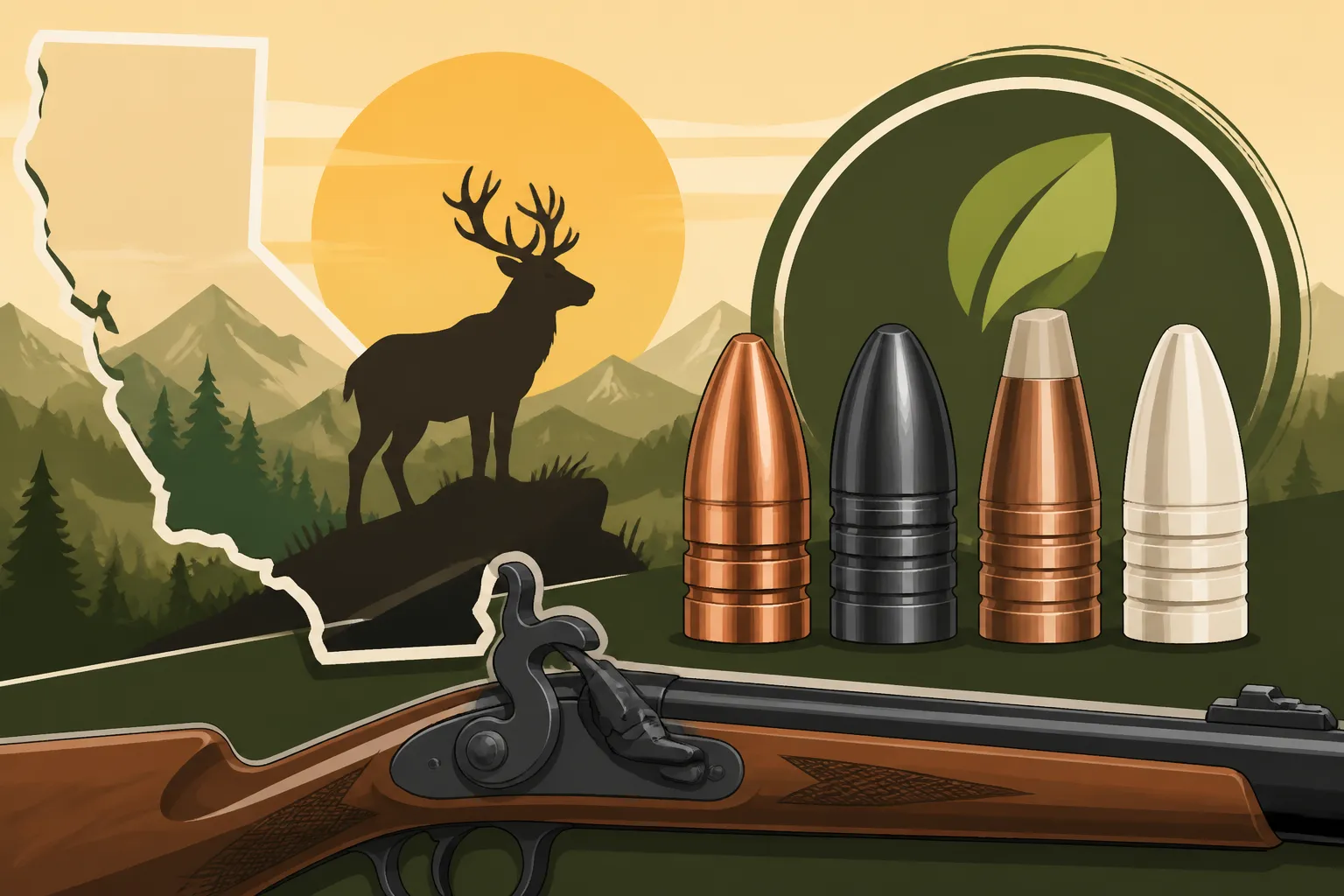
These are solid copper bullets designed to be loaded directly into your muzzleloader barrel without a plastic sabot. Think of them as the modern, non-lead equivalent of traditional lead conicals. Manufacturers craft these from solid copper or a copper alloy, which makes them inherently tougher than lead. When they hit game, they retain almost all of their weight and penetrate deeply, often passing through the animal for an exit wound and a good blood trail. This deep penetration is a huge advantage, especially on larger game.
However, the hardness of copper presents some challenges. First, you need an exact fit for your bore. If the bullet is too tight, it can be incredibly difficult to load, especially after a few shots when fouling builds up. If it's too loose, you'll lose accuracy due to a poor gas seal. Second, these longer, heavier copper projectiles often require a faster barrel twist rate to stabilize them in flight. Many older or traditional muzzleloaders might have slower twist rates designed for round balls or shorter lead conicals, which can struggle to stabilize these modern copper designs, leading to "keyholing" or poor accuracy. You'll need to do some serious research into your specific rifle's twist rate before committing to a full-bore copper option. While they typically cost more than lead, many hunters find the on-game performance worth it.
Sabots with Non-Lead Inserts
Sabots are essentially plastic sleeves that allow you to shoot a smaller diameter, modern rifle bullet out of a larger diameter muzzleloader barrel. For instance, you might use a .45 caliber sabot to shoot a .40 caliber non-lead bullet, or a .50 caliber sabot to shoot a .45 caliber non-lead bullet. The plastic sabot expands to grip the rifling and creates a gas seal, then sheds away shortly after leaving the muzzle, sending the smaller bullet on its way.
This system opens up a much wider array of non-lead bullet choices, as many manufacturers already produce monolithic copper or copper-alloy bullets for modern rifles that can be adapted for sabot use. Brands like Barnes, Hornady, and Nosler offer excellent non-lead bullet designs (such as Barnes's all-copper projectiles) that perform exceptionally well in sabot setups. These bullets are engineered for controlled expansion and high weight retention, delivering devastating energy transfer without lead fragmentation. The main advantages are increased bullet selection and often better accuracy for hunters with slower twist rate muzzleloaders, as the lighter, smaller-diameter bullets are typically easier to stabilize.
The downsides? Sabots can be finicky. Finding the right sabot-bullet combination that loads smoothly, shoots accurately, and seals well in your particular barrel is a process of trial and error. Some plastics can melt or deform at higher velocities, causing accuracy issues. Also, plastic sabots contribute to bore fouling, requiring more frequent cleaning between shots at the range. Despite these challenges, sabots are often the most practical and accurate non-lead solution for many inline muzzleloaders.
Non-Lead Patched Round Balls (Limited Use)
While the traditional patched round ball is iconic for muzzleloaders, its utility as a non-lead option for big game hunting in California is severely limited. A patched round ball typically relies on a pure lead sphere, which is soft and deforms easily to create a seal and expand on impact. Creating a non-lead round ball from something like pure copper, while technically possible, introduces significant hurdles.
First, a solid copper round ball would be incredibly hard and would not deform readily upon impact, leading to very poor terminal performance for hunting. It would likely pass through an animal with minimal energy transfer, acting more like an ice pick than an expanding hunting bullet. Second, seating a hard, non-lead round ball with a patch could be problematic, potentially damaging the patch or scraping copper into the bore. While historically patched round balls were used for smaller game and even deer, the effectiveness of a non-lead round ball for ethical big game hunting is highly questionable. Most hunters seeking effective non-lead performance will look to conical bullets or sabot combinations for big game like deer or bear. For small game, non-lead pellets or shot in a shotgun (if legal for the species) would be a more appropriate non-lead choice.
Key Considerations When Choosing Non-Lead Muzzleloader Bullets
Choosing the right non-lead bullet for your muzzleloader isn't a one-size-fits-all situation. There are several critical factors you'll need to meticulously evaluate to ensure safety, accuracy, and effective performance in the field. Ignoring these can lead to frustration, wasted money, and potentially an unsuccessful or unethical hunt.
Muzzleloader Barrel Twist Rate
This is arguably the most crucial factor when selecting a non-lead muzzleloader bullet. The twist rate, usually expressed as 1:28", 1:48", or 1:60", tells you how many inches of barrel length it takes for the rifling to complete one full rotation. Faster twist rates (smaller numbers like 1:28") are designed to stabilize longer, heavier projectiles. Slower twist rates (larger numbers like 1:60") are typically for shorter, lighter projectiles like round balls.
Non-lead bullets, particularly monolithic copper designs, tend to be longer than lead bullets of the same weight due to copper's lower density. This increased length demands a faster twist rate to ensure the bullet spins fast enough to fly point-first downrange. If your muzzleloader has a slow twist (e.g., a traditional 1:48" or 1:60" barrel), trying to shoot a long, heavy copper conical will likely result in poor accuracy, with bullets tumbling or "keyholing" before reaching the target. Many modern inline muzzleloaders come with faster twist rates (1:28" or 1:24") specifically to handle these heavier, longer bullets and sabots. Before buying any non-lead projectiles, you absolutely must know your barrel's twist rate. This information is usually stamped on the barrel or can be found in your rifle's manual. A quick search on the GoHunt forums or other dedicated hunting sites can also yield insights from other hunters with similar muzzleloaders.
Powder Charges and Velocity
Switching to non-lead bullets often means you can't just plug them into your old lead-based powder charge recipe and expect the same results. Different bullets, even of the same weight, will react differently to various powder charges. The harder nature of copper can create different pressures and friction in the bore. You might find that your rifle prefers a slightly different charge weight, or even a different type of powder, to achieve optimal velocity and accuracy with non-lead projectiles.
When you're dealing with non-lead, you're looking for that sweet spot where the bullet is stable, achieves sufficient velocity for expansion on game, and groups tightly. This requires diligent testing at the range. Start with manufacturer-recommended loads for your chosen non-lead bullet, if available, and work your way up or down in small increments. Pay close attention to recoil, muzzle report, and most importantly, group size. It's not just about maximum velocity; it's about accuracy. A slightly lower velocity, if it yields tighter groups, is always preferable to a blazing fast bullet that flies erratically. You'll want to ensure your chosen load provides enough kinetic energy for an ethical kill on your target species.
Bore Sizing and Loading Ease
The fit of your projectile in the bore is paramount for muzzleloaders. Too loose, and you lose gas seal, velocity, and accuracy. Too tight, and loading becomes a strenuous, often dangerous, chore. Non-lead bullets, being harder, don't compress or deform as easily as lead. This means the precise diameter of the projectile, whether it's a full-bore conical or a sabot, is even more critical.
When using full-bore copper conicals, you need to find a bullet that provides a snug fit but can still be loaded without excessive force. A good rule of thumb is that it should require firm, even pressure to load, but not so much that you're straining or risking damage to the bullet or ramrod. For sabots, the fit involves two components: the sabot to the bore, and the non-lead bullet to the sabot. You might find that some sabots are too tight in your barrel, while others are just right. Fouling also plays a significant role; a non-lead bullet that loads easily on a clean bore might be incredibly difficult to seat after a few shots without swabbing the barrel. This consideration is vital for follow-up shots in the field and for minimizing frustration at the range. Make sure to try loading a few practice rounds cold, and then after a few shots, to get a realistic feel for real-world conditions.
Accuracy and On-Target Performance
Ultimately, the goal of any hunting projectile is to be accurate and perform effectively on game. Non-lead bullets, especially monolithic copper designs, are renowned for their high weight retention and deep penetration. This means they often pass completely through an animal, creating two wound channels (entry and exit) and a better blood trail, which is incredibly helpful when Blood Trailing After Dark in California. However, their expansion characteristics can differ from traditional lead-core bullets. Some non-lead designs might expand less dramatically at lower velocities, while others are engineered for impressive mushrooming.
Your job is to test your chosen non-lead load at various distances relevant to your hunting scenarios. Don't just shoot at 50 yards; push it out to 100 or even 150 yards if your hunting often takes you that far. Consistency is key. A load that produces a 3-inch group at 100 yards consistently is far better than one that sometimes shoots 1-inch and sometimes 6-inch groups. This meticulous testing allows you to build confidence in your setup and understand its limitations. If you're struggling to find the right combination, consider reaching out to online communities or hunting forums on sites like GoHunt where other California muzzleloader hunters share their experiences and successful loads.
| Projectile Type | Material | Pros | Cons | Best For |
|---|---|---|---|---|
| Full Bore Copper Conical | Solid Copper Alloy | Deep penetration, high weight retention | Needs fast twist, can be hard to load, bore fouling | Modern inlines with fast twists, larger game |
| Sabots with Non-Lead Bullet | Plastic/Copper | Wide bullet selection, good accuracy | Sabot fit can be finicky, more fouling, plastic waste | Most inline muzzleloaders, varied game |
Finding and Testing Your Non-Lead Muzzleloader Setup
Once you've wrapped your head around the different non-lead options and what your muzzleloader is capable of, the real work begins: acquiring your components and putting them to the test. This phase is crucial for ensuring you're ready for the field. Don't skip steps here, or you'll likely regret it when the pressure is on during hunting season.
Researching Approved Options and Availability
The first hurdle is actually getting your hands on non-lead muzzleloader projectiles. While the market for non-lead centerfire ammunition has grown significantly, specific non-lead muzzleloader bullets can sometimes be harder to find. Start by checking the websites of major bullet manufacturers like Hornady, Barnes, Traditions, and Thompson/Center. They often list their non-lead options and sometimes even recommend specific sabots or powder charges. Look for products explicitly labeled as "non-lead" or "copper" and designed for muzzleloaders.
Online retailers and specialty hunting stores are your best bet. Given the specific requirements of California, it's always wise to confirm that any bullet you choose is indeed considered non-lead under state law. Sometimes, specific brands are even on an approved list, which can save you a headache. Don't be afraid to cast a wide net; what one store doesn't have, another might. The challenge of Non-Lead Ammo Availability and Cost is real, so start your search well before season. Keep an eye on forums or communities, like those you'd find through GoHunt, as other hunters often share where they've found their favorite non-lead components.
Range Time is Non-Negotiable
This isn't just a suggestion; it's a mandatory step for any responsible hunter, especially when switching to a new type of projectile. Once you have your non-lead bullets, you need to dedicate significant time at the shooting range. This isn't just about shooting a few groups; it's about thoroughly understanding your setup.
- Develop Your Load: Start with recommended powder charges (if available) and then experiment in small increments to find what your rifle likes best for accuracy. Don't be afraid to try different types or brands of powder, as sometimes a subtle change can make a big difference with non-lead projectiles.
- Practice Loading: Get proficient at loading your non-lead bullets smoothly and consistently. Practice loading after a few shots, without cleaning, to simulate field conditions where fouling might be present.
- Shoot from Hunting Positions: Don't just shoot off a bench rest. Practice from kneeling, standing, and using shooting sticks or your pack as a rest – whatever positions you anticipate using in the field.
- Vary Distances: Shoot at 50, 75, 100, and even 150 yards if your ethical hunting range extends that far. Understand your bullet's trajectory and point of impact at different ranges. This helps immensely when Zeroing a Rifle for Non-Lead Loads and ensuring you're prepared for varied shot opportunities.
- Fouling Management: Pay attention to how quickly your muzzleloader fouls with non-lead bullets and sabots. You might find you need to swab the bore more frequently than with lead, or you might discover a load that fouls less. Knowing this is crucial for follow-up shots.
Terminal Performance Expectations
When you transition to non-lead bullets, especially monolithic copper, you'll likely observe a few differences in terminal performance compared to traditional lead-core bullets. Non-lead bullets are designed for controlled expansion and high weight retention. This means they tend to retain nearly all of their original weight upon impact, punching through bone and tissue with less fragmentation than lead.
What does this mean for you as a hunter? You can expect excellent penetration, often resulting in complete pass-throughs on game animals. This creates two holes, an entry and an exit, which typically leads to a more robust blood trail and easier recovery of your animal. However, because they expand less violently and retain more mass, the wound channel might look "cleaner" than what you're used to with highly fragmenting lead bullets. Don't mistake a clean wound for a less effective one. The deep penetration and cutting action of a non-lead bullet through vital organs are highly effective for ethical kills. Trust your testing at the range, and have confidence that a properly placed non-lead projectile will do its job effectively.
Disclaimer
This article is for general informational purposes only and does not constitute professional advice. Laws, prices and regulations vary by location and change over time. Consult a qualified professional for guidance on your specific situation.