Best Deer Cart for Flat Central Valley Terrain
There's nothing quite like the immense satisfaction of tagging a buck in California's Central Valley, but that triumph can quickly turn into a grueling test of endurance when you realize you have to drag that animal out. The reality of pulling a heavy deer through sticky, recently plowed fields, over uneven irrigation berms, or across miles of dense stubble can be absolutely back-breaking, leaving you exhausted and your hard-earned venison potentially compromised. This guide is here to save your back and your harvest, exploring the best deer carts specifically designed to conquer the unique, often frustratingly flat terrain of the Central Valley.
Why Traditional Dragging Fails in the Central Valley
Let's be real, the romantic notion of "just dragging it out" quickly fades when you're 500 yards into a freshly disked alfalfa field, your boots are caked in two inches of mud, and your shoulders are screaming. The Central Valley, for all its agricultural bounty, presents a unique set of challenges for game retrieval that traditional dragging methods simply aren't equipped to handle. It’s not like the rocky, steep slopes of the Sierra Nevada where gravity can sometimes be your friend; here, the flatness hides its own brand of misery.
The Central Valley Terrain Challenge
Imagine this: You’ve just dropped a nice blacktail at last light in a sprawling cornfield near Stockton. You get to the animal, admire your trophy, and then the real work begins. The ground, while seemingly flat, is a mosaic of potential traps. You might encounter soft, silty soil that grabs at your boots with every step, making forward progress feel like wading through quicksand. Then there are the plowed furrows – uneven, ankle-twisting obstacles that can flip a deer being dragged in an instant.
Or perhaps you're hunting rice country. Those flooded fields, even after they're drained and harvested, leave behind a thick, matted stubble that's incredibly difficult to drag anything across. It tangles, snags, and piles up, turning a simple drag into a constant battle against friction. Don't forget the omnipresent irrigation ditches and berms, which seem to appear out of nowhere, creating abrupt elevation changes that demand extra effort to lift and pull your deer over. These aren't just minor inconveniences; they're energy-sapping, momentum-killing barriers that can turn a short retrieve into an hours-long ordeal, especially if you're alone. You might even find yourself on the edge of a property line, needing to swiftly move your animal after reading local regulations or Hunting California's Zone A General Season Dates.
Protecting Your Harvest and Yourself
Beyond the sheer physical misery, trying to drag a deer through these conditions can have serious consequences for your meat and your body. A deer dragged directly on the ground through dirt, stubble, or mud can pick up debris, damage the hide, and bruise the meat, especially on the underside. In the often-warm Central Valley temperatures, getting that animal cooled down quickly is paramount to prevent spoilage. A slow, difficult drag means more time exposed to heat, leading to faster bacterial growth and a lower quality harvest. Nobody wants to put in all that effort for venison that isn't at its best.
Then there's your own well-being. Repeatedly straining to pull a heavy, dead weight over uneven ground is a recipe for back injuries, pulled muscles, and extreme fatigue. This isn't just about discomfort; it can impact your ability to hunt safely in the future or even cause a more serious, immediate injury far from help. A deer cart is an investment in both the quality of your game and your physical health, allowing for a much more efficient and less damaging retrieval process. It lets you focus on the satisfaction of the hunt, rather than dreading the pack-out.
Key Features of a Great Deer Cart for Flat Central Valley Terrain
Choosing the right deer cart for the Central Valley isn't about picking the cheapest or flashiest option. It's about understanding the specific demands of the terrain and selecting features that will genuinely make your life easier. We're looking for efficiency, durability, and the ability to glide, not dig, through those challenging fields.
Wheel Type and Size Matters
This is arguably the most critical feature for Central Valley success. Forget those carts with small, hard plastic wheels; they'll sink into soft dirt faster than a brick in a pond. What you absolutely need are large-diameter, pneumatic (air-filled) tires. Think bicycle or even small ATV tires, not shopping cart wheels.
Here's why:
- Floatation: The larger surface area of a big, air-filled tire distributes the weight of the deer over more ground, preventing the wheels from digging in and getting bogged down in soft soil or mud. This "floatation" is your best friend when traversing a recently tilled field or a damp, grassy low spot.
- Shock Absorption: Pneumatic tires absorb bumps and uneven terrain far better than solid wheels. This means less jarring for your deer (and your back), and a smoother ride across those rutted farm roads or irrigation berms.
- Tread Pattern: Consider the predominant conditions you hunt. Knobby, aggressive treads offer excellent grip on muddy or grassy surfaces, helping you maintain traction. Smoother treads might roll a bit easier on harder-packed dirt roads or stubble, but could slip more in slick conditions. Many quality carts offer a versatile, moderately aggressive tread that handles a variety of Central Valley conditions well.
Aim for wheels at least 16-20 inches in diameter, if not larger. The bigger the wheel, the easier it rolls over obstacles and through soft ground. Some hunters even swap out stock tires for fatter, higher-volume options for maximum floatation, especially if they regularly find themselves Hunting a Green Field Planted for Deer that can turn into a mud bog after a good rain.
Frame Construction and Durability
A deer cart needs to be tough enough to handle the weight of a mature buck and the abuse of rough terrain, yet ideally not so heavy that it's a burden to get to your hunting spot.
- Materials: Look for frames made from either lightweight aluminum or durable steel. Aluminum carts are fantastic for portability, as they're much lighter to carry in or out empty. However, they can sometimes be less rigid under extreme loads. Steel carts, while heavier, are typically more robust and can handle heavier deer without flexing. The best options strike a balance, using high-quality tubing and smart design.
- Joints and Welds: Examine how the cart is put together. Welded joints are generally stronger and more reliable than bolted connections, especially on critical stress points. If it's a folding cart (which is great for transport in a truck bed or ATV), ensure the hinges and locking mechanisms are heavy-duty and won't wobble or fail when loaded. A flimsy folding mechanism will only add frustration.
- Weight Capacity: Don't skimp here. A cart rated for, say, 150 pounds might be fine for a small doe, but a mature Central Valley blacktail can easily push 200 pounds or more dressed, not to mention the weight of your pack. Always choose a cart with a generous weight capacity to ensure it can handle any animal you might take and still perform reliably.
A well-constructed frame will also often feature a thoughtful design for balancing the load. You want a cart that allows you to position the deer's weight directly over the axle(s), minimizing the amount of lifting force you need to apply to the handles.
Securing Your Load
Once you've got your deer on the cart, the last thing you want is for it to slide off or shift dramatically, especially when navigating an irrigation ditch or a muddy patch. Proper securing mechanisms are crucial for stability and safety.
- Built-in Straps/Nets: Many quality deer carts come with integrated cam buckle straps or cargo netting. These are incredibly convenient, as they're always with the cart. Look for strong, wide straps that can hold firm without cutting into the hide. Cargo nets can be great for oddly shaped loads or keeping smaller items from falling off.
- External Bungees/Rope: While not always built-in, a good set of heavy-duty bungee cords or a length of durable rope is invaluable. Even if your cart has straps, sometimes you need extra points of contact to truly stabilize a deer. Learning to tie a few basic knots, like a trucker's hitch, can turn a simple rope into a powerful load-securing tool.
- Loading Technique: It’s not just about the straps; how you load the deer makes a difference. Typically, placing the deer head-first or feet-first with the bulk of its body over the axle is most stable. Distribute the weight as evenly as possible from side to side. Then, use your straps to cinch the animal down tightly to the frame. A well-secured deer will feel lighter and easier to maneuver, especially when crossing uneven ground, or when you might need to leave your cart for a moment to consult your GoHunt app for a better route. Hunting a Funnel Between Two Oak Ridges or other specific terrain requires careful navigation.
Types of Deer Carts and Their Central Valley Suitability
Not all deer carts are created equal, and what works wonderfully in the timbered mountains might be a complete flop in the open, flat expanses of the Central Valley. Understanding the fundamental differences between cart designs will help you make the best choice for your specific hunting grounds and style.
Single-Wheel Carts vs. Two-Wheel Carts
This is the primary distinction you'll encounter, and each has its unique advantages and disadvantages when applied to the Central Valley's diverse agricultural landscape.
Two-Wheel Carts:
These are the workhorses most people envision when they think "deer cart." They typically feature two large, widely spaced wheels and a sturdy frame.
- Pros:
- Stability: With two wheels, these carts are incredibly stable when stationary or moving over relatively even ground. You don't have to constantly balance the load. This is a huge benefit when you’re out in an open field, perhaps Hunting a Standing Alfalfa Field, and need to stop to catch your breath or consult your map.
- Weight Distribution: The two-wheel design effectively distributes the deer's weight, allowing you to carry heavier loads with less effort exerted on balancing. You're primarily pushing or pulling, rather than also balancing side-to-side.
- Capacity: Many two-wheel carts boast higher weight capacities and larger platforms, making them ideal for bigger bucks or even multiple smaller game animals.
- Cons:
- Maneuverability in Tight Spots: Their wider stance can be a hindrance in dense brush, narrow fencerows, or threading through a thick patch of marsh grass near a slough. They tend to snag on obstacles more easily.
- Navigation of Uneven Cross-Slopes: While stable on flat ground, crossing a steep irrigation ditch or a deeply rutted field at an angle can be awkward, as one wheel might be significantly lower than the other, causing the load to shift.
- Storage: They can be bulkier, even when folded, making transport in smaller vehicles or ATVs a bit more challenging.
Single-Wheel Carts (Game Barrows):
Less common but incredibly effective in certain scenarios, these carts resemble a heavy-duty wheelbarrow.
- Pros:
- Maneuverability: Their single-track design makes them exceptional for navigating narrow trails, thick brush, dense cover along creek bottoms, or dodging between trees in an oak woodland fringe. If you’re often Hunting Coastal Range Oak Woodlands bordering the valley, this could be a great choice.
- Easier Over Obstacles: A single large wheel can often roll over logs, rocks, or irrigation berms more smoothly than two wheels, which can get hung up.
- Compact Storage: Generally more compact than two-wheel carts, even non-folding versions, making them easier to transport.
- Cons:
- Requires Constant Balance: Like a wheelbarrow, you are responsible for maintaining lateral balance, which can be tiring with a heavy load, especially over long distances or very uneven ground.
- Stability When Stationary: They will tip over if not propped up, which can be a minor inconvenience when taking a break.
- Lower Weight Capacity: While robust, many single-wheel designs have slightly lower practical weight capacities compared to their two-wheel counterparts for comfortable hauling.
Central Valley Suitability: For most open, flat agricultural areas of the Central Valley, the two-wheel cart is generally the more practical and less physically demanding choice due to its inherent stability and ease of pushing/pulling over long distances. However, if your hunting involves a lot of thick, linear cover like riparian corridors, overgrown fencerows, or small patches of timber, a single-wheel cart might surprisingly shine.
Haulers with Added Features
Beyond the basic wheel configuration, some deer carts come equipped with additional features that can significantly enhance their utility in the Central Valley. These aren't always essential, but they can certainly add convenience and performance.
- Brakes: While rare on simpler models, some high-end deer carts or larger game haulers include hand brakes. These are incredibly useful for controlling the cart on slight declines (even the subtle slopes of irrigation canals can build momentum) or for holding the cart steady while loading a heavy animal. They add a layer of safety and control that can be appreciated, especially when you're solo.
- Wider Frames/Modular Designs: Some carts feature wider frames or expandable sides, designed to accommodate larger game like elk (though Hunting Tule Elk in the Central Valley is a different beast entirely, requiring specialized permits) or simply to provide a more stable platform for an oversized deer. Modular designs might allow you to convert the cart into a gear hauler for camp supplies or even detach sections for more compact storage.
- Integrated Gear Storage: A few models incorporate small mesh pockets or attachment points for strapping on your backpack, rifle, or other gear. While you'll still need your main pack for Packs and Gear for a Backcountry Elk Hunt, having a place to secure smaller items on the cart can prevent fumbling and dropped items during the retrieve.
- Adjustable Handles: Being able to adjust the handle height is a subtle but important feature, allowing hunters of different heights to find a comfortable pushing/pulling position, reducing strain on the back and arms.
When evaluating these extra features, consider if they genuinely address a pain point you've experienced in the Central Valley. Is a brake going to save you struggle on a particular levee you often traverse? Will a wider frame simplify handling a larger buck from a specific Hunting a California BLM Desert Wash for Deer area? These additions, while sometimes adding to the cost or weight, can often pay dividends in comfort and efficiency.
Practical Tips for Using Your Deer Cart in the Central Valley
A deer cart is a fantastic tool, but like any piece of gear, its effectiveness is maximized with smart planning and proper technique. The Central Valley's unique landscape demands a bit of foresight to ensure your cart truly becomes your best friend, not another piece of gear to wrestle with.
Pre-Hunt Prep and Scouting
The retrieve starts long before you pull the trigger. Good pre-hunt scouting is crucial for identifying the best potential extraction routes.
- Identify Exit Routes: When you're Scouting California Public Land Before Season or even private land, don't just look for deer sign; actively look for paths of least resistance. Are there old farm roads, field edges, or dry irrigation ditches that offer a relatively smooth path back to your vehicle? Can you see where the terrain shifts from soft earth to firmer ground?
- Mind the Moisture: The Central Valley can go from dusty dry to muddy mess overnight. If rain is in the forecast, consider how that will impact your planned routes. A path that's perfectly fine when dry might become impassable with a loaded deer cart after a significant downpour. Reading California Mud for Fresh Deer Movement can also give you clues about how firm the ground is likely to be.
- Use Mapping Apps: Modern hunting apps like those offered by GoHunt are invaluable here. Use satellite imagery layers to identify trails, fencerows, and roads. You can mark potential retrieval points and obstacles directly on your map. This way, if you do tag an animal, you have a pre-planned route, even if it's getting dark. Knowing your options beforehand saves precious time and effort.
- Practice with a Load: If you're new to using a deer cart, or even if you're just trying out a new one, consider doing a practice run. Load it with a bag of sand or some heavy logs and try pulling it over similar terrain to what you expect to encounter. This will give you a feel for its balance, how it handles obstacles, and how to best secure a load.
Field Dressing and Loading Techniques
Getting the deer on the cart efficiently and securely is half the battle. This process needs to be quick, clean, and minimize unnecessary strain.
- Field Dress Thoroughly: Before you even think about the cart, field dress your deer where it falls. This immediately removes a significant amount of weight (organs and blood), making the animal lighter and easier to handle. In the Central Valley's warmer conditions, Field Dressing a Deer in Hot Weather is especially critical for cooling the meat quickly. Make sure to drain as much blood as possible.
- Positioning for Loading: Try to position the deer next to the cart with its back to the cart. This allows you to roll the animal onto the cart rather than having to lift its entire weight. If you're alone, use the cart itself as a lever. Get the deer's chest or hindquarters onto the cart's platform, then lift the other end while pushing the cart, effectively "walking" the deer onto the frame.
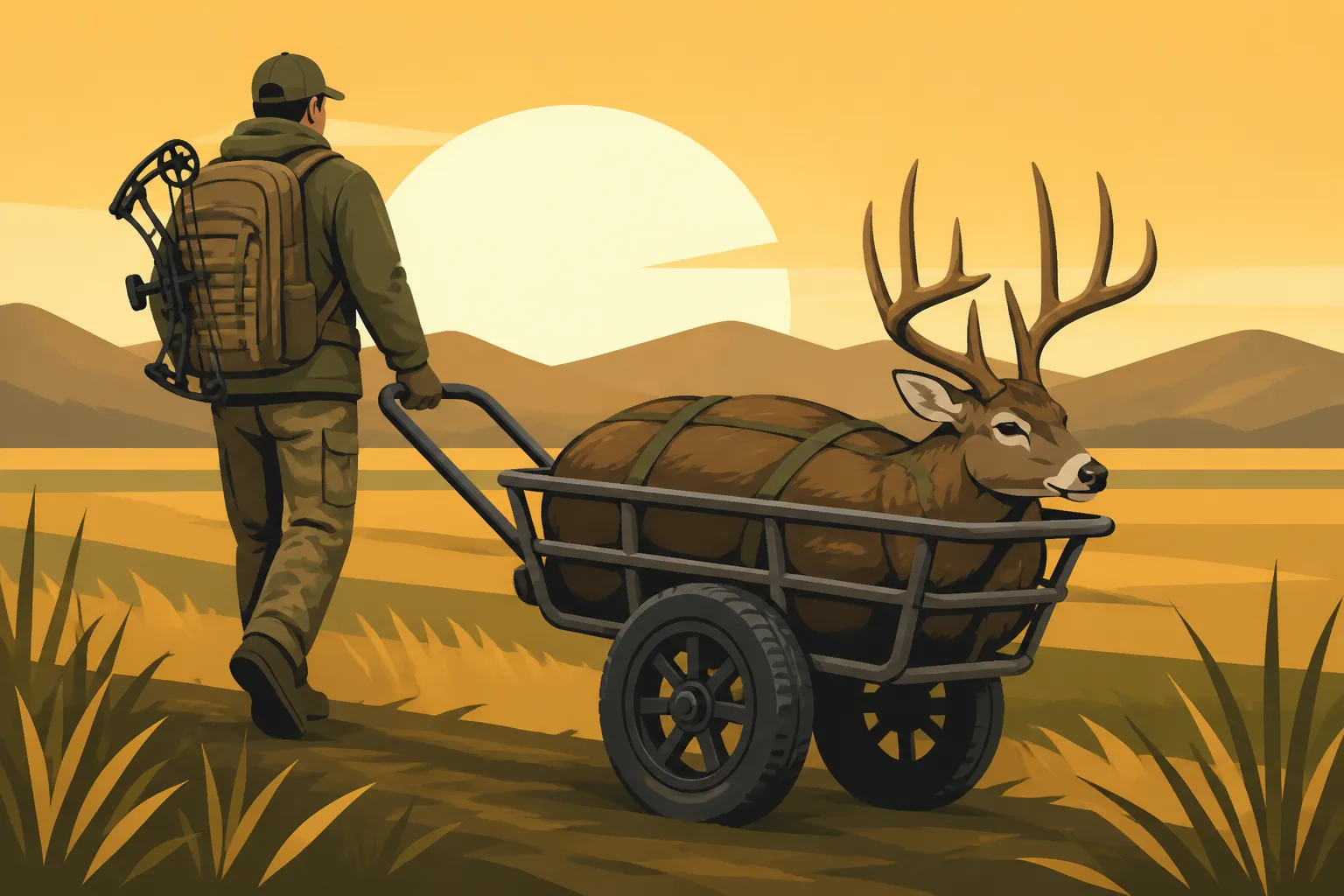
- Head-First vs. Feet-First: Generally, loading the deer head-first, with the antlers (if present) facing forward over the handles, is often the most stable. This puts the bulk of the deer's body weight over the cart's axle(s), where it's most efficiently carried. If the antlers are particularly wide or cumbersome, you might opt for feet-first, but still aim to center the weight over the axles.
- Secure It Tight: Once on the cart, use all available straps, bungees, or ropes to cinch the deer down tightly. You want it to be an extension of the cart, not a wobbly passenger. Cross-strap it where possible to prevent lateral movement. A loose load will constantly shift, requiring more energy to control and potentially damaging the cart or the animal.
Navigating Challenging Central Valley Obstacles
Even with the best cart, the Central Valley will throw some challenges at you. Here's how to tackle them with grace (and minimal grunting).
- Irrigation Ditches and Berms: These are common features. For ditches, approach perpendicular to minimize the chance of getting a wheel stuck lengthwise. If it's a small ditch, you might be able to simply roll the cart through. For wider, deeper ditches, you might need to lift one end of the cart over, then the other. Use the handles for leverage, and if hunting with a partner, communicate clearly. For berms, approach slowly and use your body weight to leverage the cart up and over. If the berm is steep and high, you might need to partially unload the deer, lift the cart, then pull the deer over, and reload. It's often better to go around if a less strenuous option exists.
- Muddy Patches and Soft Ground: This is where those large, pneumatic tires truly earn their keep. Maintain slow, steady momentum. Don't stop in the middle of a muddy section if you can avoid it. If the mud is particularly deep, you might need to push and pull from both ends (if you have a partner) or apply consistent force while shifting your body weight to keep the cart moving. Sometimes, it's better to find a slightly longer but firmer route, using your GoHunt maps to identify higher ground or field edges that might be more compact.
- Thick Stubble and Tall Grass: Similar to mud, dense stubble or matted grass can create significant drag. Again, steady forward momentum is key. A two-wheel cart with large wheels generally handles this better than a single-wheel, as it won't tend to "plow" as much. If the stubble is very high and stiff (like old corn stalks), consider walking slightly to the side of the cart to create a clearer path for the wheels, or even breaking some of the taller stalks ahead of the cart.
Remember, patience and persistence are your greatest allies. A well-chosen deer cart, combined with smart planning and execution, will transform your Central Valley deer retrieval experience from a grueling chore into a manageable task, allowing you to fully enjoy the fruits of your labor.
Deer Cart Comparison for Central Valley Hunters
Choosing the right deer cart involves weighing various features against the specific demands of the Central Valley landscape. Here's a quick comparison of common cart types and features relevant to this region.
| Feature / Cart Type | Two-Wheel Cart (Standard) | Single-Wheel Cart (Game Barrow) | Enhanced Two-Wheel Cart (with extra features) |
|---|---|---|---|
| Stability | Excellent (self-balancing) | Requires active balancing | Excellent, often with added brakes |
| Maneuverability | Good in open fields, poor in tight brush | Excellent in tight brush, narrow trails | Good in open fields, may be bulkier |
| Wheel Size | Critical: Large pneumatic (16"+) is best | Critical: Large pneumatic (16"+) is best | Critical: Large pneumatic (18"+) is common |
| Frame Material | Steel (durable) or Aluminum (lighter) | Steel or Aluminum | Often heavy-duty steel or reinforced aluminum |
| Weight Capacity | Good to Very Good (>250 lbs) | Moderate to Good (150-250 lbs) | Very Good to Excellent (>300 lbs) |
| Ideal Terrain | Open fields, farm roads, clear paths | Dense cover, fencerows, small obstacles | Open fields, varied farm terrain, slight grades |
| Central Valley Suitability | High, especially for large, open areas | Moderate, for specific brushy/narrow access | High, for maximum efficiency and control |
| Common Frustrations Without | Back strain, slow progress in soft ground | Instability with heavy loads, constant balancing | Less common, but can be bulky/heavy to transport empty |
| Typical Cost | Mid-range | Lower to Mid-range | Upper Mid-range to High-end |
This table should give you a quick reference when you're considering your options. For most Central Valley hunters, a well-built two-wheel cart with large, pneumatic tires will be the most versatile and effective choice.
Disclaimer
This article is for general informational purposes only and does not constitute professional advice. Laws, prices and regulations vary by location and change over time. Consult a qualified professional for guidance on your specific situation.