Layout Blind Hunting a Cut Corn Field
You finally got permission on a cut corn field where geese have been piling in every morning, but the field is flat as a tabletop and there is nowhere to hide. The birds circle once, see something wrong, and slide off to the next field. This guide explains how to hunt a cut corn field from a layout blind in California, from scouting the feed to the last bird of the morning.
Why Cut Corn Fields Draw California Waterfowl
Cut corn is one of the most attractive feeds in the Central Valley for geese and ducks, and understanding why helps you hunt it well.
What Makes Corn Stubble So Attractive
After harvest, a corn field is littered with waste grain: kernels knocked loose by the combine, broken ears, and spilled corn along the rows. That is high-energy food, exactly what migrating and wintering birds need to build and maintain fat reserves through cold, foggy Central Valley winters. Corn is especially attractive to white-fronted geese, Canada and cackling geese, and snow and Ross’s geese, and mallards and pintails will also feed heavily in corn when it is close to water and roosts.
In California, much of the corn ground that matters to waterfowl hunters is in the Sacramento Valley, the Delta islands, and parts of the northern San Joaquin Valley. Fields near refuges and big roost ponds tend to see the heaviest use. If you want the bigger picture of how birds use this landscape, our article Duck Migration Timing Through California explains when different species tend to arrive.
Dry Field Versus Flooded Field Hunting
Many California hunters think of flooded rice when they think of field hunting, and many corn fields in the Delta are flooded after harvest for waterfowl habitat or weed control. A dry cut corn field is a different hunt. Birds approach it differently, you set up differently, and your concealment challenges are different.
In a flooded field, you might use a layout blind on a raised spot, a sunken pit, or a boat blind. In a dry field, the layout blind is the go-to tool because it lets you lie low in the stubble and blend in. For a deeper look at hunting wet ground, see Layout Blind Hunting a Flooded Field.
Reading the Birds’ Daily Pattern
Geese and ducks in the Central Valley typically roost on refuges, wetlands, flooded fields or large ponds at night, then fly out to feed in the morning. Some birds feed again in the afternoon, and some feed through the day in foggy weather. When you find a corn field that birds are using, your goal is to be set up before they arrive and to look like the safest place to land.
Watch the field for a few days before you hunt it if you can. Note when the birds arrive, where they land, how long they stay, and which direction they come from. That information tells you where to put your blinds and your decoys. A classic example is a field near a refuge where white-fronted geese arrive at first light, followed by a second wave of snow geese mid-morning. Setting up for the first wave and staying hidden for the second is the plan.
Scouting and Setting Up in a Cut Corn Field
The best layout blind hunt starts long before the alarm clock goes off. Getting the setup right is more important than any single piece of gear.
Finding the X
The “X” is the exact spot in a field where the birds want to land. It might be a slightly higher patch of ground, a spot with more spilled grain, or a place where they landed yesterday. When you scout a field, mark the exact spot where the birds landed and fed. If possible, set up right on that spot.
Scouting is not just about finding a field with birds. It is about finding the field that birds will return to tomorrow. If you see geese feeding hard in a field at midday, there is a good chance they will be back the next morning. If you see them use a field briefly and leave, they may have been just passing through.
Mapping tools and apps help a lot here, especially when you are trying to keep track of multiple fields across a large area. GoHunt’s maps, for example, let you mark fields, roads and land ownership so you know who to ask for permission and how to get to the spot in the dark. Keep careful notes, because birds often follow patterns that repeat over several days.
Setting Up Your Layout Blinds
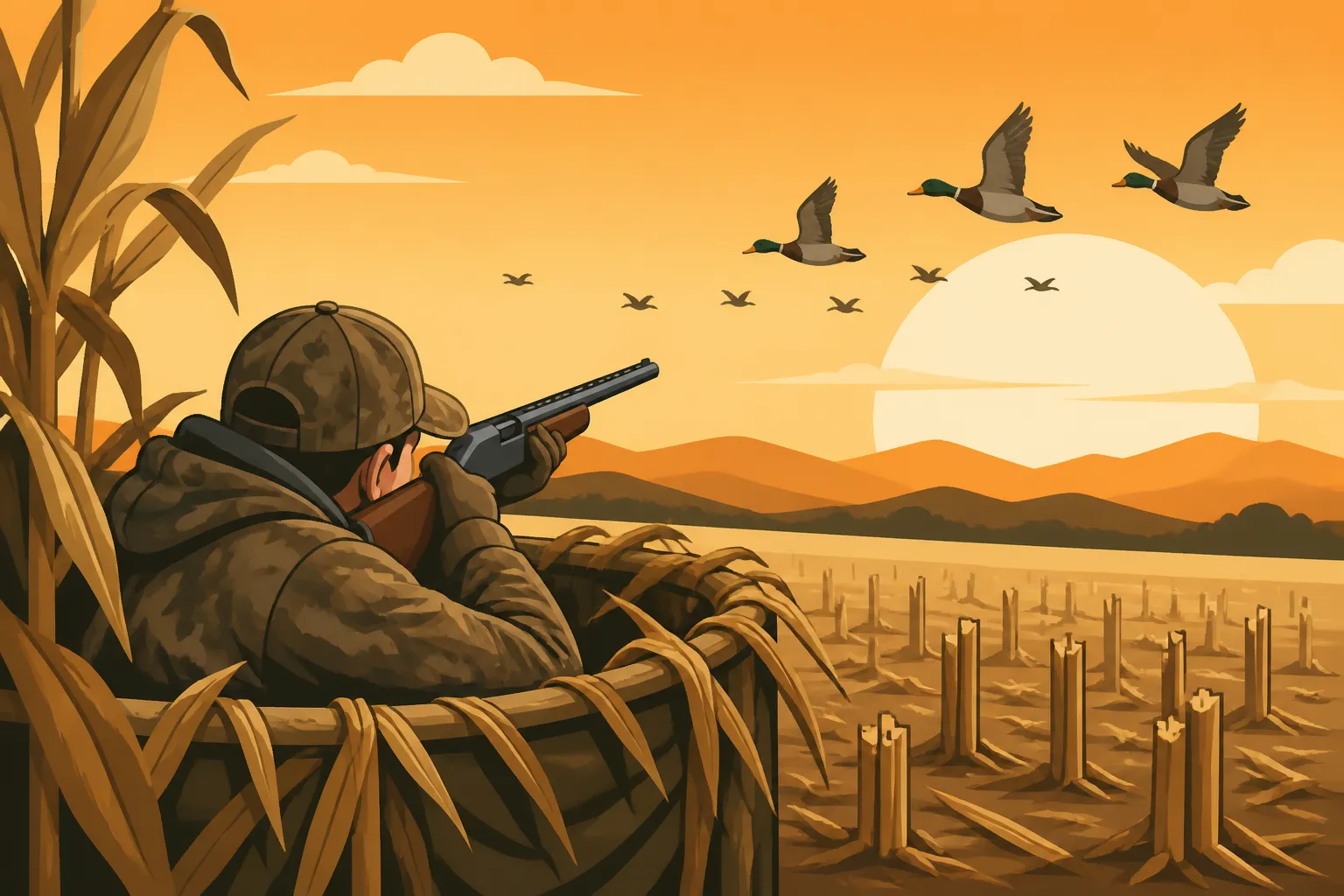
Layout blinds are low-profile blinds that let you lie on your back in the field and sit up to shoot. They work best when they blend into the stubble around them.
- Arrive well before shooting time, ideally an hour or more, to set up in the dark.
- Place blinds in a line or a loose cluster, depending on the number of hunters.
- Face the blinds so the birds will approach into the wind and toward the hunters.
- Brush in each blind with corn stalks and stubble from the field.
- Check from a distance, ideally from where birds will approach, and fix anything that stands out.
Brushing in is where many hunters cut corners, and it is where the hunt is often won or lost. A blind sitting in a field of shredded stalks looks very different from a blind covered in standing stalks. Use what is actually in the field, and pay attention to the shadow your blind casts as the sun rises. Our guide Brushing In a Blind on a Field Edge covers concealment techniques that apply here as well.
Decoy Spreads for Corn Fields
Decoys tell the birds that it is safe to land. In a corn field, you might use goose decoys, duck decoys, or a mix, depending on what is using the field.
For geese, full-body decoys are often the most realistic, though shells and silhouettes work well too, especially in large numbers. Place decoys in family groups with feeding and resting postures, and leave a landing zone in front of the blinds where birds can come in. For snow geese, many hunters use large spreads with hundreds of decoys, including windsocks and rags.
For ducks, mallard decoys and spinning-wing decoys can be effective, but check the current California rules on motion decoys and their use during certain parts of the season before you set them out. Our article Goose Decoy Spreads for Refuge-Adjacent Fields goes into more detail on spread design.
| Target Species | Decoy Type | Typical Spread | Landing Zone |
|---|---|---|---|
| White-fronted geese | Full-body specklebellies | Family groups, moderate numbers | Open pocket in front of blinds |
| Canada and cackling geese | Full-bodies and shells | Small family groups | Downwind of decoys |
| Snow and Ross’s geese | Shells, windsocks, rags | Large spreads | Gap near the blinds |
| Mallards and pintails | Full-body and motion decoys | Smaller groups near the edge | Open area close to the blinds |
Calling, Shooting and Hunt-Day Tactics
Once the blinds are set and the decoys are out, the hunt comes down to timing, calling and shooting discipline.
Calling Birds Into the Spread
Calling geese and ducks into a corn field is about reading the birds and responding to what they are doing. If birds are coming straight in, call softly or not at all. If they are passing by, call more aggressively to get their attention, then ease off as they turn toward you.
White-fronted geese respond well to their distinctive yodeling call. Canada geese respond to honks and clucks. Snow geese respond to a chorus of high-pitched calls, which is why snow goose hunters often call as a group, each person adding to the noise. Electronic calls are generally not allowed for waterfowl, so plan on doing all your calling by mouth and check the current regulations if you have any doubt.
Flagging can also help. A black flag waved low over the stubble can mimic geese landing or stretching their wings, and it can catch the attention of distant birds.
Shooting From a Layout Blind
Shooting from a layout blind takes practice. You start lying on your back, then sit up and swing the gun in one motion. That can feel awkward at first, and many hunters miss birds because they rush the shot or shoot from an uncomfortable position.
Practice sitting up and mounting your gun before the season. Know where your shooting lanes are and agree with your partners on who shoots which birds. Wait for the caller or the designated hunter to call the shot, so everyone shoots together when the birds are in range.
California and federal rules require nontoxic shot for waterfowl, and California’s statewide non-lead rule applies as well. Steel shot patterns differently from lead, so pattern your shotgun with the load you will hunt with. Our guide Patterning a Shotgun With Steel Shot explains how to find the right choke and load combination.
Safety and Identification in the Field
Hunting from layout blinds puts hunters close together, which makes safety essential. Never swing your gun across another hunter’s blind. Agree on shooting zones before the hunt, and keep your safety on until you sit up to shoot.
Bird identification matters too. Sandhill cranes use many of the same Delta and Sacramento Valley corn fields as geese, and they are not legal game in California. They are big, gray and long-legged, and they can show up mixed in with geese. Know the difference, and do not shoot if you are unsure. Swans also show up in some areas and are not legal either.
Working With Fog, Wind and Bluebird Days
Weather changes everything in a corn field. Central Valley tule fog can sit on the fields for days in winter. On those mornings, birds may fly low and late, appear suddenly out of the gray, and land with little circling. Keep calling to a minimum, stay hidden, and be ready for close, fast shots. Fog also makes bird identification harder, which is one more reason to hold off on any bird you cannot clearly see.
Wind is usually your friend. Birds land into the wind, so a steady breeze lets you predict their approach and set the landing zone right in front of the blinds. If the wind shifts during the morning, do not be afraid to move a few decoys or even reposition a blind between flights. Ten minutes of work can turn a morning of birds sliding past at the edge of range into a morning of birds finishing in the pocket.
Calm, clear bluebird days are the hardest. Birds can see everything, and they often circle high and long before committing. On those days, your concealment has to be perfect. Keep faces down, keep hands still, and resist the urge to peek. A smaller, more natural spread sometimes works better than a big one because it does not draw as much scrutiny.
Here is how a typical good morning might unfold. Three hunters set up in the dark near a muddy low spot where they watched specklebellies feed two days earlier. The first flock of whitefronts arrives at shooting time, works the spread twice to soft yodeling, and drops into the pocket. After the first volley, the hunters stay down while a dog retrieves. Mid-morning, a big flock of snow geese passes high and ignores the spread, but a pair of cackling geese and a handful of mallards decoy well before the hunters pack up around ten, leaving the field quiet for the farmer and the birds.
Rules, Permissions and Practical Details
A great setup means nothing if you are hunting illegally. California waterfowl hunting comes with layers of rules that apply to every corn field hunt.
Licenses, Stamps and Certifications
To hunt waterfowl in California, you need a valid California hunting license, a state duck validation, a federal duck stamp, and HIP certification. See California Federal Duck Stamp Requirement and California HIP Certification for Bird Hunters for the details.
Your shotgun must be plugged to hold no more than three shells. Shooting hours for waterfowl typically start a half hour before sunrise and end at sunset, but check the current regulations for your zone. Bag limits vary by species and change year to year, so check the current regulations before every season.
Getting Permission and Respecting the Farm
Most cut corn fields in California are private land, and access usually comes through permission, a lease, or a club. Ask the landowner or farm manager well before the season, and be specific about when and how you will hunt.
Once you have permission, treat the field with respect. Do not drive on wet fields, do not leave trash, and do not damage equipment or irrigation. Leave gates as you found them. Many farmers allow hunting because they appreciate respectful hunters, and a single bad experience can close a field to everyone.
Gear Checklist for a Corn Field Layout Hunt
Beyond the basics, a few pieces of gear make a layout blind hunt much more comfortable and effective. A good layout blind is first on the list. Our gear guide Best Layout Blind for a Refuge-Adjacent Field discusses the features that matter most in Central Valley fields.
You will also want warm, waterproof clothing, especially for foggy winter mornings in the Valley. A sled or cart helps haul decoys and blinds across the field. A headlamp, decoy bags, a field-appropriate camouflage pattern, and a dog if you have one round out the setup.
Retrievers are a huge asset in corn fields, especially for crippled birds that run into the stubble. Train your dog to stay down in a dog blind or next to your layout blind until the shooting is over.
Research tools such as GoHunt can help you keep track of fields, permissions and bird movements over the season. Whatever system you use, keep notes on what works and what does not, because next season’s success often starts with this season’s notes.
Disclaimer
This article is for general informational purposes only and does not constitute professional advice. Laws, prices and regulations vary by location and change over time. Consult a qualified professional for guidance on your specific situation.