Blacktail Versus Mule Deer Range
It's incredibly frustrating, isn't it, when you're staring at a deer in California and just can't quite tell if it's a blacktail or a mule deer? This isn't just a matter of curiosity; understanding the subtle (and sometimes not-so-subtle) differences in their ranges and characteristics is absolutely vital for planning your hunt, identifying legal animals, and appreciating the diverse landscapes our state offers. This comprehensive guide will break down the distinct territories of California's blacktail and mule deer, clarify those tricky hybrid zones, and give you the knowledge you need to confidently identify the deer you're pursuing.
The Core Distinction: True Blacktails and Mule Deer in California
California is a hunter's paradise, boasting two distinct subspecies of deer that offer unique challenges and rewards: the Columbia Blacktail and the Rocky Mountain Mule Deer. While they share a common ancestry, centuries of adapting to vastly different environments have shaped them into the creatures we know today. Getting a handle on these fundamental differences is the first step to becoming a more informed and successful hunter in the Golden State.
Understanding Subspecies and Hybridization
Let's start with the basics. When we talk about "blacktail" and "mule deer" in California, we're really discussing subspecies of the same species, Odocoileus hemionus. The Columbia Blacktail (Odocoileus hemionus columbianus) is found predominantly in the western, coastal regions, while the Rocky Mountain Mule Deer (Odocoileus hemionus hemionus) inhabits the higher elevations of the Sierra Nevada and the eastern desert ranges. This distinction is crucial because these aren't just arbitrary lines on a map drawn by wildlife biologists; they represent millennia of genetic divergence shaped by habitat, climate, and food sources.
The real head-scratcher for many hunters, though, comes in the form of "hybridization zones." These are areas, often in the transitional Sierra Nevada foothills or parts of the Cascades, where the ranges of blacktails and mule deer overlap, and they actually interbreed. This genetic mixing can produce deer that display a confusing blend of characteristics from both subspecies. You might see a deer with mule deer-like antlers but a blacktail-shaped tail, or vice versa. It's enough to make even seasoned hunters scratch their heads and wonder what exactly they're looking at. This phenomenon makes identifying a deer purely by its looks a bit of a guessing game in certain areas, emphasizing why understanding the typical range of each subspecies is so important. For more on the specific populations, check out our guide on Columbia Blacktail and Mule Deer in California.
Geographic Home Ranges: A Broad Overview
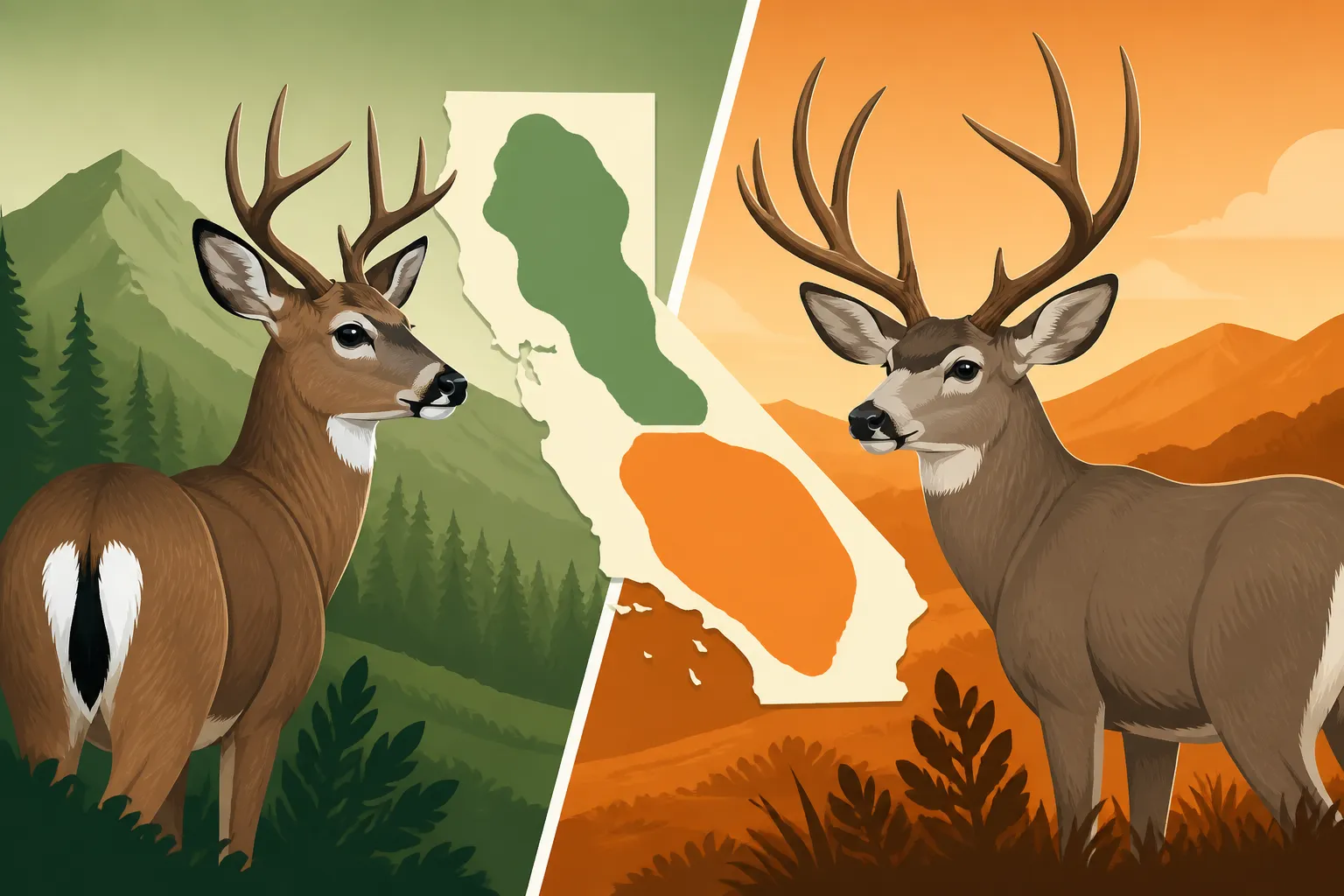
To simplify, imagine California divided by a general, albeit wiggly, line. To the west of that line, especially in the coastal mountains and foothills, you're primarily in blacktail country. Think dense forests, chaparral, and oak woodlands. To the east of that line, stretching up into the high Sierras and across the vast desert lands, you're primarily in mule deer territory. Here, the landscape opens up, dominated by pine forests, sagebrush flats, and rugged peaks.
It's important to understand that these aren't impenetrable barriers, and deer are not always reading the same maps we are. There's plenty of overlap, particularly in the aforementioned hybrid zones. However, this broad geographic understanding gives us a strong foundation. Blacktails are masters of thick cover, preferring areas with high rainfall and dense vegetation. Mule deer, on the other hand, are built for vast, open spaces, often found at higher elevations or in arid environments that demand different survival strategies. Knowing these general zones, especially when combined with tools like GoHunt's detailed maps, can quickly narrow down the possibilities for what type of deer you'll encounter on your next hunt.
Delving Into Blacktail Territory: Coastal Forests and Foothills
When you think of the quintessential California hunting experience – thick brush, misty mornings, and a wary buck slipping through the timber – you're likely picturing blacktail country. These deer are the embodiment of their environment, perfectly adapted to the verdant, rugged landscapes of the Golden State's western half.
The Realm of the Columbia Blacktail
The Columbia Blacktail deer finds its ideal home in the dense coastal chaparral, sprawling oak woodlands, and majestic redwood forests that stretch from the Oregon border down to parts of the Central Coast. If you're hunting in counties like Humboldt, Mendocino, Sonoma, or even westward in areas like the Los Padres National Forest, you are squarely in blacktail territory. These deer thrive where cover is abundant, often preferring to stick to the shadows and dense undergrowth. Unlike their mule deer cousins, who might browse openly in a meadow, blacktails are masters of concealment. They are often found in areas that receive more rainfall and tend to have milder winters, which allows for consistent forage growth year-round.
Hunting blacktails often means still-hunting through nearly impenetrable brush or setting up along game trails that wind through dense timber. They are notorious for being ghost-like, appearing and disappearing with uncanny ease, making them a truly challenging animal to pursue. Many hunters have spent entire seasons in blacktail country, only catching fleeting glimpses of these elusive deer. Our guide on Hunting Coastal Range Oak Woodlands delves deeper into tactics for these specific environments.
Habitat Characteristics and Food Sources
The blacktail's habitat dictates not only where they live but also what they eat and how they behave. Their diet consists primarily of browse – the leaves, twigs, and shoots of woody plants – along with forbs (broad-leafed herbaceous plants) and, when available, acorns. California's oak woodlands provide an invaluable food source, particularly in the fall, making areas with a good acorn crop prime hunting grounds. The dense cover provided by manzanita, ceanothus, and various oaks offers both food and protection from predators and harsh weather.
The milder, wetter coastal climate means that snow, while present in higher elevations, doesn't typically force blacktails into drastic migratory patterns like it does for mule deer. They tend to have smaller home ranges and rely on the year-round availability of green browse. Their smaller body size, compared to mule deer, is also an adaptation to this dense environment, allowing them to navigate thick brush more easily. Their antlers, while impressive, often grow with a bifurcated (forking) pattern rather than the typical branching of mule deer, though this can be one of those confusing characteristics in hybrid zones. Understanding these specific habitat needs can help you pinpoint where to focus your scouting efforts, whether you're looking for Hunting a Funnel Between Two Oak Ridges or tracking signs along a creek bottom.
Exploring Mule Deer Domain: High Sierra and Eastern Deserts
Switching gears entirely, we move from the dense, damp coastal zones to the vast, rugged expanses where the Rocky Mountain Mule Deer reigns supreme. This is a landscape of grandeur, sharp contrasts, and, for hunters, often a test of patience and long-range glassing skills.
The Majestic Rocky Mountain Mule Deer
The Rocky Mountain Mule Deer in California primarily occupies the higher elevations of the Sierra Nevada, the extensive Modoc Plateau in the northeast, and the arid eastern desert ranges. Think of iconic areas like Mono County, Inyo County, Lassen, and eastern Plumas and Sierra counties. These are deer that thrive in more open environments, often at elevations where winter snow can be significant, necessitating seasonal migrations. You'll find them in ponderosa pine forests, vast sagebrush flats, and rugged, rocky canyons.
Hunting mule deer in these parts often involves covering significant ground, climbing steep ridges, and spending hours behind good optics, glassing expansive basins for a bedded buck. Their preference for open country means they're often spotted from a distance, requiring precise shot placement or a well-executed stalk over exposed terrain. Unlike the blacktail's elusive nature, a mule deer might hold tight, relying on its camouflage and the vastness of its surroundings to avoid detection, but it's often visible if you know where and how to look. If you're aiming for a high-country buck, our guide on Hunting California's High-Country X-Zones is a must-read.
Adaptations to Arid and Mountainous Environments
Mule deer are built for the challenging conditions of their domain. Their large ears, which give them their name, are excellent for detecting predators in open country. Their impressive bounds, often described as a "four-legged pogo stick" or stiff-legged "stotting," allow them to cover broken, rocky terrain with surprising speed. This adaptation helps them escape danger across uneven ground where a flat-out sprint might be less efficient.
One of the most defining characteristics of mule deer in these regions is their migratory behavior. As winter snows deepen in the high country, mule deer will migrate down to lower, more hospitable winter ranges, sometimes traveling many miles. Conversely, in the spring, they follow the receding snowline back up to lush summer pastures. Their diet consists of various forbs, grasses, and browse species adapted to drier conditions, such as sagebrush, bitterbrush, and mountain mahogany. Their larger body size is an advantage in colder climates, helping them retain heat and store more fat for harsh winters. When it comes to antlers, mule deer typically exhibit a "forked" antler growth where each main beam forks into two points, then each of those points forks again, creating a more branching appearance. This, along with their larger body size, is often what leads to the question of Why Sierra Deer Grow Bigger Than Coastal Deer.
The Blurring Lines: Hybrid Zones and Overlap
Here's where it gets truly fascinating and, let's be honest, a little confusing for many California hunters. While we've discussed the distinct territories of blacktails and mule deer, California is also home to significant zones where these two subspecies meet and interbreed.
Where Blacktails and Mule Deer Meet
The most prominent hybridization zones in California are found in the transition areas where the coastal ranges meet the Sierra Nevada foothills, and also in parts of the Modoc Plateau and the Cascades where ranges overlap. Essentially, these are ecological crossroads. For example, in counties like Tehama, Butte, or even parts of Mariposa or Madera, you're in an area where blacktail genetics from the west slowly blend with mule deer genetics from the east. It's not a sudden, sharp dividing line, but rather a gradient where the genetic influence of one subspecies gradually gives way to the other.
This genetic mixing means that a deer born in one of these zones might have a blacktail parent and a mule deer parent, or even multiple generations of mixed ancestry. The result is a deer that can exhibit a perplexing mosaic of traits. You might see a deer with the characteristically large ears of a mule deer, but the smaller body size of a blacktail, or the forked antlers of a mule deer combined with the entirely black-tipped tail of a blacktail. This is precisely why just looking at a deer isn't always enough to definitively classify it, making the concept of Where Deer Hybridize in the Sierra Foothills so critical for understanding California's deer populations.
Identifying Hybrid Deer in the Field
Distinguishing a pure blacktail from a pure mule deer is one thing, but figuring out where a hybrid falls on the spectrum can be incredibly tricky. However, there are a few key characteristics to pay attention to that can give you clues:
- Tail: This is often the most reliable indicator. True blacktails have a broad tail that is almost entirely black or dark brown on top, with white fringes. True mule deer have a narrower, rope-like tail that is mostly white with a distinctive black tip. Hybrids can have tails that are a mix – perhaps white with a black tip, but the black tip is much larger than a typical mule deer, or a partially black tail that isn't quite the full black of a blacktail.
- Antlers: Mule deer antlers typically fork, and then fork again, leading to a "forked-horn" or "branching" appearance with multiple tines off each main beam. Blacktail antlers, especially mature bucks, often have a more distinct "bifurcated" pattern, where the main beam forks into two, and then each of those forks again, maintaining a more symmetrical "double fork" look. Hybrids can show any combination of these patterns, sometimes with a main beam that forks and then has additional points, or one side that looks more "blacktail" and the other more "mule deer."
- Ear Size: As their name suggests, mule deer have notably larger ears than blacktails. Hybrids may have ears that are intermediate in size.
- Body Size: While less reliable due to age and nutrition, blacktails tend to be smaller-bodied than mule deer on average. A hybrid might be a bit larger than a typical blacktail but not quite as large as a full-grown Sierra muley.
- Gait: Mule deer are famous for their "stotting" or "bounding" gait, where all four feet push off and land together when they're startled or running. Blacktails tend to run with a more traditional bounding motion, alternating hind and front legs. A hybrid might show either, or a mixed gait depending on the terrain and how startled it is.
Ultimately, identifying a hybrid in the field can be a judgment call, and even experienced hunters often discuss the "muley traits" versus "blacktail traits" of a particular animal. The good news is that for most general deer tags in California's zone system, these distinctions are mainly for your personal identification and satisfaction, as the tag is simply for "deer." However, understanding these nuances enhances your overall hunting experience and appreciation for the animals.
Practical Implications for California Hunters
Understanding the range distinctions and the existence of hybrid zones isn't just academic; it has very real, practical implications for how you plan, prepare, and execute your California deer hunts. Ignoring these differences is akin to bringing a duck call to a turkey hunt – you might get lucky, but you're probably going to be less effective.
Tailoring Your Hunting Strategy
The difference in range directly translates to vastly different hunting strategies. If you're deep in prime blacktail country, like the dense chaparral of Zone A or C, your tactics will likely involve a lot of still-hunting. This means moving slowly, often just a few steps at a time, pausing for long periods to glass the shadows and listen for subtle sounds. Blacktails thrive in thick cover, so you'll be looking for subtle movements, a flick of an ear, or a patch of hide through the brush. Calling can sometimes be effective, using soft grunts or rattling to draw out a curious buck from the dense undergrowth. You'll likely need to spend time Still-Hunting California's Sierra Nevada Timber or similar dense habitats.
Conversely, if you're pursuing mule deer in the high Sierra X-zones or the vast eastern desert ranges, your primary tool will be your optics. Hours spent behind binoculars and spotting scopes, systematically picking apart distant hillsides and canyon bottoms, is the name of the game. This approach, known as Glassing Mule Deer in Open California Country, allows you to cover immense amounts of terrain visually, spotting bedded deer that would be impossible to see otherwise. Stalks can be long, arduous, and exposed, demanding careful planning to stay out of sight and downwind. Your gear choices will also reflect this: lightweight, durable boots for steep climbs in mule deer country versus potentially heavier, waterproof options for the damp, brushy blacktail woods.
Using Maps and Resources to Pinpoint Deer
In today's age, there's no excuse for not using all the resources at your disposal to understand deer range and habitat. Detailed mapping applications like GoHunt's mapping features are invaluable. You can overlay public land boundaries, check topography, and even identify potential migratory corridors or areas with specific vegetation types that favor one deer species over another. For instance, if you're looking at a map and see extensive areas of coastal oak woodlands and dense chaparral, you can be fairly certain you're looking at blacktail habitat. If it's high-elevation pine forests, vast sage flats, and rugged peaks, you're likely in mule deer territory.
The California Department of Fish and Wildlife (CDFW) game zone regulations also inherently reflect these range distinctions. Our guide on California's Multi-Zone Deer Season System explains how these zones are drawn. Zone A, for example, is predominantly blacktail, while many X-zones are known for their mule deer or hybrid populations. Paying attention to these zone characteristics, cross-referencing them with aerial photos and topographical maps (as covered in Reading Aerial Photos for Sierra Deer), and combining that with local knowledge and scouting, will exponentially increase your chances of finding the deer you're targeting.
Conservation and Management Considerations
Beyond the thrilling pursuit, understanding deer ranges also connects us to the broader picture of wildlife conservation and management in California. These animals are a vital part of our ecosystems, and their populations are dynamic, influenced by a multitude of factors.
Maintaining Genetic Integrity
Wildlife biologists, including those at CDFW, closely monitor deer populations across the state, and the genetic integrity of distinct subspecies is a significant area of interest. While hybridization is a natural process that has occurred for millennia, rapid, widespread hybridization could potentially dilute the unique adaptations that each subspecies has developed over time. Scientists use genetic analysis to track where deer populations are pure blacktail, pure mule deer, or various stages of hybrid. This data helps inform management decisions, ensuring that conservation efforts are tailored to the specific needs of the deer in different regions. For instance, monitoring the overall California Deer Population Estimate helps agencies understand trends and allocate resources.
Climate Change and Range Shifts
The concept of deer range isn't static; it's constantly evolving. Climate change, with its potential for altered rainfall patterns, increased wildfires, and shifting temperature zones, could significantly impact where blacktails and mule deer thrive. A severe drought, for example, might push blacktails into areas they typically wouldn't inhabit in search of water and forage, potentially increasing interaction with mule deer populations. Similarly, extended periods of heavy snow could force mule deer to linger longer in lower elevation winter ranges, creating different pressures on the land. Wildfires, like those that create Hunting a National Forest Burn Scar, can dramatically alter habitat overnight, creating new foraging opportunities in the short term but potentially long-term shifts in cover and food availability that influence deer movement and distribution.
Understanding these ongoing changes is crucial for the future of California deer hunting. By staying informed and supporting science-based wildlife management, hunters play a vital role in ensuring that both the elusive blacktail and the majestic mule deer continue to roam our diverse landscapes for generations to come. After all, the health and vibrancy of our California Deer Herd Size directly impacts our hunting opportunities.
Table: Key Differences Between Blacktail and Mule Deer in California
To help clarify the distinctions, here's a quick comparison of the typical traits you'll find when observing these two amazing deer species in California. Remember, hybrids can show a mix of these!
| Characteristic | Columbia Blacktail | Rocky Mountain Mule Deer |
|---|---|---|
| Primary Range | Coastal mountains, western foothills, dense forests | Sierra Nevada, Modoc Plateau, eastern desert ranges |
| Typical Habitat | Thick brush, chaparral, oak woodlands, redwood forests | Open pine forests, sagebrush flats, high country |
| Body Size | Smaller, more compact | Larger, more robust |
| Antler Pattern | Often bifurcated (double fork off each main beam) | Typically forked (main beam forks, then points off that) |
| Tail | Broad, mostly dark brown/black on top, white fringe | Narrow, rope-like, mostly white with a black tip |
| Ear Size | Proportionate to head, smaller than mule deer | Very large, prominent ("mule-like") |
| Gait | Traditional running/bounding | Stotting/bounding (all four feet land together) |
| Migration | Less migratory, smaller home ranges | Often highly migratory (seasonal elevation shifts) |
| Hunting Style | Still-hunting, tracking, short-range | Glassing, long-range stalks, extensive hiking |
Disclaimer
The information provided in this guide is for general informational purposes only and does not constitute legal advice. Hunting regulations in California are subject to change. Always consult the most current California Department of Fish and Wildlife (CDFW) regulations and speak with local authorities before engaging in any hunting activities. Hunters are responsible for understanding and adhering to all applicable laws and regulations.