Where Deer Hybridize in the Sierra Foothills
It's incredibly frustrating when you're out in California's gorgeous Sierra foothills, glassing a distant ridge, and you just can't quite tell if that buck is a true blacktail, a mule deer, or something in between. This guide aims to clear up that common confusion, diving deep into the fascinating world of deer hybridization in these transitional landscapes, offering insights into identification, behavior, and how to approach hunting these unique animals.
Understanding California's Deer Species: Blacktail vs. Mule Deer
California is home to two primary subspecies of deer: the coastal or Columbia Blacktail (Odocoileus hemionus columbianus) and the Rocky Mountain Mule Deer (Odocoileus hemionus hemionus), with a sprinkle of the California Mule Deer (Odocoileus hemionus californicus) in southern parts. For hunters in the northern and central parts of the state, the real distinction lies between the blacktail and the mule deer, and recognizing their characteristics is the first step to understanding hybridization. It’s not just about antler size, but a whole host of subtle differences that tell their story.
The Distinctive Blacktail Deer
Blacktail deer are typically smaller and darker in body color than their mule deer cousins. Their coat is a rich, reddish-brown in summer, fading to a more grayish-brown in winter. The key identifiers are often right in their name: a tail that is entirely black or dark brown on top and sometimes down the sides, ending in a black tip. Their ears are smaller, more proportional to their head, and their antlers tend to grow in a forked pattern, often forming distinct "forked horn" bucks or true "3×3" or "4×4" main beams with tines originating from the main beam rather than extensive branching. These deer are creatures of dense cover, often found in the thick chaparral and timber of the Coast Ranges and western slopes of the Sierra. They're masters of stealth, preferring to slip away unnoticed through brush rather than bounding across open ground. Learning about the full scope of their habits can be found in a detailed look at Columbia Blacktail and Mule Deer in California.
Blacktails are well-adapted to the dense undergrowth and often steep, rugged terrain. They don't typically undertake the long, dramatic migrations of many mule deer, though they will shift elevation seasonally. You'll find them relying heavily on browse from shrubs and forbs, and they absolutely love acorns when they're dropping. Their smaller stature and quicker movements are perfect for navigating the dense oak woodlands and mixed conifer forests. For hunters, this means stalking through thick brush, often relying on still-hunting techniques or ambushing them along established game trails.
The Majestic Mule Deer
On the other end of the spectrum is the Rocky Mountain Mule Deer, a larger, often lighter-colored deer. Their most iconic features are their large, mule-like ears (hence the name) and a distinctive tail. Unlike the blacktail's all-dark tail, the mule deer typically has a white or cream-colored tail with a black tip. Some mule deer might have a darker stripe on top of their tail, but the overall impression is distinctly lighter. Their antlers are also different; they typically "fork" or "dichotomously branch," meaning each tined point forks again, creating a more widespread, basket-like appearance rather than points off a single main beam. You often hear hunters talk about mule deer as "forked on each side," referring to this branching.
Mule deer are creatures of more open country – think high mountain meadows, vast sagebrush flats, and the more open pine forests of the eastern Sierra. Their bounding gait, often described as a "stotting" or "pronking" motion, allows them to cover rough terrain quickly and efficiently, clearing obstacles in long, high leaps. They tend to be more visible, relying on their keen eyesight and the ability to cover ground quickly when alarmed. Their range is extensive, and understanding the nuances of Blacktail Versus Mule Deer Range is critical for any hunter trying to pinpoint where these two species might meet and mingle. This is where the Sierra Nevada comes into play, creating a natural transition zone.
The Hybrid Zone: Sierra Foothills as a Melting Pot
The Sierra Nevada foothills represent a fascinating ecological crossroads, a literal melting pot where the ranges of blacktail and mule deer overlap. This geographical overlap is the primary driver of hybridization, creating a "hybrid zone" where genetic mixing occurs. It's not just a theoretical concept; it's a real phenomenon that makes deer identification a thrilling, and sometimes maddening, challenge for hunters.
Defining the Hybrid Zone in California
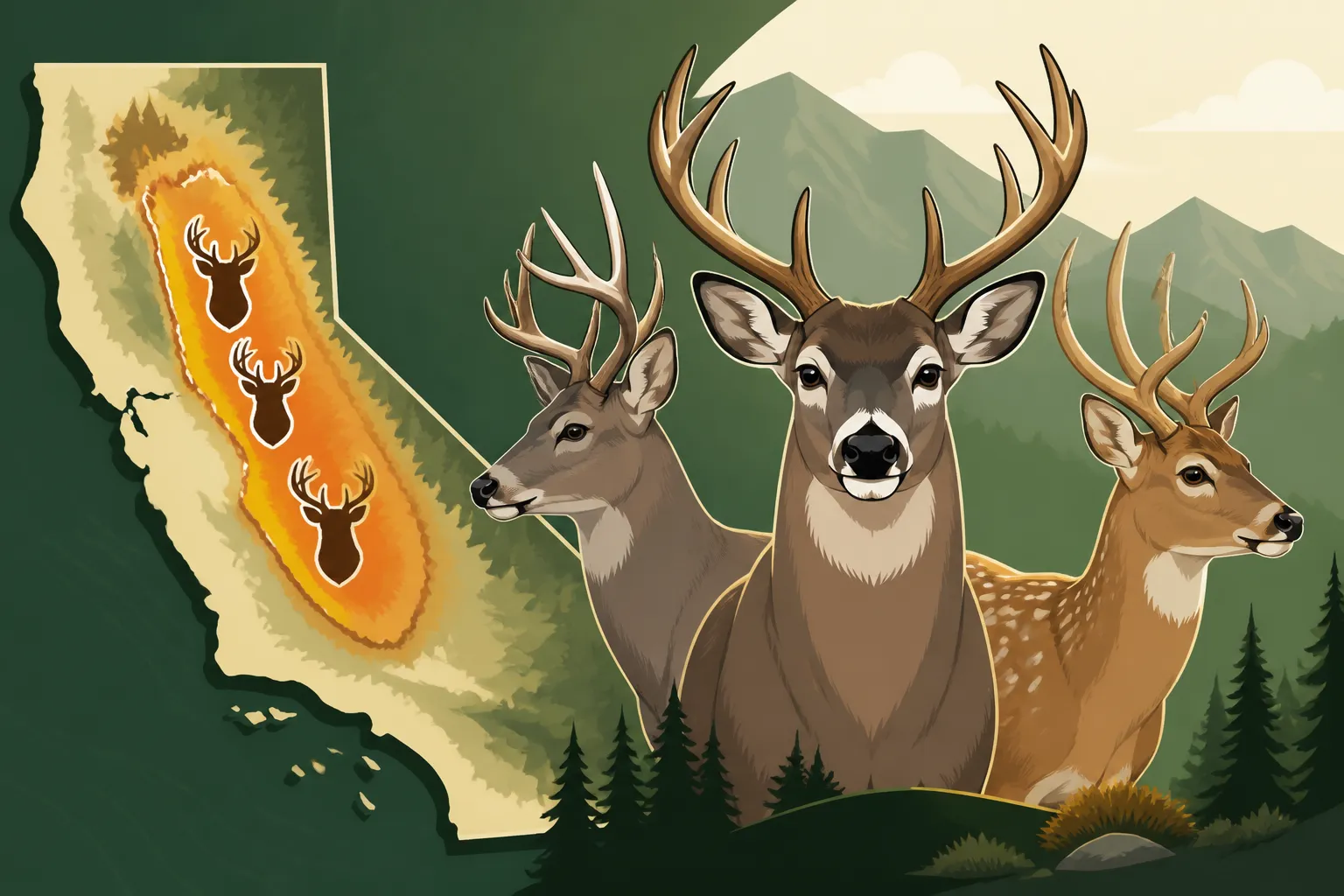
The hybridization zone generally follows the western slopes of the Sierra Nevada mountains, particularly where the dense, brushy habitat favored by blacktails transitions into the more open, high-country terrain preferred by mule deer. Think of areas from Plumas County down through counties like El Dorado, Amador, Calaveras, Tuolumne, and even parts of Mariposa and Madera. These are the places where you'll find characteristics of both species in a single animal. It's not a hard line but a gradient, a fuzzy boundary where the genetics slowly blend over many miles and generations. One side of a canyon might hold animals that look distinctly blacktail, while the other side, just a few miles away, could have deer with noticeable mule deer features. This intermingling adds an exciting layer of complexity to hunting in these beautiful areas.
The Sierra foothills offer a diverse landscape of oak woodlands, mixed conifer, chaparral, and open grasslands. This mosaic habitat provides niches for both species, allowing them to coexist and, inevitably, interact reproductively. As human development and fire regimes alter landscapes, these zones can shift and expand, creating more opportunities for genetic exchange. For example, a severe wildfire might open up dense blacktail habitat, making it more amenable to mule deer, or vice-versa with a dense regrowth.
Why Hybridization Occurs in Transitional Habitats
Hybridization happens when two distinct species, or in this case, subspecies, interbreed. In the Sierra foothills, it's primarily driven by geographical proximity and the breakdown of reproductive barriers. Historically, blacktails might have kept to the denser coastal and western Sierra slopes, while mule deer dominated the eastern, more arid, and higher elevation landscapes. However, as deer populations fluctuate, and habitats change due (in part) to human activity, climate shifts, and natural disturbances like fire, these boundaries become less rigid.
Think about it: a young mule deer buck might wander down from the high country during a tough winter, or a blacktail doe might push higher into new territories searching for forage or less hunting pressure. When they meet members of the other subspecies, and reproductive opportunities arise, hybridization can occur. The offspring then carry a mix of genes, and if they reproduce, the genetic blending continues. It’s a testament to the adaptability of deer and the dynamic nature of ecosystems. These transitional areas offer a buffer where neither pure species fully dominates, creating a perfect laboratory for evolution in action.
Physical Characteristics: How to Spot a Hybrid
Identifying a hybrid deer isn't always straightforward, and it can be a real head-scratcher. You'll often see a mix of features that leaves you guessing. It's like looking at a puzzle where some pieces are from one box and some from another. But by paying close attention to specific details, you can often make an educated guess.
Tail, Ear, and Antler Clues
The tail is often the most telling feature. A pure blacktail will have a broad, all-black or dark brown tail, sometimes with a touch of white on the underside only visible when flagged. A pure mule deer will typically have a narrow, rope-like white tail with a distinct black tip, often with a dark dorsal stripe that doesn't dominate the tail's color. A hybrid, however, might show a tail that is predominantly dark but with more white showing than a typical blacktail, or a mule deer-like tail that is wider and has more black extending further up the tail. Some might have a dark brown tail with a prominent black tip, but with white on the sides that's more extensive than a typical blacktail. It's the "in-between" look that often screams hybrid.
Ears are another big clue. Mule deer have famously large ears, capable of rotating independently to pinpoint sounds. Blacktails have smaller, more rounded ears. A hybrid might have ears that are larger than a blacktail's but not quite as massive as a full-blown mule deer's, or they might simply appear disproportionately large for a blacktail's body size.
Antlers can be a bit trickier because antler growth is influenced by age, nutrition, and genetics. However, mule deer typically exhibit dichotomous branching (forking), while blacktails tend to grow tines off a main beam. A hybrid might show a main beam with a single fork, then another tine that forks off that, or a more irregular branching pattern that doesn't quite fit either pure type. You might see a main beam that tries to fork twice like a mule deer, but then a single G2 or G3 tine comes off of it, creating a blend of styles. It's rare to see a perfectly typical set of antlers in a hybrid, and that irregularity is often the sign. It’s worth noting that distinguishing a Judging a Blacktail's Fork Versus a Forked Horn can be challenging even with pure species.
Body Size and Coloration Variations
Body size and coloration also offer hints, though these can be more subjective and influenced by diet and regional factors. Blacktails are generally smaller and more compact, with a darker, sometimes almost chocolate-brown coat. Mule deer tend to be larger, with a longer body and legs, and a lighter, grayish-tan coat, especially in the high country.
Hybrid deer might display an intermediate body size – larger than an average blacktail but perhaps not as bulky as a prime mule deer. Their coat color could be a mottled blend, perhaps a darker brown overall but with a lighter rump patch or belly than a typical blacktail, or a gray coat with a richer, darker brown tint not usually seen in mule deer. It's the subtle blend, the lack of definitive purity in their appearance, that starts to paint the picture of a hybrid. For instance, a deer that has the slightly larger stature of a mule deer but a coat that's a bit too dark for a typical muley could be a hybrid.
This table provides a quick reference for distinguishing features, though remember, hybrids will often fall somewhere in the middle!
| Feature | Columbia Blacktail Deer | Rocky Mountain Mule Deer | Hybrid Deer (Likely) |
|---|---|---|---|
| Tail | Broad, all black/dark brown top & tip, sometimes white underneath | Narrow, rope-like, white with black tip, often dark dorsal stripe | Mix of features: Darker with more white than blacktail, or wider/more black than mule deer. Irregular. |
| Ears | Smaller, rounded, proportional | Very large, "mule-like," rotate independently | Intermediate size, or somewhat disproportionate to head/body |
| Antlers | Tines off main beam (forked pattern) | Dichotomous branching (forking forks) | Irregular branching, mix of main beam tines and forking |
| Body Size | Smaller, compact | Larger, longer legs/body | Intermediate size, varying by specific genetics and nutrition |
| Color | Dark reddish-brown (summer), grayish-brown (winter) | Lighter gray/tan, sometimes pale yellow (summer) | Mottled blend, intermediate tones, mix of dark and light patches |
| Gait | Sneaky, slips through cover | Stotting/Pronking (bounding) | Mix, may try to sneak but can also bound when pushed |
Behavioral Blending: How Hybrids Act
It's not just physical traits that get mixed when deer hybridize; their behavior can also be a fascinating blend of both subspecies. How a deer moves, feeds, and reacts to pressure is deeply tied to its genetics and habitat. In the hybrid zone, you might witness a deer exhibiting traits from both its blacktail and mule deer ancestry.
Movement Patterns and Habitat Preferences
Blacktail deer are renowned for their secretive nature. They tend to stick to dense cover, moving stealthily through brush and timber. Their movements are often more localized, and they rely on their ability to remain hidden. Mule deer, on the other hand, are more accustomed to open spaces. They might spend more time out in the open, relying on their superior eyesight and the "stotting" gait to escape predators across vast distances. They also tend to have more pronounced migratory patterns, moving between high summer ranges and lower wintering grounds. Learning about California Deer Migration Corridors gives great insight into how mule deer especially traverse the landscape.
Hybrid deer in the Sierra foothills often display a mix of these behaviors. You might encounter a deer with mule deer characteristics that is surprisingly adept at slipping through thick oak brush, or a deer with blacktail features that isn't as wary of open clearings. They might undertake shorter, less defined seasonal movements, perhaps moving only a few miles from the oak woodlands to slightly higher, more open slopes, rather than the extensive migrations of true high-country mule deer. This adaptability allows them to thrive in the transitional foothill habitat where neither pure strategy is always optimal. They learn to blend the best of both worlds, using cover when available but not being completely confined by it.
Reaction to Pressure and Hunter Encounters
How a deer reacts when it senses a hunter is a true test of its instincts. A pure blacktail will often freeze, then quietly slip away through the densest cover, using every bush and tree to obscure its escape. If pushed hard, they might break into a short, fast run, but they typically prefer to disappear rather than make a long, open dash.
Mule deer, especially those accustomed to open, less-pressured landscapes, are more likely to bound away, often pausing to look back at a safe distance. Their large ears and keen eyesight make them excellent at detecting threats from afar.
Hybrid deer can throw you for a loop. You might stalk a hybrid buck moving through a brushy draw, expecting it to bust out like a blacktail, only for it to jump and stot across a small opening like a mule deer. Or, conversely, you might spot a deer with muley ears and tail in an open field, expecting a long, bounding escape, only for it to melt into a small pocket of timber with surprising speed and silence. Their response can be unpredictable, making hunting them even more challenging and rewarding. They often seem to assess the situation and choose the most effective escape route, whether it's disappearing into dense cover or quickly gaining distance across more open ground. When you're Still-Hunting California's Sierra Nevada Timber, paying attention to these subtle shifts in behavior can make all the difference.
Genetic Realities and Management Challenges
The existence of hybrid deer isn't just a curiosity for hunters; it represents a significant topic for wildlife biologists and management agencies like the California Department of Fish and Wildlife (CDFW). Understanding the genetic landscape of California's deer populations is crucial for effective conservation and hunting regulation.
The Science of Deer Genetics
At its core, hybridization is about genes. When blacktail and mule deer interbreed, their offspring inherit a mix of genetic material from both parents. Over generations, if hybrids continue to breed with either pure subspecies or with other hybrids, this genetic mixing can become quite complex. Scientists use various genetic markers to identify the degree of hybridization in individual deer. This involves analyzing DNA samples (often from tissue or hair) to determine the proportion of blacktail versus mule deer ancestry.
What researchers have found is that these hybrid zones are indeed real, and the genetic lines aren't always clear-cut. There can be deer that are 75% blacktail/25% mule deer, 50/50, or any other combination. This genetic blending is a natural evolutionary process, but it can also have implications for the fitness and adaptability of the deer populations. For example, some studies suggest that hybrids might be less fit in certain environments than purebreds, while others indicate they might be more adaptable to changing conditions in the hybrid zone. It’s a dynamic area of study that contributes to our understanding of California Deer Herd Size and overall population health.
Implications for Wildlife Management
For wildlife managers, hybridization presents a unique set of challenges. One of the primary goals of management is to conserve distinct species or subspecies. If widespread hybridization occurs, it can potentially lead to the loss of genetic distinctiveness of the pure subspecies over long periods. This is particularly concerning if one subspecies is rare or endangered. However, both blacktails and mule deer are generally thriving in California, so the concern isn't about immediate extinction, but rather maintaining genetic diversity.
Furthermore, management decisions regarding hunting seasons, bag limits, and habitat projects are often made with specific subspecies in mind. If hunters in a particular zone are encountering a high proportion of hybrids, it complicates data collection for population health and harvest success. How do you classify a hybrid in a harvest report? Is it a blacktail or a mule deer? Generally, CDFW manages by geographical zones, and hunters simply report based on the zone tag they possess, which often means an animal in the foothills is considered whatever the zone specifies. Understanding these complexities is something a detailed resource like GoHunt can help clarify, offering data-driven insights into different zones.
Hunting the Hybrid: Strategies for Success
Hunting in the Sierra foothills, where hybrids roam, demands a blend of techniques and a keen eye. You can't just apply a "mule deer strategy" or a "blacktail strategy" exclusively; you need to adapt to the varied terrain and the unpredictable nature of the deer themselves. It's a true test of a hunter's versatility and observation skills.
Adaptable Scouting and Approach
Effective scouting in hybrid zones means looking for all deer sign, regardless of whether it points to blacktail or mule deer. You need to be familiar with both dense brush patterns and more open-country travel corridors. When using tools like GoHunt to scout, pay attention to terrain features that act as transition zones – where oak woodlands meet mixed conifer, or where a deep canyon opens up into high-elevation meadows. These are often prime hybrid areas. Look for rub lines, scrape lines, and bedding areas that might blend characteristics. For example, a bed in slightly thicker cover than a typical mule deer might choose, but in an area with more open visibility than a blacktail might prefer. You’ll need to put in the legwork to understand Scouting California Public Land Before Season.
Your approach to hunting should also be adaptable. If you're still-hunting through a thick stand of oaks, maintain the stealth and slow pace you would for a blacktail. But if you emerge into a more open slope or a burn scar, be prepared to glass extensively for deer moving or bedded in the open, much like you would for a mule deer. Don't be surprised if a deer you jump from thick brush stops out in the open to get a better look, or if one you spot in the open disappears into surprisingly light cover.
Choosing Your Method and Gear
Given the mixed terrain, a versatile hunting method is often best. Spot-and-stalk is a classic for both species and highly effective in these hybrid zones. You can Glassing Mule Deer in Open California Country from a vantage point, then plan your stalk through mixed cover. Utilize terrain features for concealment, whether it's a rocky outcrop or a thicket of manzanita. Still-hunting, moving slowly and deliberately through areas of good cover, can also be very productive, especially during the early morning or late evening when deer are most active.
Regarding gear, having quality optics is paramount. A good pair of binoculars and a spotting scope will help you pick apart distant slopes and identify deer in varied habitats. Given the non-lead ammunition requirement in California, ensure your rifle is sighted in with appropriate lead-free projectiles. Caliber choice should be versatile enough for medium-sized deer, something in the .270 to .30-06 range is usually excellent. Check out detailed guides on Rifles and Calibers for California Big Game for more specific recommendations. Always carry adequate water, layers of clothing to deal with temperature swings, and a robust pack to haul out your game, as these areas can be rugged. Utilizing GoHunt's mapping features to mark water sources and potential game trails can be invaluable.
The Thrill of the Unpredictable
Ultimately, hunting in the Sierra foothills' hybrid zone is about embracing the unpredictable. You might go out specifically looking for a blacktail and come across a beautiful buck with obvious mule deer influence. The excitement lies in the challenge of identifying and adapting to these unique animals. Every buck taken from these transitional zones tells a story of genetic mingling and ecological adaptation. It’s a rewarding experience that deepens your understanding of California's diverse deer populations. And remember, no matter what, if it's a legal buck in your open zone, it's a trophy worth celebrating. Consider using a platform like GoHunt to explore the specific characteristics and success rates in different zones, helping you narrow down areas where these fascinating hybrids might be more prevalent.
The Future of California's Hybrid Deer
The ongoing phenomenon of deer hybridization in the Sierra foothills highlights the dynamic nature of California's ecosystems and the adaptability of its wildlife. As habitats continue to change, influenced by factors like climate change, wildfire, and human development, these hybrid zones may expand, contract, or shift. Understanding these deer is more than just academic; it contributes to a broader understanding of how species adapt and evolve in complex environments.
Environmental Shifts and Deer Distribution
Environmental shifts, particularly those driven by climate change, play a significant role in influencing deer distribution. Warmer temperatures and altered precipitation patterns can change vegetation types, shift snow lines, and affect water availability. As these conditions change, the preferred habitats for both pure blacktail and mule deer may shift. For instance, if certain high-elevation areas become less hospitable for mule deer due to lack of forage or increased temperatures, they might be pushed into lower, more transitional zones, increasing their interaction with blacktail populations. Similarly, if drought impacts coastal blacktail ranges, these deer might expand their search for resources, moving further inland and higher into traditional mule deer territories.
Wildfires, which are increasingly prevalent and intense in California, also dramatically alter landscapes. A severe burn can transform dense, brushy blacktail habitat into more open country with new browse opportunities, potentially making it more attractive to mule deer. Conversely, the regrowth after a fire can create new, dense cover in areas that were once more open, drawing blacktails into previously mule deer-dominated regions. These large-scale disturbances continuously reshape the boundaries of these hybrid zones, ensuring that the genetic mingling remains an active process. This constant flux means that the "best" places to hunt for a hybrid buck might change subtly year to year.
Conservation and Genetic Diversity
From a conservation standpoint, the presence of hybrid zones raises important questions about genetic diversity. While hybridization can lead to novel adaptations that allow deer to survive in changing environments, it can also dilute the unique genetic characteristics of each subspecies if not managed carefully. The CDFW, along with academic researchers, continues to monitor these deer populations through various studies, including genetic analysis and population surveys. Their work helps to ensure that California's deer populations remain healthy and resilient.
Hunters play a crucial role in this monitoring effort. By accurately reporting harvest data, observing deer in the field, and sharing information, hunters contribute valuable insights that help wildlife managers understand the distribution and health of both pure species and hybrids. The challenge is to maintain robust populations of both blacktail and mule deer while acknowledging and studying the fascinating evolutionary processes at play in the hybrid zones. Ultimately, the Sierra foothills will continue to be a biological hotspot where the lines between California's two main deer subspecies beautifully, and sometimes confusingly, blur.
Disclaimer
Please remember that hunting regulations, seasons, and requirements can change. Always consult the official California Department of Fish and Wildlife (CDFW) regulations and proclamations before planning any hunt. This guide is for informational purposes only and does not supersede state law.