Best Rangefinder for Open Desert Country
Hunting California's vast, open desert country presents a unique set of challenges, especially when it comes to accurately judging distance. The wide-open spaces and often sparse vegetation can play tricks on your eyes, making a 300-yard shot look like 200, or vice versa, leading to frustrating misses or, worse, unethical shots. This guide is all about helping you cut through that optical illusion, ensuring you're confident in your shot placement by choosing and effectively using the best rangefinder for California's arid hunting grounds.
Why Accurate Ranging is Non-Negotiable in the Desert
The sheer scale of California's desert environments, from the sprawling BLM lands of the Mojave to the rugged washes of the Eastern Sierra, means you’ll often be spotting game at distances that are simply unheard of in timbered country. Without clear reference points like dense trees or fence lines, your natural perception of distance can become unreliable. This isn't just about making a clean shot; it's about respecting the animal and the hunt itself.
The Deceptive Nature of Desert Distances
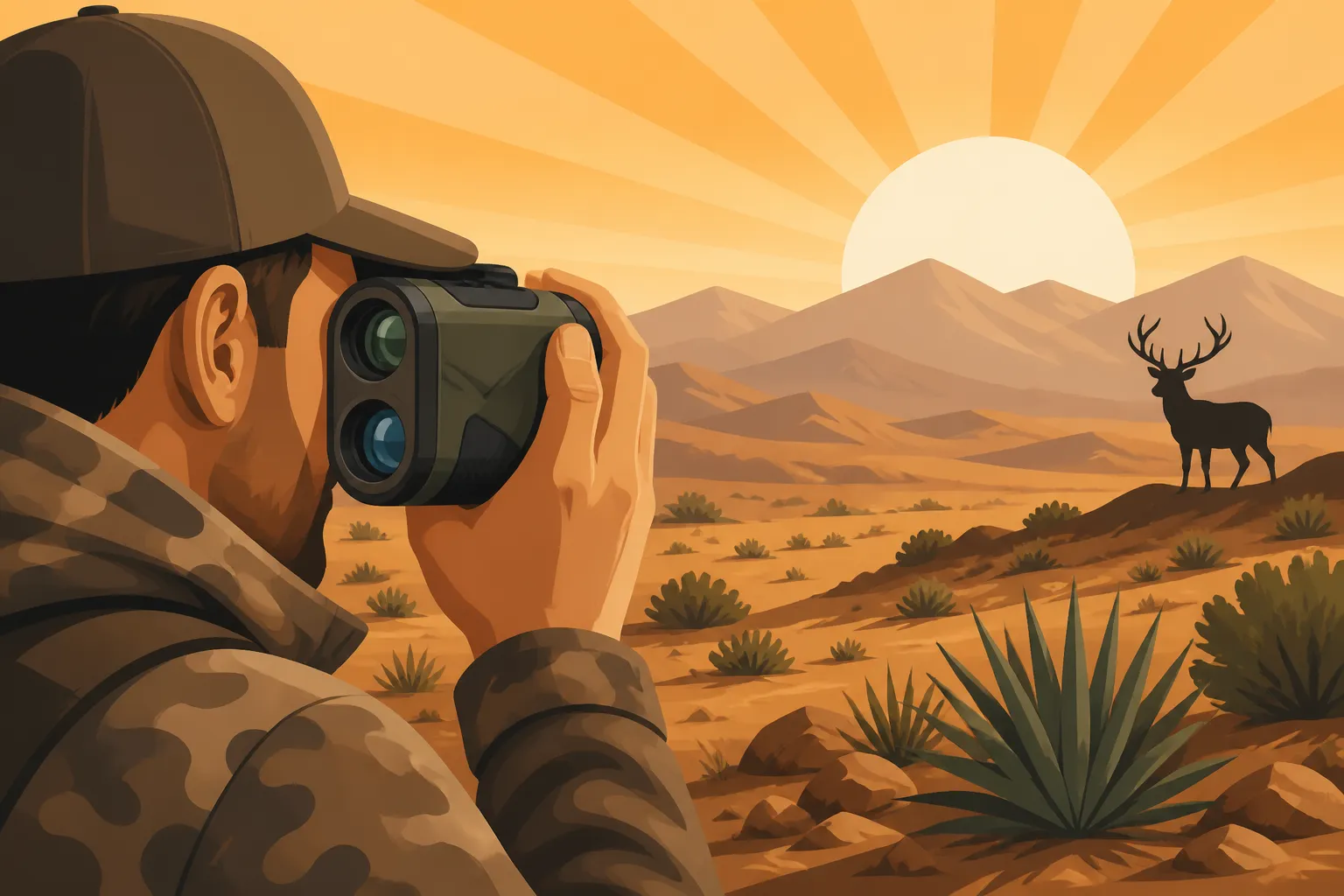
Imagine you're glassing a distant ridge line near the Alabama Hills, a lone mule deer silhouetted against the morning sun. Your gut might tell you he's 250 yards out, but without a rangefinder, that's just a guess. In the desert, a lack of vertical cover and common objects to compare against (like a house, a specific tree species, or a vehicle) means your brain struggles to process depth. The air itself can shimmer with heat, distorting the image and making everything appear closer or further than it actually is. This phenomenon can easily add or subtract 50-100 yards from your estimate, turning a perfectly capable shot into a gamble.
A good example comes from hunting a wide-open flat. You might spot a coyote at what looks like a comfortable 150 yards. You settle in, take the shot, and watch it kick up dirt 50 yards short. The next time, you add a little holdover, only to shoot over its back. The reality was, it was 225 yards, and without ranging it, you were constantly adjusting to incorrect data. This is why experienced desert hunters carry a rangefinder as essential as their rifle or binoculars.
Ethical Shot Placement and Game Recovery
Beyond simply hitting your target, ethical hunting demands a clean, humane kill. This means understanding your rifle's ballistics and your personal limitations at varying distances. A rangefinder provides the precise data needed to make these critical decisions. If you know your rifle shoots flat out to 250 yards, and your rangefinder tells you that desert mule deer is at 310 yards, you instantly know you need to account for bullet drop or consider closing the distance.
Conversely, if you're taking a shot across a deep canyon or a steep slope, the line-of-sight distance might be greater than the actual horizontal distance the bullet travels. Most modern rangefinders account for this "angle compensation," giving you the "shoot-to" distance that truly matters for gravity's effect on your bullet. Missing this crucial detail can lead to a wounded animal that travels miles through unforgiving terrain, making recovery incredibly difficult in a place where Blood Trailing After Dark in California is already a challenge.
Navigating Expansive, Featureless Terrain
The desert isn't just about long shots; it's about vastness. You might be Hunting a BLM Desert Wash for Mule Deer, and the wash itself could stretch for miles, twisting and turning. After taking a shot, or even just after spotting game and trying to get into a better position, landmarks can quickly disappear or blend into the monotony. Ranging prominent features, even if you’re not shooting at them, can help confirm your position on a map and keep you oriented.
For instance, if you range a distinct rock formation at 800 yards, then move to a new position and range it again at 650 yards, you know you've moved 150 yards closer to that landmark. This spatial awareness is invaluable in an environment where every scrub bush can start to look the same. Integrating your rangefinder's readings with a good mapping application like GoHunt can make a huge difference in staying found and successfully recovering game.
Key Features to Look for in a Desert Rangefinder
When you're out in the scorching heat and vastness of California's desert, your gear needs to perform flawlessly. A rangefinder isn't just a gadget; it's a precision instrument. Choosing the right one means focusing on features that directly address the unique demands of this environment.
Maximum Ranging Capability
In open desert, you'll often spot game at extreme distances, sometimes a mile or more away, even if you don't intend to shoot that far. Your rangefinder needs to be able to pick up these distant objects to help you plan your stalk or identify potential game movement corridors. While you might only need to range out to 500-800 yards for a typical shot, having a unit that can consistently range reflective targets (like rocks or bright surfaces) out to 1,500 yards or even 2,000+ yards, and deer-sized objects out to 800-1,000 yards, is incredibly beneficial. This allows you to verify distant landmarks, judge travel lanes, and confirm the range of that far-off patch of scrub where you suspect a buck is bedded.
Don't just look at the maximum advertised range; consider the "deer-ranging" capability. Manufacturers often list two figures: maximum reflective range and maximum deer range. The latter is far more relevant for hunters. When you are Glassing a Canyon for a Bedded Buck, you need to be able to reliably range that buck, not just the rock behind it.
Angle Compensation (ARCH/BOW Mode)
California's desert isn't always flat. While you might think of the desert as an endless plain, many prime hunting areas involve rolling hills, steep washes, and rocky outcroppings. The Eastern Sierra, for example, has incredibly rugged terrain where you might be shooting drastically uphill or downhill. Angle compensation, often called ARCH (Angle Range Compensation for Hunting) or a specific "Bow Mode" even if you're rifle hunting, is absolutely critical here.
When shooting at an upward or downward angle, gravity affects the bullet for the horizontal distance, not the line-of-sight distance. An uncompensated rangefinder might tell you a deer 30 degrees downhill is 400 yards away, but the actual "shoot-to" distance might be 350 yards. Shooting for 400 yards would result in a high shot. A quality rangefinder will calculate this and give you the correct holdover distance. This feature is particularly valuable when Wind and Thermals in Steep Sierra Country are already making things tricky, allowing you to remove one variable from the equation.
Scan Mode for Moving Targets or Multiple Reads
Desert animals, especially deer and antelope, are often on the move, grazing or traveling between cover. A good rangefinder will have a "scan mode" that allows you to continuously press the button and pan across an area. This gives you multiple, real-time distance readings as you scan, making it much easier to range a moving target or to get quick readings on different points within a group of animals.
Imagine a small herd of wild pigs moving through a palo verde thicket. With scan mode, you can quickly get readings on the lead boar, the trailing sow, and various points of cover they might move behind. This is also incredibly useful for verifying distances to multiple potential shooting lanes or finding the range to the closest and furthest edges of a distant juniper patch where a blacktail might be hiding.
Optical Quality and Reticle Clarity
You'll be glassing for long periods in the desert, often in harsh sunlight. The optical quality of your rangefinder—its light transmission, clarity, and brightness—matters. A crisp, bright image helps you quickly identify your target through the small viewfinder, especially at dawn, dusk, or when heat shimmer is present. Look for fully multi-coated lenses. The reticle, or aiming point, inside the rangefinder should also be clear, easy to see against various backgrounds (dark rock, light sand), and not overly cluttered. Many modern rangefinders offer illuminated reticles, which are a game-changer in low light conditions or against dark targets, ensuring you can always pinpoint your aim.
Durability and Weather Resistance
The California desert is unforgiving. Dust, fine sand, extreme heat, and occasional sudden downpours are all part of the experience. Your rangefinder needs to be built to withstand this abuse. Look for models that are fully waterproof and fog proof, with robust, rubber-armored housings. This protects the delicate internal electronics and optics from moisture and impacts. While "weather resistant" sounds good, "waterproof" provides peace of mind when a surprise thunderstorm rolls in or you accidentally drop it in a shallow wash. A good ergonomic design, allowing for a firm grip even with gloves on, is also a plus for those long days afield.
| Feature | Why it Matters in the Desert | What to Look For |
|---|---|---|
| Max Ranging Capability | Deceptive distances; need to range far for scouting and accurate shot setup. | "Deer-ranging" capability of 800-1000+ yards; reflective ranging 1500-2000+ yards. Fast acquisition speeds are a bonus. |
| Angle Compensation (ARCH) | Desert isn't always flat; canyons, washes, and slopes are common, affecting bullet trajectory. | Clearly stated angle compensation feature (e.g., "ARCH," "True Ballistic Range," "Horizontal Distance"). Essential for ethical shots on varied terrain. |
| Scan Mode | Animals often on the move; need to quickly range multiple points or moving targets. | Continuous scan function that updates readings quickly as you sweep across an area or follow a moving animal. |
| Optical Quality | Long periods of glassing in harsh light; need clear vision for target identification. | Fully multi-coated lenses for brightness and clarity; clear, uncluttered reticle, preferably with adjustable illumination for varying light conditions. |
| Durability & Weather | Extreme heat, dust, occasional rain are normal; gear must withstand harsh conditions. | Fully waterproof and fog proof (nitrogen purged) construction; rubberized armor for shock absorption and grip; robust battery compartment. |
| Ergonomics & Size | Carrying often, using with gloves; needs to fit comfortably in hand and pack. | Compact and lightweight design that fits easily in a bino harness or pocket; textured grip for secure handling, even when hands are sweaty or gloved. |
| Battery Life | Remote areas, no easy recharging; need reliable power for extended hunts. | Common battery type (CR2, CR123A, AAA); long battery life with an indicator. Carry spare batteries, always. |
Using Your Rangefinder Effectively in California's Desert
Having the best rangefinder means nothing if you don't know how to use it to its full potential. In the dynamic environment of the California desert, effective use is about practice, quick application, and smart integration with your other hunting tools.
Pre-Hunt Preparation and Practice
Just like you wouldn't head into the field with an un-zeroed rifle, you shouldn't rely on an unfamiliar rangefinder. Before season opens, spend time practicing with your unit. Go to an open area that mimics desert conditions – a large park, open fields, or even an empty golf course – and range objects at various distances. Practice quickly acquiring targets. Try ranging a distant bush, then a fence post, then a parked car. Get a feel for how fast your rangefinder delivers readings and how steady you need to be.
If your rangefinder has angle compensation, try ranging objects from elevated positions, like a hilltop overlooking a valley. Compare the line-of-sight distance with the compensated "shoot-to" distance. This builds muscle memory and confidence. Understand your rifle's ballistic chart and how those rangefinder numbers translate into holdover or dial adjustments. The desert is not the place for guesswork. For example, knowing your 6.5 Creedmoor needs 1.5 MIL of elevation at 400 yards means nothing if you range a buck at 375 yards and can't quickly adjust. The more familiar you are with your tools, the more effective you'll be when it counts.
Ranging Specific Targets and Obstacles
When you're actually hunting, don't just range the animal itself. Range the ground directly beneath it, especially if it's bedded or standing in thick brush. Sometimes, ranging the animal directly can be difficult if it's partially obscured or if the laser struggles to get a clean return. Ranging nearby, easily acquired objects like rocks, bushes, or even a different part of the animal (like its belly or hindquarters) can often give you a precise reading.
Also, range obstacles. If a mule deer is moving towards a clump of junipers, range the junipers. If it’s crossing a wide wash, range both sides of the wash. This creates a mental map of the terrain and helps you anticipate its movement. In a vast, open area, you might spot a potential game trail leading to a water source. Ranging several points along that trail, and the water source itself, can confirm distances and help you choose an ambush point. For long-range glassing sessions, having a clear understanding of the distances to key landmarks can make the difference between a successful stalk and a blown opportunity. When you're Glassing Mule Deer in Open California Country, these small details can be vital.
Integrating with Mapping Tools and Scouting
Your rangefinder isn't a standalone device. It's an integral part of your overall hunting system, especially when combined with modern mapping applications like GoHunt or similar tools. Before your hunt, use satellite imagery to identify potential vantage points, game corridors, and natural funnels in the desert. You can then use your rangefinder in the field to confirm the distances between these points.
For instance, if you've marked a water seep on your GoHunt app and identified a distant ridge as a potential bedding area, you can range the distance from your vantage point to both. This helps you understand the scale of the area and plan your movements. If you're Scouting California Public Land Before Season, use your rangefinder to mark exact distances to landmarks you've identified on aerial photos. This helps you understand the landscape on the ground and will make you much more efficient when season opens.
Maintenance and Care for Desert Conditions
The desert environment is tough on gear. Dust, heat, and intense sunlight can degrade electronics and optics if not properly cared for. A little preventative maintenance goes a long way in ensuring your rangefinder is ready when you need it most.
Battery Life and Spares
Rangefinders rely on batteries, and cold weather can drain them faster than normal. While California's desert rarely sees extreme cold during hunting season, the vastness of the area means you might be out for days without access to power. Always start your hunt with fresh batteries. Even if the battery indicator shows full, if it's been in there for a year, swap it out. Lithium batteries tend to perform better in temperature extremes and hold a charge longer.
More importantly, always carry spare batteries. Keep them in a small, waterproof pouch in your pack, separate from your main gear to prevent accidental drainage or damage. Imagine finally spotting that trophy desert mule deer after a grueling stalk, only to press the range button and get nothing but a dead screen. That’s a frustration no hunter wants. When you're in remote areas, charging options are nonexistent, so preparedness is key.
Keeping Lenses Clean and Free of Dust
The desert is dusty, plain and simple. Fine particulate matter can easily accumulate on your rangefinder's lenses, degrading image quality and making it harder for the laser to get an accurate reading. Always use a soft lens cloth or a lens pen specifically designed for optics. Never use your shirt, a paper towel, or anything abrasive, as this can scratch the delicate lens coatings. A small lens brush is also excellent for gently sweeping away loose dust before polishing.
When not in use, keep your rangefinder in a protective case or bino harness. This shields the lenses from dust and impacts. If you're on a multi-day hunt and your gear gets particularly grimy, a quick wipe-down each evening can keep things clear. The clearer your lenses, the more precise your readings, and the quicker you can acquire your target when that critical moment arises.
Protecting from Dust, Heat, and Moisture
Beyond lens care, the entire unit needs protection. While most quality rangefinders are sealed against dust and water, constant exposure to direct sunlight and extreme heat can still take a toll on the electronics and housing. Avoid leaving your rangefinder baking on your dashboard or exposed to the sun for extended periods. When glassing, keep it in the shade of your body or a hat when not actively in use.
When transporting your rangefinder, whether in a pack or a vehicle, ensure it's protected from bumps and jostles. A good padded case or a dedicated compartment in your bino harness will absorb impacts. Although you're primarily concerned with the desert's heat and dust, remember that sudden rain showers are not uncommon in some California desert regions. Ensure any case you use is also water-resistant, or that your rangefinder itself is fully waterproof. Taking these simple precautions will extend the life of your rangefinder and ensure it performs reliably for many seasons to come.
Disclaimer
This article is for general informational purposes only and does not constitute professional advice. Laws, prices and regulations vary by location and change over time. Consult a qualified professional for guidance on your specific situation.