Predator Calling a Desert Wash at Dusk
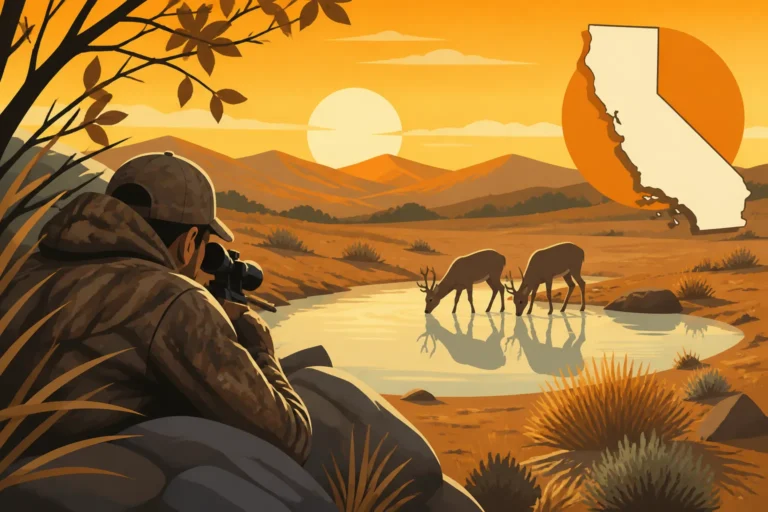
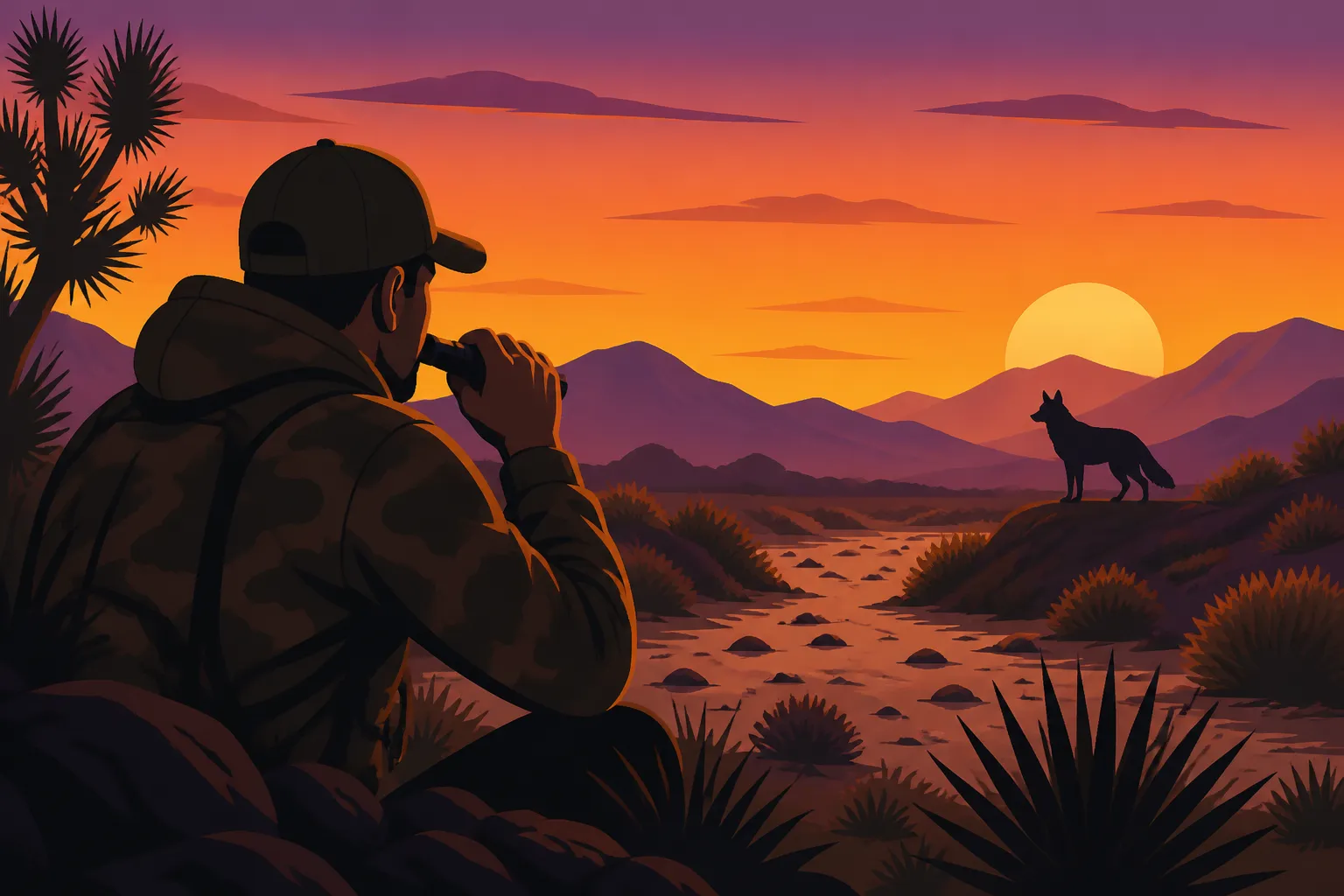
You drive out to a sandy desert wash an hour before sunset, play a rabbit distress call for twenty minutes, and see nothing but a raven. Then, as you walk back to the truck in the last light, a coyote trots across the wash two hundred yards behind you, completely unbothered. This guide explains how to call predators in a California desert wash at dusk, from picking the stand to the final minutes of legal light.
Why Desert Washes and Dusk Work So Well
Desert washes are natural travel lanes and food corridors, and the hours around sunset are when desert predators start their nightly rounds. Putting those two facts together is the heart of a good evening stand.
How Predators Use a Wash
A desert wash is a dry streambed that carries water only during storms. Even when it is bone dry, it matters. Washes collect more moisture than the surrounding flats, so they grow more vegetation: creosote, mesquite, palo verde, catclaw acacia, desert willow and grasses. That cover holds rabbits, rodents, quail and lizards, which in turn draw coyotes and other predators.
Washes are also highways. Their sandy bottoms are easy walking, quiet underfoot, and they connect bedding cover in rocky hills with feeding areas on the flats. Coyotes use them to travel, hunt and check for scraps. If you walk a wash in the morning, you will often see their tracks running right down the middle, sometimes for miles.
Bigger washes in Mojave Desert country can be a quarter mile wide, with braided channels and islands of brush. Smaller ones may be a few yards across with steep cutbanks. Both can hold predators. For a broader look at that region, see Predator Calling California’s Mojave Desert Country.
Why Dusk Changes Predator Behavior
Desert predators avoid the heat of the day. In summer, coyotes are mostly active from evening through early morning, and even in winter they often lie up in shade or in rocky cover during the brightest hours. As the sun drops and the desert cools, they start moving toward hunting grounds, often down or along washes.
That makes the last hour or so of light a natural time to call. Coyotes are already up and hungry, the air is cooling, and sound carries well in calm evening air. Many experienced desert callers will tell you their best stands happen in the last thirty minutes of light, when coyotes come in more confidently than at midday.
Morning stands work too, and there are reasons to prefer them in some situations. If you want to compare, Coyote Calling at First Light explains how sunrise stands differ.
What You Are Likely to Call In
In most California desert washes, the main target is the coyote. Coyotes are classed as nongame mammals in California, and they can generally be hunted year-round with a valid hunting license, but the details matter and change. Check California Coyote Hunting Season Rules before you go.
You may also call in animals you cannot shoot. Bobcats are no longer legal to hunt in California. Desert kit foxes are protected. Mountain lions are protected, and you should never shoot one in response to a call; see Why You Cannot Hunt California Mountain Lions for background. Badgers, owls and hawks can also respond to distress calls. Positive identification before every shot is not optional.
| Animal | Can You Hunt It? | How It Often Responds to a Call |
|---|---|---|
| Coyote | Yes, with a license and following current rules | Fast approach or careful circling downwind |
| Bobcat | No | Slow, quiet stalk, may sit and watch |
| Desert kit fox | No | Quick, curious, often close |
| Mountain lion | No | Rare, silent, may come from behind |
| Raptors and ravens | No | Fly in and land nearby |
Choosing and Setting Up Your Dusk Stand
A good stand is the difference between watching a coyote come in on a string and watching one bust you from four hundred yards. In the desert, where cover is sparse and visibility is long, setup matters even more.
Picking the Right Wash
Look for washes that have plenty of cover, show predator sign, and sit away from roads and houses. Fresh tracks in the sand, droppings on trails and the remains of rabbits are good signs. A wash that runs from rocky hills down to a flat is often better than one that runs across open flats, because coyotes bed in the rocks and move out to hunt.
Use maps to find washes that meet these criteria. Desert washes show up well on satellite imagery as lighter bands of sand with darker vegetation along the edges. GoHunt and other mapping platforms let you combine satellite imagery with land ownership layers, which is essential in the desert, where public BLM land often borders private parcels, military land, national parks and wilderness areas.
Pay attention to land status. Much of California’s desert is BLM land open to hunting, but national parks such as Joshua Tree and Death Valley do not allow hunting, and military installations such as Fort Irwin and China Lake are closed to the public. The Mojave National Preserve allows hunting under state rules, but check current regulations. Our guide Best Offline Map App for BLM Desert Land covers mapping tools that work without cell service.
Wind, Sun and Your Approach
Wind is the biggest factor in predator calling. Coyotes will often circle downwind of a call to check it with their noses before they commit. Set up so that the wind blows from the area where you expect coyotes to come toward you, or at least crosswise, and give yourself a view of the downwind side.
In the evening, desert thermals often shift. As the ground cools, air starts to flow down slopes and along washes. That can change the wind direction near the end of your stand. Watch it carefully.
The setting sun is both a help and a hazard. If you face west, the sun will be in your eyes for much of the stand, and anything coming toward you will be hard to see. If you face east, the sun will be behind you, lighting up the country in front of you, but you may be silhouetted. Ideally, set up with the sun to your side or behind you, with something behind you to break up your outline.
Walk in quietly. Park well away from your stand, at least a quarter mile and more if possible, and close the doors softly. Walk in along the edge of the wash or behind cover, not down the middle where you can be seen for miles.
Where to Sit and Where to Put the Caller
Sit with a good view of the wash and the country around it. A slight rise along the edge, a cutbank or a clump of brush is often ideal. Avoid sitting in the open where you stand out.
If you use an electronic caller, place it 30 to 60 yards away from you, ideally upwind or crosswind, in a spot where coyotes coming to it will be visible and in range. That pulls the coyote’s attention away from you and gives you a shot as it approaches the caller.
Use a decoy if you have one. A moving decoy near the caller can hold a coyote’s attention and give you a better shot. It also helps the coyote commit when it arrives and does not see the source of the sound.
Your own concealment matters as much as the caller’s placement. Desert coyotes live in open country and pick up movement from a long way off. Wear camouflage that matches the tans, grays and muted greens of the desert, cover your face and hands, and sit in the shade of a bush rather than in front of it. Keep your rifle up on sticks or a bipod and pointed toward the most likely approach so you only need small movements when a coyote shows up. A cushion or small stool makes it much easier to sit still for half an hour on rocky ground.
Planning More Than One Stand
Dusk gives you a narrow window, so most callers plan two or three stands for an evening rather than one. The first stand might start an hour and a half before sunset in a smaller side wash, the second around forty minutes before sunset, and the last right at the prime time in the wash you like best.
Space stands far enough apart that coyotes near one are not already alerted by the last. In open desert, a mile is a reasonable minimum, and more is better if the terrain is flat and sound carries well. Move between stands quietly, ideally by walking the back side of a ridge or driving to a new parking spot well away from the next wash.
Save your best stand for the last of the light. If you only have time for one stand, choose the wash with the freshest sign and the best cover, set up early enough to let things settle, and plan to stay until you can no longer see your crosshairs clearly against a coyote’s shoulder.
Calling Sequences and Shot Opportunities
Once you are set up, the stand itself is a combination of calling, waiting and watching.
A Typical Dusk Calling Sequence
Every caller has their own approach, but a typical dusk stand might look like this:
- Sit quietly for a few minutes after arriving to let the area settle.
- Start with a soft distress call at low volume, in case a coyote is close.
- After a few minutes, increase the volume to reach coyotes farther away.
- Call in sequences, with pauses of a minute or two to watch and listen.
- Consider a coyote howl or a pup distress call if prey sounds do not work.
- Stay on the stand for 20 to 30 minutes, longer as light fades and activity picks up.
Many callers start with prey distress sounds such as a rabbit or rodent in distress, because they appeal to hunger. Coyote vocalizations, like howls, barks and pup distress, can work well in some situations, especially during the breeding and pup-rearing seasons.
Do not rush. In the desert, coyotes may come from a long way off, and it can take them several minutes to arrive. Stay alert and keep scanning.
Reading How a Coyote Approaches
How a coyote comes in tells you a lot about what to do next. A coyote running hard straight at the caller is usually hungry and committed. Let it come, and stop it with a bark or a lip squeak when it reaches an opening. Many coyotes will stop and look, giving you a standing shot.
A coyote that trots in, then swings wide, is usually trying to get downwind. This is where your setup pays off. If you planned the stand with an open downwind side, the coyote may have to cross that opening to get your scent. Be ready to shoot as it crosses rather than waiting for it to come closer.
A coyote that stops at a distance and sits is often suspicious. Something about the stand does not feel right: it might have seen movement, caught a whiff of scent, or simply be cautious. Try lowering the volume or switching to a softer, more curious sound like a few rodent squeaks. Sometimes a long pause brings it the rest of the way.
Pairs and groups are common in the desert, especially in winter. If you shoot one coyote, stay ready. A second coyote may stop to look back, and a well-timed bark or distress call can sometimes hold it long enough for another shot.
Picture an evening stand on a broad wash north of Barstow. Twelve minutes into a rabbit distress sequence, a coyote appears on the far bank, three hundred yards out, and starts circling downwind. The caller cuts the volume and switches to soft squeaks. The coyote drops into a side channel and pops out at a hundred and twenty yards in the open strip the hunter picked out before sitting down. A bark stops it, and the shot comes with the sun just touching the horizon.
Spotting and Shooting in Fading Light
As the light fades, spotting coyotes gets harder. Their tan and gray coats blend into the desert, and they often move along the edges of brush. Scan constantly, and look for movement rather than a whole animal.
Shooting in fading light requires good optics and a steady rest. A scope with good low-light performance helps a lot. Shooting sticks or a bipod give you the stability you need for a precise shot.
Know your rifle and your load. California’s non-lead requirement applies to predator hunting too, so use a non-lead bullet that performs well on coyotes. Common choices include .223 Remington, .22-250 and .243 Winchester with appropriate non-lead bullets. A shotgun is a good backup for close encounters in thick brush. Use a non-lead shotgun load that will cleanly kill a coyote at close range.
Before every shot, make sure of your target and what is beyond it. In the desert, bullets can travel a long way, and washes often lead toward roads, camps or other hunters. Be absolutely sure there is a safe backstop.
When the Light Is Gone
As legal light ends, you have to decide whether to continue. California has specific rules about hunting coyotes at night, including rules on lights and on where night hunting is allowed. Some areas and land types have restrictions that do not apply to daytime hunting, so check the current regulations before you plan to stay after dark.
If you do not plan to hunt at night, make sure your last shot is taken while you can still positively identify the animal and see your backstop. Then walk out carefully with a headlamp. Desert washes can be confusing in the dark, and it is easy to lose your bearings.
Safety, Ethics and Desert Realities
Predator calling in the California desert comes with a few realities that are easy to underestimate.
Heat, Water and Flash Floods
The desert can be dangerous. In summer, temperatures can be extreme even in the evening. Carry plenty of water, wear sun protection and avoid overexertion. Even in winter, cold nights can be surprisingly harsh.
Washes are formed by floods, and they can flood again. Do not park or camp in the bottom of a wash, especially if storms are possible anywhere upstream. A storm miles away can send a flash flood down a dry wash with very little warning. After a storm, washes can be good hunting, as described in Hunting a BLM Wash After a Rain, but give the ground time to settle and watch for soft sand and washouts.
Rattlesnakes are common in desert washes, especially on warm evenings. Watch where you put your hands and feet, and wear sturdy boots and gaiters. Our gear guide Desert Boots for California BLM Wash Hunting covers footwear for this terrain.
Protecting Desert Wildlife and Habitat
The California desert is home to many sensitive species, including the threatened desert tortoise. Be careful where you walk and drive, stay on existing routes, and never disturb tortoises or their burrows. Avoid crushing vegetation along washes, which provides habitat for many animals.
Respect closures and wilderness boundaries. Some areas are closed to vehicles, and others are closed entirely. Wilderness areas can usually be hunted on foot, but vehicles and mechanized equipment are not allowed inside them.
Communication and Planning
Cell service is unreliable in much of the desert. Tell someone where you are going and when you plan to return. Carry a satellite communicator if you hunt alone or in remote areas. Bring a basic first aid kit and know how to use it.
Plan your stands ahead of time. Use mapping tools to mark parking spots, wash locations and potential stands, and save them offline. GoHunt and similar apps can store this information and help you navigate even without cell service.
Keep notes on each stand: where you set up, which calls you used, what came in, and how it approached. Over a season, those notes reveal patterns that help you choose better stands. Saving them alongside your map waypoints in an app like GoHunt keeps everything in one place when you plan the next trip.
Disclaimer
This article is for general informational purposes only and does not constitute professional advice. Laws, prices and regulations vary by location and change over time. Consult a qualified professional for guidance on your specific situation.