California Elk Tag Draw Odds by Species
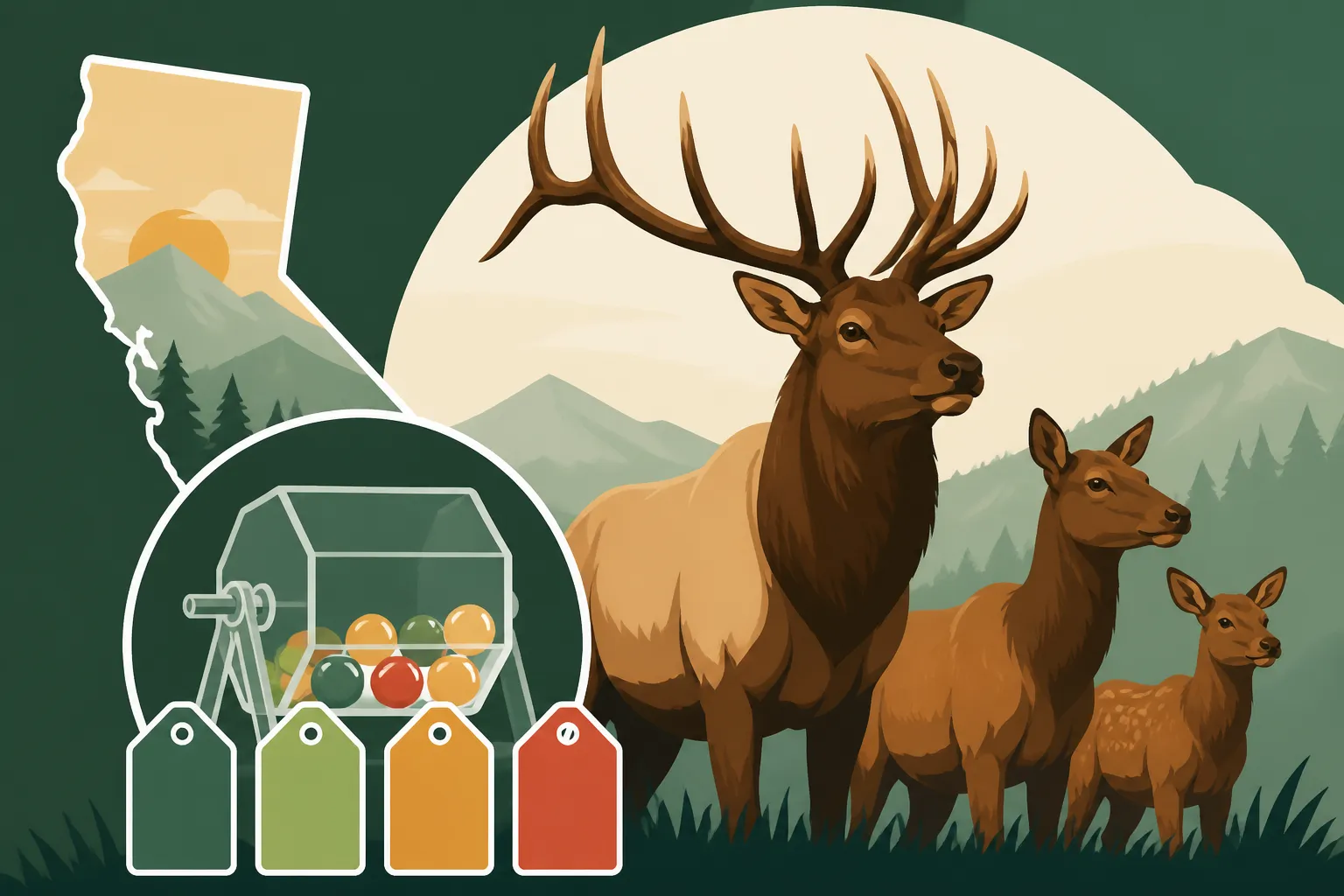
Every spring, thousands of California hunters pay a nonrefundable fee, pick an elk hunt, and wait for results that almost always say “unsuccessful.” The frustrating part is not losing, it is not knowing why some hunts feel impossible while others seem merely hard. This guide breaks down how draw odds really work for tule, Roosevelt and Rocky Mountain elk, and how to apply smarter.
Why California Elk Tags Are So Hard to Draw
If you have applied for a California elk tag for a few years and never pulled one, you are in very good company. California has a huge hunting population, a modest number of elk, and a drawing system that rations those animals carefully. Put those three things together and you get odds that look discouraging on paper and feel even worse when the results email lands.
A Big State With Small Herds
California is home to three elk subspecies, which is unusual for any single state. Tule elk live only in California and are found from the Owens Valley to the coastal hills, Roosevelt elk roam the wet northwest corner around Del Norte and Humboldt counties, and Rocky Mountain elk occupy the high, dry country of Siskiyou and Modoc counties near the Oregon border. If you want the bigger picture of the animals themselves, Hunting California’s Three Elk Species walks through the differences in habitat and behavior.
The catch is that none of these herds is large by Western standards. States like Colorado or Montana count elk in the hundreds of thousands. California manages its elk in many small, scattered herds, and each one can only support a limited harvest without hurting the population. When a wildlife agency sets a quota for a herd of a few hundred animals, the number of hunting tags that herd can support is small, sometimes a single tag for an entire hunt period.
Now picture the other side of the equation. California sells a large number of hunting licenses every year, and a meaningful share of those hunters toss an elk application into the drawing because it costs relatively little to try. Even a hunt with a dozen tags can attract applicants in the thousands. That gap between applicants and tags is the whole story of California elk draw odds.
How the Big Game Drawing Rations Tags
Elk tags are distributed through the Big Game Drawing run by the California Department of Fish and Wildlife. You choose hunts in order of preference, pay the application fee, and the computer sorts everyone once the application window closes. If the mechanics are new to you, The California Big Game Drawing Explained is the best starting point before you go any further.
For elk, the drawing combines two methods. Most tags are awarded to the applicants who hold the most preference points for elk, and a smaller share is set aside for a random drawing that any applicant can win regardless of points. The exact split between the point pool and the random pool is printed in the current regulations booklet, so confirm it there before you plan a long-term strategy. What matters for odds is that a brand-new applicant is effectively competing only for the random slice, while a veteran with many points has a real shot at the larger point-based pool.
That structure is why odds can feel wildly uneven. Two hunters applying for the same hunt in the same year may face completely different chances. One is a zero-point applicant hoping to win a lottery inside a lottery. The other is a long-time applicant who may finally be at or near the top of the point list for a modest hunt.
What “Odds” Really Mean on a Results Sheet
When people talk about elk draw odds, they usually mean one of two things. The simplest version is tags divided by applicants: if a hunt has ten tags and five thousand first-choice applicants, the raw odds are one in five hundred. The more useful version breaks those numbers down by point level, because a hunter holding fifteen points is not facing the same math as a hunter holding zero.
CDFW publishes drawing statistics after each drawing, showing how many people applied for each hunt as a first choice and how many tags were issued. Those reports are the honest foundation for any odds estimate. Services like GoHunt take the same public data and present it in a more searchable way, with filters by species, hunt and point level, which can save a lot of squinting at spreadsheets. If you see a percentage with a decimal point and a zero in front of it, What Draw Odds Under One Percent Mean explains why that is normal for California elk rather than a sign you filled out the form wrong.
Draw Odds by Elk Species
Each of California’s three elk subspecies has its own drawing personality. The differences come down to how many animals live in each range, how many hunts are offered, and how attractive those hunts are to applicants.
Tule Elk: The Most Hunts, Still Long Odds
Tule elk are the subspecies most California hunters picture when they think of an elk tag. They have recovered remarkably from near-extinction, and today they live in many separate herds across the state. Because there are so many distinct herds, tule elk account for the largest number of hunt choices in the drawing, with hunts in places like the Owens Valley, Grizzly Island in Solano County, the La Panza area in San Luis Obispo County, the Cache Creek country in Lake and Colusa counties, and several herds in Mendocino and the Central Coast.
More hunts sounds like better odds, and in a narrow sense it is. Tule elk are where most elk tags come from, and some hunts offer antlerless or either-sex tags that draw fewer applicants than bull hunts. But the most famous bull hunts, especially in the Owens Valley, attract heavy demand and can carry odds well under one percent for applicants without many points. For hunt-specific numbers, see California Tule Elk Draw Odds, which pairs each tule elk hunt with its recent applicant counts.
The practical lesson with tule elk is that there is real variety. A careful applicant can find hunts where the odds are long but not hopeless, especially antlerless hunts or periods that fall in less popular weeks. A hunter who only applies for the marquee bull hunt is choosing the hardest version of an already hard draw.
Roosevelt Elk: Few Tags in Rugged Country
Roosevelt elk are the heaviest-bodied elk in North America and live in some of the thickest country in the state, from the redwood coast to the Marble Mountains. The herds are healthy in places, but much of the best elk ground is private timberland, parks or tribal land, and public hunting opportunities through the drawing are limited.
That means Roosevelt elk hunts usually offer only a small number of tags. A hunt with a handful of tags will always have long odds once a few hundred people apply, and Roosevelt hunts reliably attract that many and more. The numbers by hunt are collected in California Roosevelt Elk Draw Odds, along with notes on which northwestern hunts draw the heaviest interest.
One thing that sometimes works in an applicant’s favor is the reputation of the country. Hunting Roosevelt elk in dense coastal timber is physically demanding, wet and slow, and some hunters choose not to apply once they understand what the hunt involves. That self-selection does not make the odds good, but it can keep them from being as extreme as you might expect for such a rare tag.
Rocky Mountain Elk: Small Herds Near the Oregon Line
Rocky Mountain elk are the smallest piece of California’s elk picture. They live mainly in the northeastern corner of the state, in Siskiyou and Modoc counties, where herds move back and forth across the Oregon border. The country is open juniper, sage and pine, closer in feel to eastern Oregon than to anything most Californians picture.
Because the resident population is modest, very few tags are offered. Odds for Rocky Mountain elk hunts tend to be among the toughest in the state, particularly for bull tags. You can dig into the hunt-level numbers in California Rocky Mountain Elk Draw Odds, which also covers how the northeastern hunt zones are divided.
Interestingly, some hunters underrate these hunts because they assume California’s best elk are tule or Roosevelt. That keeps demand a little lower than it might be, but the tag count is so small that the odds still end up long for anyone without a deep stack of points.
Side-by-Side Species Comparison
This table summarizes how the three subspecies compare in terms of the factors that drive draw odds. It describes the general pattern, not a specific year’s numbers, so always check the latest drawing statistics before you apply.
| Factor | Tule Elk | Roosevelt Elk | Rocky Mountain Elk |
|---|---|---|---|
| Where they live | Owens Valley, Central Coast, Bay Delta, Lake and Mendocino counties | Del Norte, Humboldt and western Siskiyou counties | Siskiyou and Modoc counties near Oregon |
| Number of hunt choices | Most of the three | Few | Fewest |
| Tags per hunt | Ranges from one to larger antlerless allotments | Usually small | Usually very small |
| Applicant pressure | Very high on famous bull hunts, lower on some antlerless hunts | High relative to tags | High relative to tags |
| Realistic path for a new applicant | Random draw on lower-demand hunts | Random draw or long point build | Long point build |
| Terrain difficulty | Mostly open valley and oak hills | Thick timber and steep coastal ridges | Open juniper and pine country |
Preference Points and the Random Draw
Understanding preference points is the difference between applying blindly and applying with a plan. California’s point system for elk rewards persistence, but it does not reward it evenly.
How Points Build Over Time
Each year you apply for elk and do not draw, you earn one preference point for elk. You can also buy a point without applying for a hunt in some years, which lets you build points while waiting for a hunt that fits your schedule. The details of how points are earned, kept and used are laid out in California Preference Point System Explained.
When you do draw a tag using your points, those points are spent and you start over at zero. That reset matters. A hunter who draws a modest antlerless hunt with eight points has used up eight years of patience, and that is a perfectly fine choice if a cow hunt is what they want. It is a poor choice if they were really hoping to save toward a premium bull hunt.
It also pays to read the rules about inactivity. If you skip applying for several consecutive years, you can lose the points you have built. Set a calendar reminder for the application window so a busy spring does not cost you a decade of points.
Why Point Creep Changes Your Math
Point creep is the slow upward drift of the number of points it takes to draw a given hunt. It happens because the people at the top of the point list keep applying every year, more hunters join the system, and the number of tags does not grow fast enough to keep up. A hunt that went to five-point applicants years ago may now go only to hunters with far more.
For the most coveted California bull hunts, the top of the point list can be so long that a new applicant may never catch up through points alone. That is the uncomfortable truth a lot of people do not want to hear. For those hunts, the random pool is not a consolation prize, it is the main realistic path for anyone who started late.
Draw tools from services such as GoHunt can show how many points recent successful applicants held for a given hunt, which helps you see whether a hunt is within reach. Use that information to decide whether you are building toward something achievable or simply hoping for the random draw.
Playing the Random Pool Wisely
Because a share of elk tags are set aside for a random drawing, every applicant has some chance every year. That chance is tiny for the famous hunts, but it is not zero. The key is to recognize that, in the random pool, your points do not help you, so your choice of hunt matters more than anything else.
If you are a low-point applicant, a smart approach is to put a hunt with lower demand as your first choice, especially if you would genuinely be happy to go. A tag for an antlerless tule elk hunt in a less popular period, or a hunt with heavy access challenges that discourage casual applicants, may give you meaningfully better random odds than a headline bull hunt. Deer hunters chasing premium zones use the same logic: pick the choice you can realistically win, not just the one everyone talks about.
Residents, Nonresidents and Special Allocations
Not everyone in the drawing is competing for the same tags. Residency, landowner programs and special fundraising allocations all shape the true pool.
The One-Tag Nonresident Rule
California treats nonresident elk applicants very differently from residents. Only one elk tag a year is available to nonresidents through the drawing, which makes the nonresident odds some of the longest in North American elk hunting. Hunters from across the country still apply, partly for the chance at a tule elk, which exists nowhere else. The background, including why the state caps nonresident elk opportunity so tightly, is covered in California’s Once-a-Year Nonresident Elk Tag.
If you live outside California, treat the drawing as a long-shot lottery ticket rather than a plan. Many nonresident hunters who seriously want a tule elk look at private-land options or fundraising tags instead, which are priced and allocated outside the drawing.
Landowner Tags and Private-Land Programs
Some elk tags never enter the public drawing at all. California has programs that allocate tags to qualifying private landowners, who can then use or sell them under program rules. These tags are often tied to large ranches that provide significant elk habitat, and they can be an option for hunters willing to pay for access.
From an odds standpoint, landowner tags do two things. They reduce the number of animals available to the public drawing on some herds, and they create a separate, paid path for hunters who can afford it. If that route interests you, Buying a Tule Elk Landowner Tag explains how these purchases usually work and what kind of budget to expect.
Fundraising Tags and Apprentice Opportunities
California also offers a small number of fundraising elk tags each year, sold through auctions or raffles run in partnership with conservation organizations. The money supports elk management, and the winners get a tag outside the normal drawing. These are not a reliable path for most hunters, but raffle-style fundraising tags can carry odds that compare favorably with the hardest public hunts, depending on how many entries are sold.
There are also apprentice and youth-focused hunts for some species, so if you have a young hunter in the family, check whether any elk opportunities are reserved for them that year. These allocations do not change the odds for adult applicants much, but they can be a wonderful door into elk hunting for a new hunter.
Building a Realistic Application Strategy
Knowing the odds is only useful if it changes the choices you make on the form. A clear strategy helps you spend your application fee wisely and keeps your points working for you.
Step-by-Step Application Planning
Here is a practical way to work through your elk application every year:
- Decide what kind of hunt you actually want, such as a bull hunt, a cow hunt, a specific subspecies, or simply any elk tag.
- Check your current preference point total for elk in your online license account.
- Review the latest CDFW drawing statistics for the hunts you are considering, paying attention to first-choice applicant numbers.
- Look at how many points successful applicants held in recent drawings for each hunt, using CDFW reports or a draw research tool.
- Sort hunts into three groups: reachable with your points, random-draw only, and long-term goals.
- Put your realistic first choice at the top, because most tags go to first-choice applicants.
- Fill remaining choices with hunts you would genuinely enjoy, in case your first choice falls short.
- Submit before the deadline, keeping a copy of your confirmation and noting the results date.
The application window closes in early summer each year, and missing it costs you a year of points. California Elk Application Deadline keeps the timing straight, and your license account shows the current application fee before you submit.
Matching Hunts to Your Point Total
Your point total should shape your first choice more than your dreams do. If you hold just a few points, the chances of reaching the top of the list for a famous bull hunt are slim, so either target a less popular hunt where those points matter or accept that you are playing the random pool.
Mid-point applicants face the hardest decision. Burning a solid point total on a cow hunt can feel wasteful, but holding out for a bull hunt that keeps moving out of reach due to point creep can be even more frustrating. A good compromise is to set a deadline: if a target hunt still is not within a few points of your total in a set number of years, switch to a hunt you can draw.
High-point applicants should be looking closely at where their points will actually land them. Draw statistics, harvest information and terrain all matter here. Pairing odds with California Elk Hunt Success Rates by Species can help you avoid spending a lifetime of points on a hunt with low harvest success.
Thinking Beyond a Single Year
Elk applications in California are a long game. A hunter who applies every year for twenty years is likely to get at least one solid elk hunt out of it, especially if they are flexible about subspecies, season and tag type. A hunter who applies once in a while, skips years and only chooses the most famous hunts may never draw.
Keep a simple spreadsheet or notebook listing which hunts you applied for, your point total each year and the results. Over time, it becomes a personal record of how the system works for you, and it helps you spot hunts where your odds are slowly improving. Some hunters also use research tools such as GoHunt to track multiple states at once, applying in California while building points elsewhere for a more frequent elk hunt.
Preparing for the Hunt Once You Draw
Drawing a California elk tag is a big moment, but the work is only starting. Because these tags are so rare, it is worth preparing as if you will never get another one.
Scouting and Learning the Unit
Once you draw, study the hunt area right away. Tule elk hunts in places like the Owens Valley or the Central Coast may involve large private ranches, refuges or access restrictions, so learn the boundaries and access rules early. For Roosevelt elk, plan on thick timber and wet weather. For Rocky Mountain elk, expect long glassing sessions across open country.
Take time to visit the area before the season if you can. Talk to wildlife area staff, look at maps, and learn the roads and trails. Many California elk hunts have relatively short seasons, and you do not want to spend precious days figuring out where to start.
Gear, Ammunition and Practical Details
California requires non-lead ammunition for all hunting, so make sure your rifle shoots a certified non-lead load accurately well before the season. Best Non-Lead Bullets for Elk-Sized Game can help you narrow the choices, since copper bullets behave differently from the lead loads many hunters grew up with.
Plan how you will handle the meat. Elk are large animals, and California’s warm early seasons can make meat care a real concern. Bring game bags, a plan for cooling, and enough help to get an animal out of steep country.
Reporting and Respecting the Tag
After the hunt, report your results as the regulations require, whether you harvested or not. Those reports feed into the data that shapes future quotas and help keep herds healthy and hunts available.
Treat the experience with the respect it deserves. Many California elk hunters wait years, sometimes decades, for a tag. Share what you learn with friends who are still applying, and keep applying yourself for a different subspecies or hunt in the years ahead.
Disclaimer
This article is for general informational purposes only and does not constitute professional advice. Laws, prices and regulations vary by location and change over time. Consult a qualified professional for guidance on your specific situation.