California Deer Migration Corridors
The frustration of deer hunting can often come down to one core challenge: consistently finding the deer, especially when they aren't where you typically expect them. This feeling is particularly amplified in California's vast, dynamic, and often unforgiving landscapes, where deer are perpetually on the move. Imagine spending days scouting a perfect bedding area only for the deer to seemingly vanish overnight. More often than not, this disappearance isn't magic; it's migration. Understanding California deer migration corridors is absolutely essential. It’s the key to unlocking consistent hunting success, allowing you to anticipate their movements, decode their seasonal shifts, and ultimately, be in the right place at the right time, rather than just hoping they show up.
The Rhythmic Pulse of California's Deer Migration Corridors
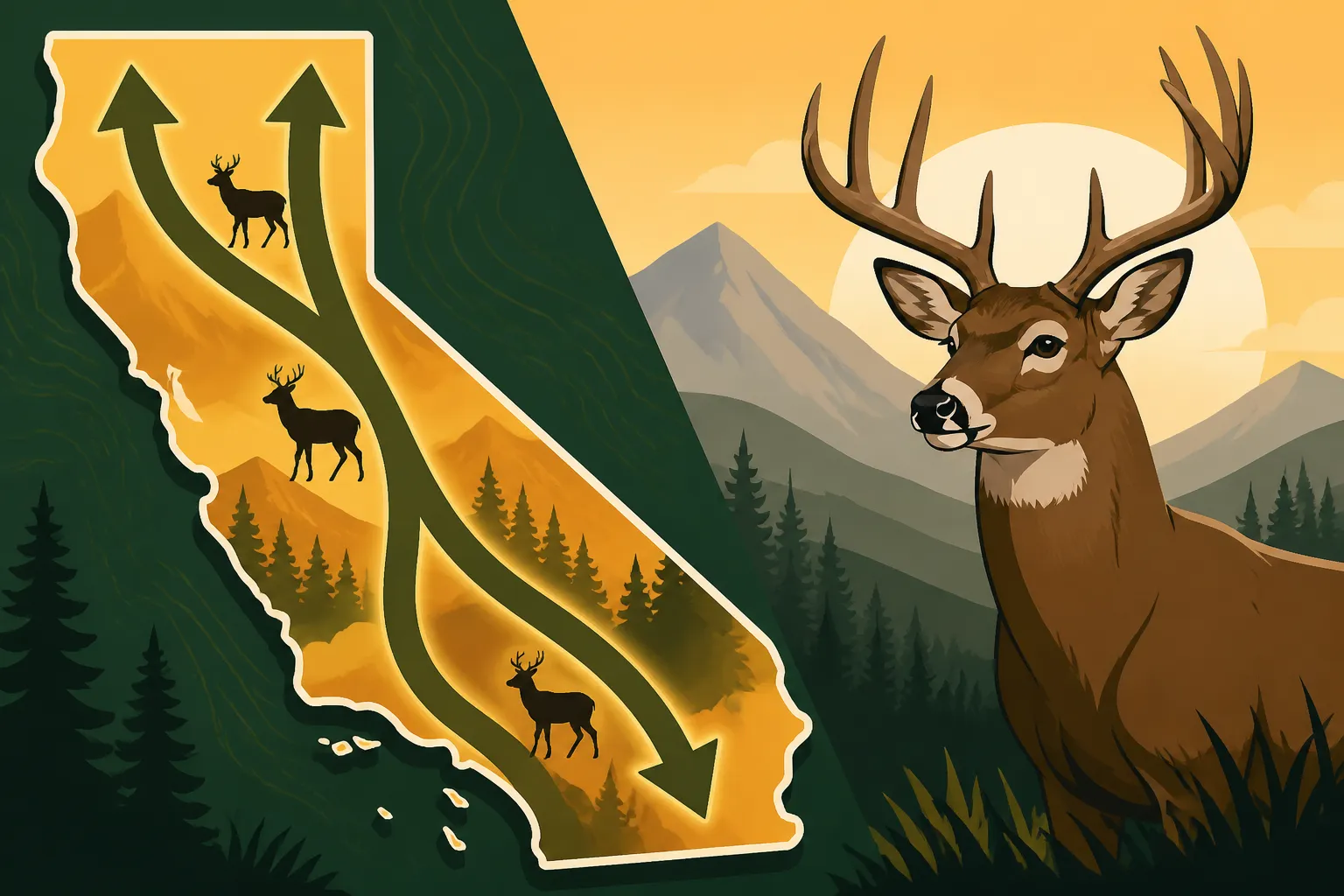
Deer in California aren't static residents; they are travelers. Unlike some smaller game species that might live their entire lives within a few square miles, our state’s deer populations, particularly the magnificent mule deer and many of the blacktail populations that call the sprawling Sierra Nevada and Cascade ranges home, undertake incredible, often epic, journeys. These aren't just random wanderings or opportunistic movements; they're predictable, genetically ingrained, and often ancient paths connecting distinct seasonal ranges. Think of these corridors as a natural, sophisticated highway system for deer, meticulously designed by millennia of evolution and driven by the fundamental need for optimal forage, reliable water sources, and safe, suitable breeding or fawning grounds. These migratory patterns are especially pronounced in areas where critical resources are seasonally limited, such as the high country that bursts with life after spring snowmelt but becomes an inhospitable, snow-bound wilderness in winter.
Defining Seasonal Deer Movement
To truly grasp the concept, picture a typical high-elevation deer herd. In the warm summer months, they're spread across lush alpine meadows and open timber, feasting on abundant forage. But as autumn deepens and the first whispers of winter descend, a primal urge stirs. These deer will embark on a journey, often many miles long, to reach lower-elevation winter ranges where deep snow is less likely to cover their essential browse. This movement isn't a one-way street, either. As spring returns, melting the snow and coaxing out new green growth, the deer reverse course, following the "green wave" back up to their summer pastures. This annual ebb and flow defines seasonal deer movement.
What makes these corridors so fascinating, and a considerable challenge for us hunters, is that while the concept of migration is straightforward, the details are incredibly nuanced and often subtle. A corridor isn't always a wide, obvious game trail. Sometimes, it’s a series of faint, almost imperceptible paths winding through dense chaparral, or a chain of strategic saddles and draws that offer the easiest path over a ridge. Other times, it might involve a specific, well-worn river crossing or a protected valley bottom that acts as a natural conduit through otherwise rugged terrain. It’s a dynamic, living system, constantly influenced by a myriad of environmental factors such as annual snowpack levels, the history of wildfires, the relentless march of human development, and the ever-present pressure from predators like mountain lions and coyotes.
Consider the immense scale involved: we’re not just talking about a single buck making his way. Often, hundreds, sometimes even thousands, of deer will utilize these same pathways, year after year, for generations. They are ingrained into the landscape, visible to the discerning eye through worn earth, ancient rubs, and accumulated sign. As hunters, recognizing these patterns allows us to transition from passively waiting for deer to actively intercepting them along their predictable, life-sustaining routes. It's about tapping into the very rhythm of their existence.
Why These Routes Matter for Deer Survival
For California's deer, these migration corridors are not merely convenient travel routes; they are quite literally lifelines. The primary driver is access to sufficient forage, which is absolutely paramount for survival, especially during the lean months of harsh winters or the parched conditions of dry summers. A healthy, thriving deer herd is fundamentally reliant on its ability to move freely and safely between these seasonal habitats, minimizing undue stress and avoiding being trapped by adverse conditions. Imagine a hypothetical scenario: a herd accustomed to migrating from the high Sierra down to lower foothills. An unusually early and heavy snowfall could potentially trap them in their high-country winter range, cutting them off from their traditional, critical low-elevation browse. Such a situation can quickly become a recipe for widespread starvation and disaster, highlighting the fragility of these systems.
Beyond simply providing food, these corridors play a vital role in maintaining the genetic health and robustness of deer populations. They facilitate genetic exchange between different sub-herds, preventing inbreeding and enhancing the overall resilience of the species. Furthermore, these routes allow deer to escape persistent pressure from predators or significant human disturbance, enabling them to find pockets of security and respite during different times of the year. When wildlife biologists and conservationists discuss strategies for deer population management, protecting these critical migration corridors is almost always at the top of the list. Their disruption, whether through new developments, fencing, or habitat fragmentation, can have profound and far-reaching negative impacts on a deer herd's long-term viability and ability to adapt to changing environmental conditions.
As ethical hunters, understanding this intrinsic and vital link to survival profoundly deepens our appreciation for the animals we pursue. It allows us to see beyond the immediate harvest and recognize the larger ecological tapestry in which our hunting efforts are woven. When you locate and study a well-used migration route, you’re not just observing fresh deer sign; you’re witnessing a testament to generations of deer adapting, enduring, and surviving in a constantly challenging and evolving environment. It's a privilege to be a part of that natural cycle, and a responsibility to hunt these areas with the utmost respect and forethought.
Decoding the Dynamics: Factors Influencing Corridor Use
Understanding the very existence of deer migration corridors is one thing; knowing when deer will use them, and how their patterns might shift, is another entirely. Various elements, both environmental and landscape-driven, dictate the precise timing and flow of deer movement through these crucial pathways. It’s a complex interplay, but one that savvy hunters can learn to read.
Environmental Triggers and Timing
The timing of California's deer migrations is almost entirely orchestrated by a symphony of environmental cues. In our state's higher elevations, the most significant trigger for the downward, fall migration is typically the arrival of the first heavy, accumulating snowfall. As the snow deepens, covering essential forage and making travel increasingly arduous, deer instinctively begin their controlled descent from their summer grounds. Conversely, as spring announces its arrival, the receding snowlines and the emergence of fresh, vibrant green-up below signal the perfect moment for them to begin their upward journey, following the flush of new growth back to higher elevations. This annual timing, however, is never static. A mild winter, for instance, might cause a noticeable delay in the downward migration, while an early and exceptionally harsh storm could accelerate it significantly, pushing deer down the mountain weeks earlier than expected.
Beyond just snow, drought conditions can also exert a powerful influence on deer movement patterns. During particularly dry years, deer might initiate their migrations earlier or travel farther than usual in a desperate search for reliable water sources and any remaining green browse. This makes scouting for Late-Season Food Sources for California Deer an invaluable strategy for those hunting later in the year, as deer will predictably concentrate around these limited resources. Wildfire is another massive, often unpredictable, factor; recent burns can temporarily disrupt established corridors, forcing deer to find new routes. However, over the long term, these same burn scars can ironically create new foraging opportunities and regeneration, subtly shifting traditional migration patterns over years as vegetation recovers.
It's a constant, intricate dance with nature, and as hunters, staying acutely attuned to real-time weather patterns, detailed snow reports, and localized conditions is far more critical than simply circling arbitrary dates on a calendar. The deer themselves will effectively "tell" you when they’re moving, if you possess the patience and observational skills to read the language of the landscape. This is where truly detailed Scouting California Public Land Before Season transcends mere curiosity and becomes an indispensable practice, shifting your focus from just finding deer in their static summer or winter homes to actively identifying those ephemeral, yet critical, transition zones.
Landscape Features and Bottlenecks
Deer, despite their often elegant appearance, are incredibly practical creatures. Their migration routes are not random; they are meticulously shaped by the very topography of the land itself. Ridgelines, for example, frequently serve as natural, efficient highways, offering easier travel and often providing better visibility for spotting predators. Conversely, drainages and creek bottoms, particularly those blessed with dense cover, act as protective conduits, shielding deer from prevailing winds and offering concealment from predators. Saddles – those low points between two higher ridges – are classic, predictable pinch points, natural funnels where deer movement invariably becomes concentrated. These are precisely the kinds of topographic features that make tactics like Hunting a Ridge-Top Saddle at First Light such a perennially productive approach.
Crucially, substantial obstacles in the landscape, such as steep, impassable cliffs, expansive urban developments, major interstate highways, or large, uncrossable bodies of water, can create significant bottlenecks. These bottlenecks force deer into narrow, often highly predictable channels, concentrating their movement even further. From a hunter's perspective, these are absolute goldmines. Deer must pass through these points on their migration. Knowing how to identify these natural choke points and understand their influence on deer movement is key to anticipating exactly where deer will be funneled, often regardless of the specific year's unique weather conditions. It’s like discovering a natural toll booth on their migration highway, a place where their passage is all but guaranteed.
Even within the vast expanses of California's public lands, these landscape features work in concert to create distinct, recurring patterns. Consider a major river drainage like the North Fork of the Feather River, or a prominent mountain range such as the Sierra Nevada. Deer migrating from their high summer ranges, down to lower wintering grounds, will naturally utilize a limited number of safe, efficient crossings and passes. Your primary objective, as a resourceful hunter, is to leverage advanced mapping tools like GoHunt to pinpoint these natural choke points, paying close attention to contours, elevation changes, and natural breaks in the terrain. This kind of detailed analysis, especially when paired with Reading Aerial Photos for Sierra Deer, can reveal migration corridors long before you ever step foot on the ground.
Strategies for Identifying and Hunting Corridors
The knowledge of migration corridors is power, but only if you know how to wield it. This section isn't just about theory; it's about practical, actionable steps for hunters to locate, understand, and effectively hunt these crucial deer pathways.
Scouting and Mapping Techniques
Identifying these elusive migration corridors isn't a casual endeavor; it demands dedicated effort, often requiring trips into the field outside of the main hunting season. Begin your reconnaissance with a broad, strategic overview. Utilize detailed topographic maps, high-resolution satellite imagery, and even historical data from the California Department of Fish and Wildlife (CDFW) to gain initial clues about traditional winter and summer ranges for specific deer herds. Look for natural funnels or constricted passages between these identified areas, such as prominent saddles, deep drainages, and gradual, less-treacherous slopes that clearly connect different elevation bands. This is precisely the kind of comprehensive research where modern digital mapping platforms like GoHunt truly come into their own. Their robust mapping features allow you to seamlessly overlay critical information such as private and public land boundaries, analyze intricate topographical contours, visualize historical burn areas, and even identify key access points—all of which are absolutely crucial for developing a complete understanding of deer movement patterns.
Beyond the digital realm, extensive ground scouting is an absolutely essential, non-negotiable step. Plan trips into the hills in the late spring after snowmelt, or during the early fall well before the general season opens. During these times, look for heavily worn trails that distinctly appear to connect different drainages or climb purposefully over prominent ridges. Pay particular attention to trails that seem to "go somewhere" with a definitive purpose, rather than just meandering idly through a localized feeding or bedding area. Search diligently for rubs and scrapes from previous seasons along these routes – deer often utilize the same migration paths year after year, and these enduring signs can confirm a consistent travel pattern. Also, take note of the distribution of deer droppings; large, concentrated accumulations in a linear fashion are often a strong indicator of a travel route, as opposed to dispersed droppings found in a feeding or resting zone.
Furthermore, judiciously deploying Trail Cameras on California Public Land in key funnels and pinch points can provide invaluable intelligence. While specific regulations and ethical guidelines must always be followed, strategically placing cameras on these potential corridors can confirm consistent deer movement patterns and provide critical insights into their timing. Even if you don't capture images of deer actively migrating during the open season, seeing consistent, heavy movement along a particular path in the weeks leading up to the season can confidently tell you it's a primary travel route they are highly likely to utilize once the migratory urge kicks in. GoHunt's data layers can even help you predict cellular coverage for remote camera setups in challenging terrain.
Timing Your Hunt with Migration Patterns
Once you've successfully identified promising migration corridors, the true art of hunting them lies in perfectly timing your presence. This means not only understanding when California's zones open on different dates but also possessing the foresight to anticipate precisely when deer will be actively moving through your specific area. For example, if you're hunting a D-zone that borders high-country X-zones, your most opportune window for success might be during the general rifle season when the first significant snows in the higher elevations begin to push deer downward. Conversely, if you're fortunate enough to draw a tag for Hunting a Late-Opening High-Country Zone, you might find success catching the tail end of the upward spring migration or the initial, subtle stages of the downward migration in early fall.
This isn't about rigidly sticking to a pre-planned date; it's about cultivating flexibility and adapting proactively to prevailing conditions. You must become a meticulous meteorologist, watching detailed weather forecasts like a hawk. A major, sudden cold front or an unexpectedly early, heavy snowfall in the high Sierra can serve as a powerful catalyst, triggering a significant, widespread push of deer. These critical weather windows are precisely when you want to be positioned and ready to capitalize. Hunting these active corridors during these brief, intense periods of movement can be exceptionally productive, as deer are often less focused on extreme caution and more singularly driven by the imperative to reach their destination. Their focus on survival can momentarily override their typical wariness.
Furthermore, consider how specific times of day might influence corridor usage. Deer, being crepuscular creatures, frequently move most heavily during the low light conditions of dawn and dusk, even during full-blown migration. Setting up on a known corridor at first light or last light can allow you to intercept them as they travel to or from temporary bedding areas established along their route. This is where a deep understanding of Wind and Thermals in Steep Sierra Country becomes paramount. You need to meticulously position yourself to ensure that your scent cone does not betray your presence and blow directly into the corridor, alerting approaching deer long before they even come into view. Every detail, from your camouflage to your scent control, plays a role in these high-stakes intercept points.
Ethical Considerations and Pressure
Hunting migration corridors, while undeniably effective, comes with a profound set of ethical responsibilities that every hunter must uphold. During peak migration, deer can be under considerable physiological stress, and their singular focus on survival movement can make them appear less cautious than usual. As ethical hunters, we bear the significant responsibility to ensure that every shot taken is both well-placed and ethical, and to avoid creating undue pressure on these animals during what is often a critical and vulnerable time for their survival. It’s about demonstrating deep respect for the resource and for the animals themselves, understanding their plight and acting accordingly.
It's also crucial to remember that many deer migration corridors unfortunately traverse both public and private lands, sometimes blurring the lines. Always, always be absolutely certain of property boundaries. Utilize detailed mapping applications such as those provided by GoHunt to meticulously verify your location in relation to private parcels, ensuring that you are hunting legally and ethically at all times. California Trespass and Permission Law is clear on this, and maintaining positive relations with landowners is paramount to preserving future hunting opportunities. There’s no excuse for unintentional trespass when technology provides such precise tools.
Finally, the increasing awareness and popularity of hunting migration corridors means that these areas can also experience significantly higher Hunting Pressure on California Public Land. If you manage to identify a particularly well-known or obvious corridor, be mentally prepared for the possibility of encountering other hunters. In such scenarios, sometimes the most productive and ethical approach is to focus your efforts on the fringes of the main corridor or to scout for subtle, secondary travel routes adjacent to it. These less-obvious paths might be utilized by pressured deer seeking to avoid heavy human traffic. It’s a delicate balance: maximizing your opportunity while simultaneously demonstrating respect for the animal, the land, and your fellow hunters.
| Corridor Type | Description | Key Hunting Strategy | Ideal Time to Hunt |
|---|---|---|---|
| High-Elevation | Connects summer alpine/subalpine range to lower-elevation winter range. Often follows ridgelines, major drainages, and saddles. These are the classic long-distance routes deer take when snow pushes them. | Ambush natural funnels (saddles, narrow canyons, river crossings). Spot and stalk from afar, focusing on movement. | Early season (upward movement during spring green-up) or late season after first heavy snows (downward movement). Look for insights into Hunting a Late-Opening High-Country Zone. |
| Foothill/Coastal | Shorter, more localized movements, often connecting dense oak woodlands to chaparral thickets or agricultural lands. Heavily influenced by seasonal food sources (acorns, green browse) and water availability. | Sit water sources, productive oak flats, or thick bedding areas. Still-hunt slowly and deliberately through cover during active times. | Peak acorn drop in fall, or during pronounced dry periods when deer are concentrated around limited water. Check Hunting Coastal Range Oak Woodlands for specific regional tips. |
| Agricultural Fringe | Deer moving between dense, often inaccessible cover on hillsides or in timber and adjacent, tempting agricultural fields (e.g., alfalfa, grain, vineyards). | Set up on field edges or strategic travel corridors leading directly to these fields at first/last light, when deer move to feed. | During specific crop harvests, or when fields offer fresh green feed, especially after dry spells that make natural forage scarce. Learn productive tactics for Hunting a Standing Alfalfa Field to maximize success. |
California deer migration corridors are far more than just abstract lines on a map; they are the vibrant, life-sustaining arteries of our state's diverse deer populations. Gaining a deep understanding of these intricate systems fundamentally transforms hunting from a hopeful, often frustrating, venture into a strategic, calculated pursuit. By diligently combining thorough research, dedicated in-the-field scouting, and a keen, adaptive eye on ever-changing environmental cues, you can dramatically increase your chances of hunting success. More than that, you'll gain a profound, almost spiritual, appreciation for the magnificent animals we are privileged to pursue in California's wild and beautiful landscapes. Whether your passion lies in chasing elusive blacktail through dense coastal timber or patiently glassing for mule deer across wide-open, rugged country, knowing precisely where they're going and understanding the deep-seated reasons for their movement is truly the ultimate hunter's edge.
Disclaimer
This article is for general informational purposes only and does not constitute professional advice. Laws, prices and regulations vary by location and change over time. Consult a qualified professional for guidance on your specific situation.