California Bear Density by Region
Hunting black bears in California is a unique challenge, especially when you're trying to figure out where these elusive animals actually live. It's not like they're standing around holding signs, waving hello! This guide will delve into the regional densities of black bears across California, helping you understand where populations are thriving and how to use this knowledge to better plan your next hunt, giving you a distinct advantage in the field.
The Broad Strokes of California's Black Bear Population
When we talk about bear density, it's not just about how many bears there are statewide, but where they choose to make their homes and raise their cubs. California is a massive state with incredible habitat diversity, and black bears have adapted to thrive in many different ecosystems, though not all equally. Understanding these broad population trends is the first step in narrowing down your search.
A Thriving, Growing Population
It might surprise some, but California's black bear population has experienced a significant rebound over the last few decades. Historically, their numbers were much lower, but through effective management and habitat protection, they've truly flourished. We're talking about a population that has grown substantially since the 1980s, expanding their range into areas where they haven't been seen in generations. This success story is a testament to conservation efforts and the bears' adaptability, leading to a robust and healthy population across many of our wildlands. You can read more about this remarkable growth in our article on California Black Bear Population Estimate.
This increase means that while bears are still a challenging quarry, the opportunities to encounter them are better than ever, provided you know where to look. They've capitalized on available food sources and excellent cover, pushing into new territories as their numbers have expanded. This expansion isn't uniform, though; certain regions have seen more dramatic increases in density than others, creating prime hunting opportunities in specific zones. Knowing this broader trend helps frame why certain areas are now considered hotspots for bear activity.
The Overall Picture: Where Bears Call Home
Generally speaking, black bears in California are concentrated in the forested and wilder mountainous regions of the state. They thrive in areas with dense cover, plentiful water, and a diverse range of seasonal food sources. Think deep timber, chaparral, and oak woodlands, especially those with good access to riparian areas. These habitats provide everything a bear needs to survive: security, sustenance, and denning sites.
While they are most common in the state's vast national forests and wilderness areas, their presence isn't exclusive to these remote locales. Occasionally, bears will venture into foothill communities or agricultural areas, especially when natural food sources are scarce or during drought years. However, for hunters, the focus remains squarely on those wilder, less disturbed regions where bears can live out their lives with minimal human interference. Understanding these favored habitats is crucial for successful scouting, as bears will consistently gravitate towards areas that offer these ideal conditions.
Regional Hotbeds and Lower Density Areas
California's varied topography means that bear density isn't a single, monolithic statistic across the state. Instead, it fluctuates wildly from one region to another, creating distinct "hotspots" where bears are abundant and other areas where sightings are a rarity. Pinpointing these regions is key to planning an effective bear hunt, whether you're looking for a challenging spot-and-stalk opportunity or aiming for an archery opener.
The Northern Tier and Sierra Nevada
When you talk about high bear density in California, the northern part of the state and the vast Sierra Nevada mountain range immediately come to mind. These regions are the undisputed strongholds for black bears. Areas like the Trinity Alps Wilderness, the rugged reaches of the Six Rivers National Forest, and the Klamath National Forest in the north are absolutely brimming with bears. They offer extensive, untouched forests, abundant berry patches, and healthy salmon runs in many drainages, all of which contribute to robust bear populations.
Moving south, the entire length of the Sierra Nevada is prime bear country. From the Lassen National Forest in the north down through the Tahoe, Stanislaus, Sierra, and Sequoia National Forests, bears are a common sight. These areas provide vast expanses of mixed conifer forests, oak woodlands in the foothills, and abundant high-country feed like manzanita berries and acorns. Hunters often find excellent opportunities in these zones, particularly when focusing on Hunting California's Sierra Nevada Backcountry or exploring specific areas within the California's Eighteen National Forests. The sheer amount of suitable habitat and food sources here ensures that bear densities remain consistently high, offering some of the best prospects for hunters in the state.
Central and Southern Coastal Ranges
While perhaps not as universally dense as the Northern Tier or Sierra Nevada, the Central and Southern Coastal Ranges also hold significant bear populations, though often in more fragmented or localized pockets. The Los Padres National Forest, stretching across several counties along the Central Coast, is a prime example. This area, with its unique blend of chaparral, oak woodlands, and riparian corridors, supports a healthy bear population, particularly in its more remote wilderness sections. Bears here often navigate steep, brushy terrain, making hunting a physically demanding but rewarding endeavor.
Further south, into the Transverse and Peninsular Ranges, bear densities tend to decrease, becoming more concentrated in specific mountain ranges that offer sufficient cover and food. The San Bernardino National Forest, for instance, has a notable bear presence. These southern bears often face more challenging environmental conditions, particularly drought, which can influence their movements and concentration around perennial water sources. For hunters, success in these regions often hinges on meticulous scouting and identifying these critical habitat features where bears are forced to congregate.
Eastern Sierra and Desert Edges
The Eastern Sierra and the fringes of California's vast desert regions represent areas where bear density tapers off considerably, yet still offers unique, albeit challenging, hunting opportunities. Along the eastern slope of the Sierra Nevada, bears are found, but their populations are generally less dense than on the western side. Here, bears are often tied closely to the higher elevation forests, particularly those with aspen groves, which provide crucial forage, or pinyon-juniper zones. Access to water is a paramount factor in this drier landscape.
As you move further into the true desert edges, such as the Mojave National Preserve area (though hunting is not typically allowed in National Preserves, general BLM land adjacent might hold bears in specific locales), bear sightings become much rarer. Any bears found in these truly arid regions are usually dependent on isolated mountain ranges with permanent water sources and sparse pockets of vegetation. For the adventurous hunter looking for a truly remote experience, understanding these specific, limited habitats is essential. These aren't the high-density areas of the Sierra, but they can offer an incredible wilderness experience if you're prepared for the challenge of finding a needle in a haystack.
Factors Influencing Local Bear Density
Bear density isn't static; it's a dynamic measure influenced by a multitude of environmental factors. Understanding these underlying drivers can give you a significant edge in predicting where bears might be concentrated, even within a generally high-density region. It's about looking beyond the map and understanding the "why" behind their presence.
Habitat, Food, and Water Availability
At the heart of bear density is the availability of suitable habitat, and within that, an abundance of food and water. Bears are omnivores, and their diets shift dramatically with the seasons. In spring, they emerge from dens seeking fresh green vegetation and opportunistic protein. As summer progresses, berries like manzanita, huckleberry, and elderberry become crucial. When fall arrives, acorns from various oak species become an absolute magnet, providing a critical fat reserve before winter. Areas with a consistent, diverse supply of these seasonal foods will inevitably support higher bear densities. If you're Spot-and-Stalk Bear Hunting a Berry Patch or an oak flat, you're on the right track.
Riparian corridors and perennial water sources are equally vital, especially in drier parts of the state or during drought years. Bears, like all wildlife, need water daily, and these areas often double as excellent travel corridors and provide lush vegetation even when surrounding areas are parched. Consider a steep canyon with a year-round creek; it will almost certainly have a higher bear density than a dry, exposed ridge nearby. Learning to read the landscape for these key elements – diverse food plots and reliable water – is paramount to locating bears, regardless of the overall regional density.
Human Presence and Pressure
Another significant factor shaping local bear density is the level of human presence and hunting pressure. Bears are incredibly intelligent and adaptable, but they are also wary. In areas with high road density, frequent recreational use (hiking, camping), or consistent hunting pressure, bears tend to become more nocturnal and utilize denser cover during daylight hours. They'll often retreat to more remote, less accessible areas to escape disturbance. This doesn't mean bears aren't there, but their visible density might appear lower due to their evasive behavior.
Conversely, large wilderness areas, national parks (where hunting is generally prohibited, creating de facto refuges), or expansive private lands with limited public access often see higher undisturbed bear densities. Bears in these areas might be more diurnal and less wary, having had fewer negative interactions with humans. Hunters should always consider how accessible an area is to people when assessing potential bear density. Sometimes, simply walking an extra mile or two away from roads can put you into an entirely different world, where bears feel more secure and are more likely to be found.
Forest Fires and Their Impact
Forest fires, while often devastating, also play a complex and sometimes beneficial role in shaping bear habitat and, consequently, their density. In the immediate aftermath of a large fire, bears will often be displaced, moving out of the burn scar to find unburnt areas with available food and cover. However, a few years post-fire, these same burn scars can become incredible attractants. The fire clears out dense undergrowth, allowing sunlight to reach the forest floor, which promotes a flush of new growth – grasses, forbs, and particularly berry-producing shrubs.
This rejuvenated vegetation provides a smorgasbord of food for bears, drawing them back into burn scars, sometimes in high concentrations. A prime example is Glassing a Burn Scar for a Feeding Bear. These areas can effectively create localized hotbeds of activity where bears graze on the recovering flora. Hunters who research past fire activity and understand how habitat regenerates can find incredible opportunities in these regenerating burn zones, often several years after the initial event. It's a testament to nature's resilience and a valuable piece of the puzzle for understanding bear distribution.
Using Density Information to Inform Your Hunt
Understanding California's bear density by region isn't just a fascinating academic exercise; it's a practical tool that can drastically improve your chances of a successful hunt. Knowing where bears should be helps you focus your limited hunting time and energy, turning general knowledge into actionable strategy.
Strategic Scouting and Area Selection
The first step in leveraging bear density information is to use it for strategic scouting and area selection. Don't just pick a random patch of national forest; instead, start by researching which counties and forest units have historically high bear populations. If you're looking for a challenging Black Bear Hunting California's Spot-and-Stalk Season, concentrating your efforts in the Northern Sierra or the coastal ranges of Mendocino or Humboldt counties, where densities are known to be higher, makes far more sense than trying to find a bear in a sparsely populated desert fringe.
Once you've identified a promising high-density region, you can then dive deeper into specific public land maps, looking for those critical habitat features we discussed: dense cover, water sources, and known food areas like oak flats or berry patches. Topographical maps and satellite imagery are your best friends here. Many hunters find tools like GoHunt invaluable for pinpointing likely spots, overlaying public land boundaries with terrain features, and even tracking historical wildfire data to identify those productive burn scars. This systematic approach, starting broad with regional density and narrowing down to hyper-local features, dramatically increases your efficiency in the field.
Understanding Bear Behavior in Different Densities
The way bears behave can also be influenced by the density of their population and the amount of human interaction in an area. In extremely high-density zones, especially those with significant hunting pressure, bears might be more wary, more nocturnal, and utilize denser escape cover. They've learned to avoid humans, making them harder to spot and approach. This calls for a slower, more deliberate hunting style, often focusing on ambushing bears near food or water sources during low-light conditions, or employing still-hunting tactics in heavy cover.
Conversely, in areas with lower overall density but healthy pockets, or in very remote, less-pressured wilderness, bears might be more likely to move during the day and be less sensitive to human presence. This can open up more opportunities for classic spot-and-stalk hunting, where long-range glassing becomes an incredibly effective strategy. Always keep an eye on the California's 1,700-Bear Statewide Quota and check if the bear season is still open, as understanding the overall hunting pressure can inform your tactical decisions. Knowing the nuances of bear behavior relative to their environment and local density allows you to adapt your approach, increasing your chances of success during either the California Bear Archery Season Dates or the California Bear General Season Dates.
It’s worth remembering that California's bear population is managed under a statewide quota, so it's critical to constantly Checking Whether the Bear Quota Has Closed before heading afield. While density maps help you find bears, understanding the regulatory landscape is equally important for a legal and ethical hunt.
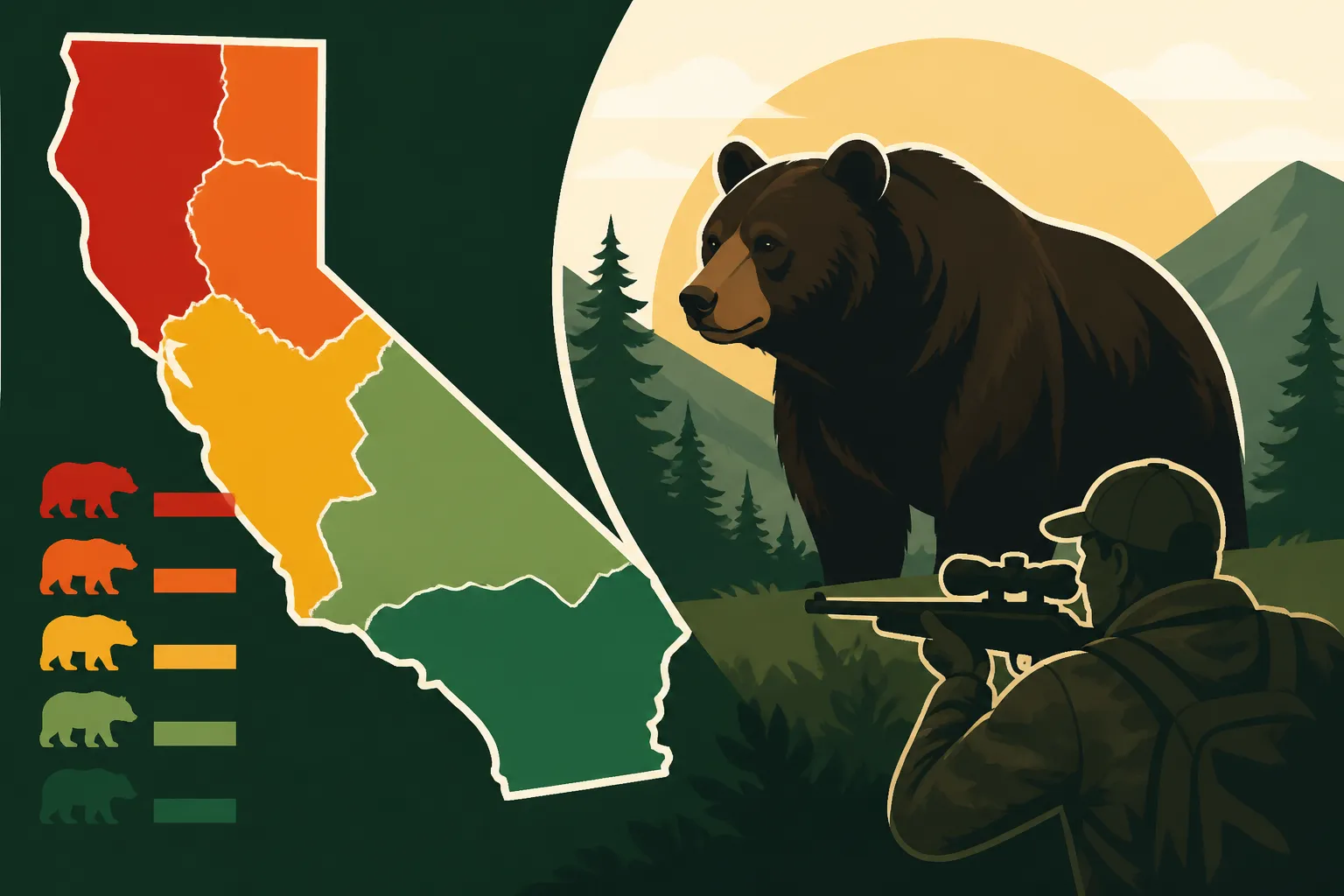
Regional Bear Density Overview
To give you a clearer picture, here's a general overview of California's black bear density by major region. Keep in mind these are broad categorizations, and localized variations will always exist.
| Region | Typical Bear Density | Key Characteristics | Prime Hunting Opportunities |
|---|---|---|---|
| Northern California Forests | High | Vast, dense conifer forests; abundant salmon runs; extensive wilderness areas. Includes Klamath, Six Rivers, Shasta-Trinity. | Spot-and-stalk in timber and clear-cuts; hunting berry patches. |
| Northern/Central Sierra Nevada | High | Mixed conifer/oak forests; high elevation meadows; abundant acorns/berries; extensive public land. Includes Tahoe, Stanislaus, Sierra NF. | Glassing high country; hunting oak flats; still-hunting dense timber. |
| Southern Sierra Nevada | Moderate to High | Similar to central Sierra but may have larger wilderness areas; includes Sequoia National Forest. | Backcountry spot-and-stalk; focusing on burn scars. |
| Central Coastal Ranges | Moderate | Chaparral and oak woodlands; steep, brushy terrain; localized dense populations, e.g., Los Padres NF. | Still-hunting dense cover; targeting water sources. |
| Southern Coastal Ranges | Low to Moderate | More fragmented habitat; lower overall rainfall; bears tied to specific mountain ranges. | Focused scouting on water/food sources; remote pockets. |
| Eastern Sierra (East Slope) | Low | Drier climate; bears concentrated in higher elevation forests and near perennial water. | High-country spot-and-stalk; targeting aspen groves. |
| Desert Mountain Ranges | Very Low | Extremely arid; bears rare, found only in isolated ranges with reliable water. | Highly specialized hunting; extensive, remote scouting. |
This table offers a quick reference, but remember, the real work comes in using detailed maps, satellite imagery, and on-the-ground scouting to find those specific honey holes within these broader regions.
Disclaimer
This article is for general informational purposes only and does not constitute professional advice. Laws, prices and regulations vary by location and change over time. Consult a qualified professional for guidance on your specific situation.