Arrow Weight for Elk-Sized Game
If you've ever stood at the pro shop, staring at various arrow shafts and components, trying to figure out the perfect setup for a California elk hunt, you know the struggle. There's so much conflicting advice out there about speed versus weight, and it can feel like you're trying to solve a complicated math problem just to pick an arrow. This guide is here to cut through the noise, helping you understand the critical factors involved in choosing the right arrow weight to maximize your chances of a clean, ethical harvest on an elk-sized animal.
The Fundamental Trade-off: Speed Versus Kinetic Energy
It’s a tale as old as archery itself: the debate between a lightning-fast arrow and a heavy, hard-hitting one. Many bowhunters, especially those new to pursuing larger game like elk, naturally gravitate towards speed. There’s something undeniably appealing about seeing your arrow zip downrange like a laser beam. However, when it comes to elk, raw speed isn't always your best friend, and often, it can be a significant disadvantage.
Why Speed Isn't Everything for Elk
A fast arrow offers a flatter trajectory, which can be forgiving if you misjudge yardage slightly. This is certainly a benefit, especially in the varied terrain of California where a flat shot from a ridge top might suddenly turn into a steep downhill angle. However, that speed comes at a cost. To achieve higher speeds, you generally need a lighter arrow. Lighter arrows shed kinetic energy and momentum much more quickly than heavier arrows as they travel downrange. What might seem like a small difference in speed at the chronograph can translate into a dramatic drop in penetration power when the arrow hits its target, particularly if it encounters bone.
Think about it this way: a light arrow might travel 300 feet per second (fps) from your bow, feeling incredibly quick. But by the time it reaches 40 yards, it might have lost a significant percentage of its initial energy. A slightly heavier arrow, perhaps leaving the bow at 270 fps, might maintain its energy and momentum more efficiently over that same distance. For elk, which possess thick hides, dense muscle, and robust bone structures, every ounce of kinetic energy and momentum matters. You're not just looking to stick an arrow in them; you're looking for deep penetration that leads to rapid incapacitation.
The Power of Kinetic Energy and Momentum
Kinetic energy (KE) and momentum (P) are the two critical physics principles at play when we talk about arrow performance, especially for big game. Kinetic energy is essentially the energy an arrow possesses due to its motion, and it's what does the work of cutting and crushing tissue. Momentum, on the other hand, is a measure of an object's mass in motion and is often considered a better indicator of an arrow's ability to drive through resistance – like bone.
A heavier arrow, even if it travels slower, carries more mass. This increased mass directly translates to higher momentum. When that heavier, slower arrow encounters resistance, it's less likely to be deflected and more likely to continue driving forward, transferring its energy into the animal. This is why seasoned elk hunters often prioritize a heavier arrow with good momentum over a feather-light speed demon. The goal isn't just to get the arrow there; it's to get it through the animal, or at least deep enough for a humane kill, especially if you hit a rib or shoulder blade on a quartering shot in the steep country of Hunting California's Sierra Nevada Backcountry.
Understanding Total Arrow Weight Components
Your "arrow weight" isn't just the shaft itself. It's the sum of several components, each playing a crucial role in the arrow's flight characteristics and terminal performance. Understanding these components allows you to customize your setup for optimal results when pursuing an animal like an elk.
The Arrow Shaft Itself
The primary component is, of course, the arrow shaft. These are typically made from carbon fiber, aluminum, or a carbon-aluminum composite. Carbon shafts are popular for their durability, consistency, and relatively light weight for their strength. Aluminum shafts tend to be heavier per inch but are known for their straightness and consistency. Composite shafts try to offer the best of both worlds.
Shaft weight is measured in grains per inch (GPI). A typical carbon hunting shaft might range from 7 to 10 GPI, but heavier carbon shafts designed for big game can go upwards of 12-14 GPI. When you choose a shaft, consider its spine (stiffness), which must match your bow's draw weight and length to fly accurately. An improperly spined arrow, regardless of its weight, will never fly true and can lead to dangerous situations or missed opportunities on an Columbia Blacktail and Mule Deer in California, let alone a huge elk.
Inserts, Points, and Fletching
Beyond the shaft, you have several critical components that add to the total weight:
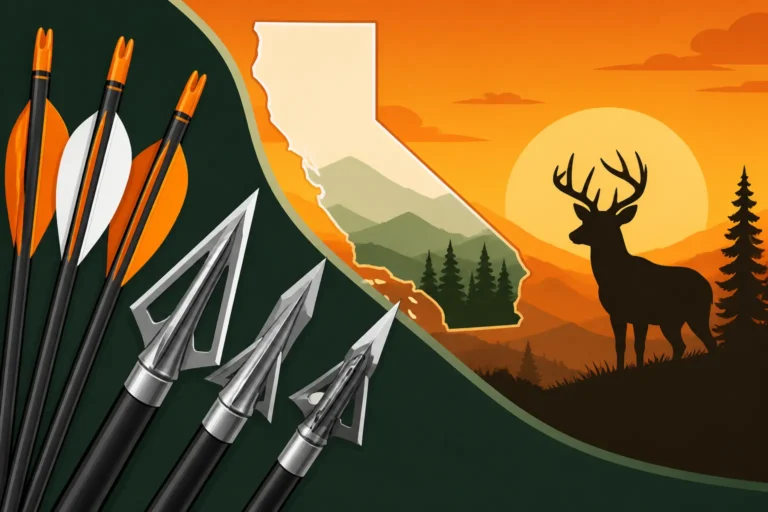
- Inserts: These are small metal or aluminum sleeves glued into the front of the arrow shaft, providing a threaded receptacle for your broadhead. Standard aluminum inserts are relatively light, but heavy brass or steel inserts are available, sometimes weighing 50, 75, or even 100+ grains. These "Front of Center" (FOC) enhancing inserts are a popular way to add weight up front, which can improve penetration and arrow flight stability.
- Points/Broadheads: This is where a significant portion of your total arrow weight resides. Field points, used for practice, typically match the weight of your hunting broadheads. Broadheads for elk can range from 100 grains to 125, 150, or even 200 grains. For elk, many hunters choose heavy-duty fixed-blade broadheads known for their robust construction and ability to penetrate tough hides and bone without failure. Mechanical broadheads can also be effective, but their performance on bone can vary depending on design, and often fixed blades are preferred for maximum penetration on tough targets.
- Fletching and Nocks: These are relatively minor contributors to total weight but are essential for arrow flight. Fletching (vanes or feathers) provides stabilization. Plastic vanes are most common for hunting, and while light, their shape and size can create drag. Nocks are the small plastic pieces that snap onto your bowstring. While often overlooked for their weight, every grain adds up.
By strategically selecting these components, you can fine-tune your total arrow weight. For instance, a lighter carbon shaft combined with heavy brass inserts and a 125 or 150-grain broadhead can create a fantastic hunting arrow for elk, offering both durability and significant momentum. This approach is often more effective than simply choosing the heaviest shaft you can find.
Kinetic Energy and Momentum: Why They Matter for Elk
When we talk about hunting elk with a bow, we're not just aiming to hit them; we're aiming to drive a broadhead completely through them or at least deep enough to disrupt vital organs effectively. This is where the concepts of kinetic energy and momentum become absolutely crucial. A small deer might be forgiving of a less-than-perfect arrow setup, but an elk is a completely different animal.
The Physics of Penetration
Imagine trying to drive a nail into a piece of hardwood. A small, light tack hammer might tap it, but a heavy framing hammer will drive it home with authority. Your arrow acts much like that hammer. Kinetic energy (KE) dictates how much "work" your arrow can do upon impact, measured in foot-pounds. Momentum (P), often measured in slug-feet per second (though usually discussed more qualitatively in archery), describes how much "oomph" the arrow has to overcome resistance and continue its path.
For elk, you're looking to overcome several layers of resistance:
- Thick Hide and Hair: Elk have surprisingly tough hides, especially mature bulls in prime condition.
- Dense Muscle: The layers of muscle are thick and fibrous, particularly around the shoulder and chest.
- Rib Cage: Even a direct hit between ribs requires significant force, and if you hit a rib head-on, you need serious momentum to break through or push it aside.
- Opposite Side Exit: The ideal scenario is a pass-through, creating two holes for a better blood trail and ensuring maximum internal damage. This means driving through all the above layers twice, plus the internal organs.
A high-KE, high-momentum arrow is far more likely to achieve this level of penetration. If your arrow lacks sufficient energy and momentum, it might deflect off a rib, not penetrate deep enough, or fail to exit, leading to a difficult blood trail and a potentially wounded animal. This is a scenario no ethical hunter wants to face in the vastness of the Hunting California's High-Country X-Zones.
Minimums and Optimal Ranges for Elk
While there are no strict legal minimums for arrow kinetic energy in California (unlike minimum draw weights or arrow lengths), the archery community has developed some generally accepted guidelines for ethical hunting. For elk, most experienced bowhunters would consider a minimum of 60-65 foot-pounds of kinetic energy to be sufficient for a humane kill, assuming a well-placed shot and a sharp, quality broadhead.
However, "sufficient" doesn't mean "optimal." Many elk hunters prefer to be well above this minimum, often striving for setups that generate 70-80+ foot-pounds of kinetic energy. This added margin of power helps ensure good penetration even on less-than-perfect shot angles or if the arrow encounters bone. The heavier arrow's momentum contributes greatly here, helping the arrow maintain its energy and drive through obstacles.
It's also worth noting that different bow setups will yield different KE and momentum values, even with the same arrow weight. A modern compound bow with a high draw weight (e.g., 70+ pounds) and a long draw length will naturally generate more power than a lighter draw weight bow. This means you might need to adjust your arrow weight slightly depending on your specific equipment. Resources like GoHunt often provide detailed gear reviews and ballistics calculators that can help you estimate these figures for your own setup, allowing you to fine-tune your choices before Scouting California Public Land Before Season.
Factors Influencing Your Ideal Arrow Weight
Choosing the "perfect" arrow weight for elk isn't a one-size-fits-all scenario. Several variables come into play, from your personal setup to the specific conditions of your hunt. Ignoring these factors can lead to a less-than-optimal setup, potentially impacting accuracy and penetration when it matters most.
Your Bow Setup and Draw Cycle
The power plant for your arrow is your bow. The draw weight you pull, your draw length, and the efficiency of your bow's cams all dictate how much energy can be transferred to the arrow.
- Draw Weight: A hunter pulling 60 pounds will need a different arrow weight strategy than someone pulling 75 pounds. Lower draw weights often benefit more from heavier arrows, as the increased mass helps retain momentum. Higher draw weights have more inherent power, allowing for a bit more flexibility in arrow weight while still achieving excellent penetration.
- Draw Length: Longer draw lengths generally mean more power stroke and thus more kinetic energy potential.
- Bow Efficiency: Different bows have different efficiencies in how they transfer energy to the arrow. Modern compound bows are incredibly efficient, but a traditional recurve or longbow will have a much lower arrow speed for a given draw weight, making arrow weight even more critical for penetration.
It’s crucial to match your arrow weight not just to the animal, but to your specific bow and your ability to comfortably and accurately shoot it. Don't crank up your draw weight beyond what you can handle, just to shoot a slightly heavier arrow. Accuracy always trumps raw power.
Broadhead Selection and FOC
Your broadhead choice is intimately tied to your arrow weight. Heavy fixed-blade broadheads are often preferred for elk due to their robust construction and proven penetration. Many hunters will choose a 125-grain or even 150-grain broadhead for elk, recognizing that the extra weight up front significantly aids in penetration.
Front-of-Center (FOC) refers to how far forward the balance point of your arrow is. A higher FOC (typically 12-18% for hunting) generally leads to better arrow flight stability and improved penetration because the weight leads the shaft, similar to how a dart flies. You can increase FOC by using heavier broadheads, heavy inserts, or even heavier shaft sections up front. Combining a heavier broadhead with a heavy insert is a common strategy to achieve a high FOC and a hard-hitting arrow, perfect for the kind of tough hide and bone you might encounter in the Hunting Coastal Range Oak Woodlands.
| Component | Typical Grain Range | Impact on Total Weight | Impact on FOC | Notes |
|---|---|---|---|---|
| Carbon Shaft | 7-14 GPI | Primary contributor | Medium | Varies by shaft model and cut length |
| Aluminum Shaft | 9-13 GPI | Primary contributor | Medium | Generally heavier than carbon shafts |
| Standard Insert | 10-20 grains | Minor | Low | Basic aluminum insert |
| Heavy Insert | 50-150 grains | Significant | High | Brass or steel for FOC enhancement |
| Broadhead | 100-200 grains | Significant | High | Most impact on FOC, crucial for penetration |
| Nock | 5-10 grains | Minor | Negligible | Standard component, small weight |
| Fletching (3) | 20-40 grains | Minor | Negligible | Plastic vanes or feathers |
Shot Distance and Terrain Considerations
While an elk shot typically occurs within 20-40 yards, you might find yourself needing to take a 50 or 60-yard shot in open country like the high Sierra. A heavier arrow will have a more pronounced trajectory arc compared to a lighter, faster arrow. This means you need to be precise with your yardage estimation. Investing in a quality rangefinder is paramount.
In rugged California terrain, where shots can be steeply uphill or downhill, a slower, heavier arrow might also exacerbate trajectory differences. However, the enhanced momentum can be a lifesaver if you encounter brush or a slight deflection. Ultimately, the priority remains ethical penetration, so if you're comfortable with your aiming points out to your maximum ethical range, a heavier arrow's trajectory is manageable. Practicing at these longer ranges with your hunting setup is non-negotiable before heading into the field. This is where applications like GoHunt can help you scout terrain and understand potential shot angles, preparing you for the real deal.
Practical Arrow Weight Ranges for Elk Hunters
Okay, so we've talked about the "why" behind arrow weight, now let's get into the "what" – what are some practical total arrow weights that most elk hunters find successful? Keep in mind, these are general guidelines, and your specific setup and preferences will ultimately dictate your final choice.
The "Sweet Spot" for Total Arrow Weight
For hunting elk-sized game, many experienced archers aim for a total arrow weight, including broadhead, in the range of 450 to 550 grains. This range offers an excellent balance of kinetic energy, momentum, and manageable trajectory for most modern compound bows with draw weights between 60-70 pounds.
- Around 450-475 grains: This lighter end of the spectrum is often favored by hunters who prioritize a flatter trajectory, especially if they anticipate longer shots in open country. With a well-tuned bow and a sharp, quality broadhead, this weight can certainly be effective, particularly if your bow generates high initial speeds. You'll want to ensure you're still hitting those minimum kinetic energy and momentum thresholds for elk.
- 475-525 grains: This is arguably the most popular and versatile range for elk. Arrows in this category strike an excellent balance. They carry substantial momentum, provide deep penetration, and still offer a relatively flat trajectory out to typical hunting distances. If you're unsure where to start, this is a fantastic sweet spot to experiment with.
- 525-550+ grains: Hunters prioritizing maximum penetration, perhaps using lower draw weights, traditional bows, or specifically targeting very large bull elk, might gravitate towards this heavier end. These arrows are absolute powerhouses, carrying immense momentum. The trade-off is a more arcing trajectory, demanding precise range estimation. However, when a heavy arrow hits, it hits with authority, giving you confidence even if you encounter bone. For more specific advice on this, you might check out resources discussing Best Arrow Weight for a Tule Elk Bull.
The "Heavy Arrow" Movement
There's been a growing movement in recent years towards even heavier arrows, sometimes exceeding 600 or 700 grains, especially for dangerous game or for hunters who want the absolute maximum penetration. While these setups can be incredibly effective, they come with significant trajectory challenges. An arrow weighing over 600 grains will have a very pronounced arc, making yardage estimation absolutely critical. If you're considering going this heavy, meticulous practice at all practical ranges, especially odd distances like 27 or 43 yards, is essential.
For the vast majority of California elk hunting scenarios, an arrow in the 450-550 grain range, combined with a sharp fixed-blade broadhead, will provide more than enough power for a clean kill. The key is consistent accuracy with your chosen setup.
The Role of Arrows in Your Overall Elk Gear
Remember that your arrow is just one piece of the puzzle. It needs to work in harmony with your broadheads, your release, and your sights. All these components must be properly tuned for optimal performance. You can have the perfect arrow weight, but if your bow isn't tuned, or your broadheads aren't flying true, it won't matter. When assembling your kit for a serious backcountry hunt, considering items like a sturdy pack for Packs and Gear for a Backcountry Elk Hunt and high-quality optics for glassing are just as important as your arrow setup itself.
Tuning Your Bow for Heavy Arrows
You can have the most expensive, perfectly weighted arrows, but if your bow isn't properly tuned to shoot them, all that potential is lost. Tuning is the process of adjusting your bow to make arrows fly straight and consistently, and it's even more critical when you're dealing with heavier hunting arrows designed for big game like elk.
The Walk-Back and Paper Tuning Method
Two common and highly effective methods for tuning your bow are walk-back tuning and paper tuning.
- Paper Tuning: This involves shooting an arrow through a piece of paper suspended a few feet in front of your bow. The tear in the paper reveals how the arrow is leaving your bowstring. A perfect tear (a small bullet hole) indicates clean arrow flight. If the tear shows the nock-end of the arrow going left, right, up, or down, it means the arrow is oscillating, and adjustments need to be made to your rest, nocking point, or cam timing. Paper tuning is a great starting point for any setup.
- Walk-Back Tuning: After paper tuning, walk-back tuning refines your horizontal sight settings. You stand close to a target (e.g., 10 yards) and shoot an arrow aiming at a specific spot. Then, without adjusting your sight, you walk back to 20, 30, and 40 yards, aiming at the exact same spot. If your arrows are vertically aligned but horizontally spreading left or right, it indicates your center shot isn't perfect. Adjusting your arrow rest slightly left or right until your arrows stack vertically at all distances will refine your tuning for your heavy arrows, ensuring they fly true over varying distances, which is vital when you're Hunting California's Three Elk Species.
Broadhead Tuning and Point of Impact
Once your field points are flying perfectly, it's time to broadhead tune. This is a critical step that many hunters skip, to their detriment. Broadheads, especially fixed-blade models, can create aerodynamic drag that can cause your arrow to fly differently than it does with a field point.
- Shoot Your Broadheads: Shoot your actual hunting broadheads at various distances (20, 30, 40 yards).
- Compare to Field Points: Compare the point of impact of your broadheads to your field points. Ideally, they should hit the exact same spot.
- Adjust as Needed: If your broadheads are consistently hitting differently, you'll need to make fine adjustments to your bow. For minor differences, small shifts to your arrow rest (micro-adjustments are key here) or even slight tweaks to cam timing can often bring them together. For significant differences, you might need to reconsider your broadhead choice or re-evaluate your base bow tune. Never accept a broadhead that doesn't fly like your field points. This is paramount for ethical hunting.
Tuning takes time and patience, but it's an investment that pays huge dividends in the field. A perfectly tuned bow, paired with an appropriately weighted arrow and a sharp broadhead, gives you the confidence that your shot will go exactly where you aim, maximizing your chances for a quick, humane kill. This dedication to precision is what separates a prepared hunter from one who leaves too much to chance, particularly when applying for highly coveted tags like Applying for a California Roosevelt Elk Tag in the Northwest or Applying for a California Tule Elk Tag in the Big Game Drawing.
Arrow Components and Aftermarket Options for Elk
Beyond the standard components, there's a whole world of aftermarket options designed to help you build the perfect elk arrow. These often focus on increasing overall weight, enhancing FOC, or improving durability – all crucial considerations when pursuing such a formidable animal.
Heavy Inserts and Outserts
As mentioned, heavy inserts are a game-changer for elk hunters. Instead of just relying on the broadhead for front weight, brass or steel inserts push the FOC significantly forward, improving flight stability and increasing momentum. Companies like Ethics Archery or TopHat produce high-quality systems that allow you to customize front-end weight precisely. These inserts are heavier than standard aluminum, often ranging from 50 grains to 100 grains or more, giving you much more control over your total arrow weight and FOC without having to drastically change your shaft choice.
For some ultra-thin micro-diameter shafts, outserts might be used instead of inserts. These fit over the outside of the shaft and offer similar weight-forward benefits. The choice between an insert and an outsert often depends on the specific arrow shaft and broadhead system you're using. The goal is the same: to create a robust, weight-forward system that will stand up to the impact of big game.
Durable Fletching and Nock Systems
While the weight contribution of fletching and nocks is minimal, their durability is paramount, especially on a physically demanding elk hunt in rugged country. You'll likely be hiking through brush, climbing over fallen timber, and potentially exposing your arrows to harsh conditions. Choosing tough plastic vanes that can withstand abuse, or easily replaceable systems, is a smart move.
Some hunters also opt for lighted nocks, which are excellent for shot placement verification in low light and for tracking your arrow after the shot. The added weight of a lighted nock (typically 20-30 grains) should be factored into your total arrow weight calculations and tuning process. While not directly impacting penetration, seeing your shot placement can save you hours of tracking, especially in the fading light of an evening hunt.
The Role of Custom Arrow Building
For many serious elk hunters, building custom arrows is the ultimate way to achieve precision. This involves selecting specific shafts, cutting them to precise lengths, squaring both ends of the shaft for perfect broadhead alignment, and then carefully installing inserts and fletching. This level of detail ensures that every arrow in your quiver is as consistent as possible, leading to better accuracy and more predictable performance.
Using a grain scale to weigh each component – shafts, inserts, broadheads, nocks, and fletching – ensures that all your hunting arrows are within a grain or two of each other. This consistency is vital for groups that are identical at 20 yards to remain identical at 60 yards. While it might sound like a lot of work, the confidence gained from knowing your arrow system is perfectly matched and tuned is invaluable when you finally get an opportunity at a magnificent California elk. This kind of attention to detail is often discussed in broader terms when looking at Rifles and Calibers for California Big Game, where precision is always key, regardless of the weapon.
Conclusion: Balancing Performance and Precision for Elk
Ultimately, choosing the right arrow weight for elk-sized game is about finding a balance. You want an arrow that carries sufficient kinetic energy and momentum to achieve a humane, quick kill through thick hide and bone, but also one that flies accurately and consistently from your specific bow setup. There's no single "magic" number, but aiming for a total arrow weight in the 450-550 grain range with a high FOC is an excellent starting point for most modern compound bowhunters.
Never compromise accuracy for speed or brute force. A perfectly placed, moderately weighted arrow will always be more effective than a heavy arrow that flies erratically. Invest the time in proper bow tuning, practice diligently at realistic hunting distances, and always ensure your broadheads are razor-sharp. When you're standing eye-to-eye with an elk in the wilds of California, your confidence in your gear, built on careful preparation and informed choices, will be your greatest asset. Good luck out there!
Disclaimer
This article is for general informational purposes only and does not constitute professional advice. Laws, prices and regulations vary by location and change over time. Consult a qualified professional for guidance on your specific situation.