California Blacktail Color Phase Rarities
If you’ve spent any time chasing blacktail deer through California’s rugged hills and dense timber, you’re familiar with their typical coloration: a handsome, almost grizzled brown-gray coat, often darker on the back and lighter on the belly, perfectly designed to disappear into the shadows. But what if you saw something entirely different? This guide isn't just about the deer you expect; it's about those incredibly rare, breathtaking moments when a blacktail buck or doe steps out of the brush, sporting a color phase that defies expectations and leaves you wondering if your eyes are playing tricks. We're going to explore these genetic anomalies, helping you understand why they occur and why they're such a seldom-seen marvel in the California deer woods.
Understanding the Standard Blacktail Palette
Before we dive into the extraordinary, it's helpful to first firmly grasp what's considered "normal" for a California blacktail deer. Most of us have a mental image, or many real-life memories, of their standard appearance, and for good reason—it’s the vast majority of what’s out there. This baseline helps us appreciate just how much of a departure the rare color phases truly are.
The Classic Columbia Blacktail Appearance
The Columbia blacktail deer, the predominant subspecies in much of California, especially in the coastal ranges and the western slopes of the Sierra Nevada, are masters of camouflage. Their typical summer coat is a reddish-brown, often quite sleek and shiny, designed to help them blend in with the sun-drenched, drier vegetation of the warmer months. As autumn approaches and the hunting seasons kick off, this gives way to a thicker, grayer, and often darker winter coat. This shift helps them melt into the deep shadows of the redwood forests or the mottled light of oak woodlands. Their defining feature, of course, is that small, all-black tail, which gives them their name and is a key identifier when you see one bolt through the brush. The face is usually a lighter gray or tan, and the muzzle can be almost white, providing a striking contrast to their dark eyes and nose. This overall pattern is what allows them to survive and thrive in varied habitats, from the dense chaparral to the towering timber.
Seasonal Coat Changes and Their Purpose
Deer don't just pick a color and stick with it; their coats are dynamic, changing with the seasons. This isn't just a fashion statement; it's crucial for their survival. The summer coat is thinner, allowing for better heat dissipation, and its reddish hue often matches the sun-bleached grasses and leaves of late summer. Imagine trying to stay cool in the intense heat of a California August while wearing a thick, dark winter coat—it would be a recipe for overheating.
As temperatures drop and shorter days signal winter's approach, a deer's metabolism shifts, prompting the growth of a denser, coarser winter coat. This coat, typically gray to brownish-gray, has hollow hairs that provide exceptional insulation, trapping air to keep the deer warm even when snow blankets the ground in higher elevations. The darker coloration can also help absorb sunlight, providing an extra bit of warmth on crisp winter days. These seasonal changes are genetically programmed, ensuring deer are always equipped for the prevailing environmental conditions. While these changes can alter the shade of a blacktail, they don't fundamentally change its color phase. That’s where the true rarities come in. You might be glassing for a buck during Hunting Coastal Range Oak Woodlands or trying to pinpoint a deer during Scouting California Public Land Before Season, and understanding these shifts helps you know what’s typical.
Melanism: The Elusive Black Blacktail
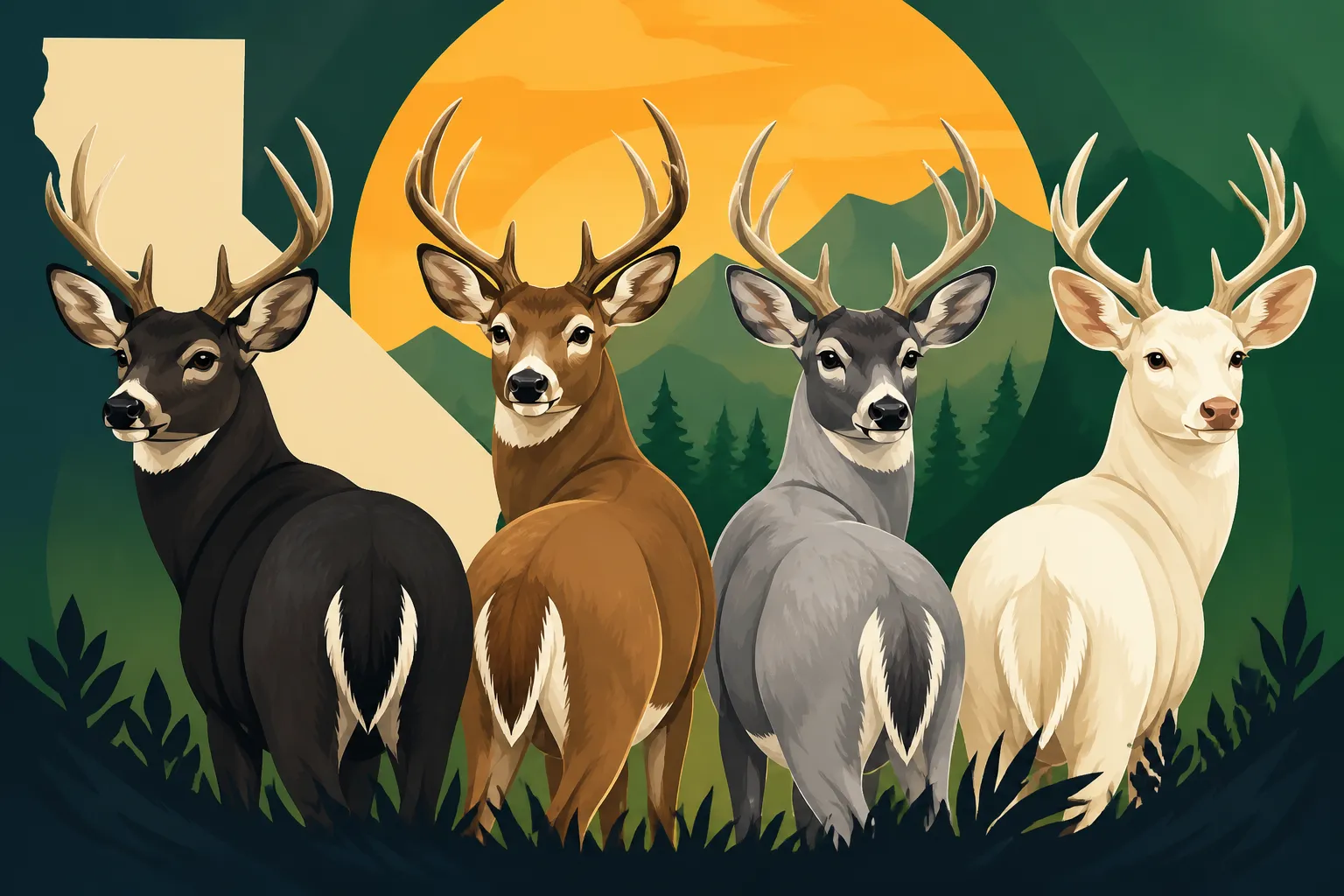
Among the most striking and perhaps most sought-after of the rare color phases is melanism. Picture a blacktail deer, but instead of the familiar brown and gray, its entire body is cloaked in a deep, glossy black. These are often referred to as "black deer" or "phantom deer," and seeing one is an experience most hunters only dream of.
What Causes Melanism in Deer
Melanism is essentially the opposite of albinism. It’s a genetic condition resulting from an overproduction of melanin, the dark pigment responsible for skin, hair, and eye color. In deer, this means the typical brown and gray pigments are overwhelmed by an abundance of black. This isn't just a darker shade of brown; it's a true, charcoal black, often with a sheen that makes them look almost wet, even when dry. The condition is often caused by a dominant gene mutation, meaning even one copy of the mutated gene can lead to a melanistic individual.
While it's rare to see in any deer species, melanistic blacktails are particularly elusive. Their dark coloration, while striking to us, can actually be a disadvantage in some environments. In heavily forested areas, they might blend in well with deep shadows, but in open, sunlit fields or during winter when snow is on the ground, they can stand out dramatically. This increased visibility can make them more susceptible to predation, which is one of the reasons these genes don't become widespread in the population. The few sightings often come from specific geographic pockets, suggesting localized genetic prevalence.
Encounters with Melanistic Blacktails
Stories of black deer sightings are the stuff of legend around campfires. Imagine spending weeks in the field, maybe meticulously planning a hunt using resources like GoHunt to understand game movement, and then having a pitch-black deer step out. It's truly a once-in-a-lifetime encounter for most. These deer are often sighted in areas with dense cover, such as the mixed conifer forests of the North Coast or the thick riparian zones of certain river systems, where their dark coats might provide a modicum of camouflage.
One story I heard from an old timer involved a hunter who swore he saw a "bear" in the distance, only to have it resolve into a massive, melanistic blacktail buck. The sheer disbelief and awe in his voice as he recounted the story years later was palpable. Hunters who pursue Columbia Blacktail and Mule Deer in California might spend decades in the field without ever seeing such a specimen. These rare individuals become legendary, sparking discussions about local genetics and the hidden wonders of the wilderness. While they might be visually stunning, they still behave like any other deer, following established California Deer Migration Corridors or bedding in familiar spots.
Leucism and Piebaldism: The White Spectrum
On the other end of the color spectrum, we have deer that display various degrees of white coloration. These aren't just lighter brown deer; these are individuals with a significant reduction or absence of pigment, resulting in white patches or even an entirely white coat. It's important to understand the differences between these conditions to truly appreciate what you might be seeing.
Distinguishing Leucism from Albinism
Many people mistakenly use the terms "albino" and "leucistic" interchangeably, but there's a crucial distinction. True albinism is a complete lack of all pigment, not just in the hair, but also in the skin and eyes, due to a genetic mutation that prevents melanin production entirely. This results in stark white hair, pink skin, and, most tellingly, pink or red eyes (due to the blood vessels showing through the unpigmented iris). Albino deer often have poor eyesight and are highly sensitive to sunlight, making their survival in the wild incredibly challenging.
Leucism, on the other hand, is a partial loss of pigment. Leucistic deer will have white patches or an entirely white coat, but their eyes will retain their normal dark color. Their skin might also be normally pigmented in some areas. This is because the cells that produce pigment are simply absent or unable to deposit pigment in certain areas, rather than a total inability to produce pigment at all. A truly leucistic deer might appear completely white, but if its eyes are dark, it's leucistic, not albino. These deer, while still standing out in their environment, generally don't suffer from the severe visual impairments associated with albinism. For hunters Glassing a Canyon for a Bedded Buck, a flash of pure white would certainly grab attention, regardless of the precise genetic cause.
The Striking Patterns of Piebald Deer
Piebaldism is a specific form of leucism, and it's perhaps the most commonly observed "white" deer variation. A piebald deer has irregular patches of white and normal coloration, creating a strikingly mottled appearance. Think of a pinto horse, but on a deer. The size and location of these white patches can vary dramatically from individual to individual. Some might have just a white chest blaze or white socks on their legs, while others might be half white, half normal brown, or even mostly white with just a few brown spots.
This condition is typically caused by a recessive gene, meaning both parents must carry the gene for their offspring to express piebaldism. This also means that piebald deer can exist within a normal-looking population, carrying the gene silently. While piebald deer are visually stunning, the gene that causes piebaldism can sometimes be linked to other genetic anomalies, such as shortened legs, bowed noses, or internal organ issues, though many piebald deer are perfectly healthy. Spotting a piebald blacktail in the dense California chaparral is a memorable event, and their unusual patterns make them incredibly conspicuous, especially during the darker winter coat phase. Knowing Where California Blacktail Bucks Bed might give you a slight edge in seeing one, but it's still largely chance.
Erythrism: The Red Phase Blacktail
While less commonly discussed than melanism or leucism, erythrism offers another fascinating deviation from the standard blacktail coloration. This condition results in a deer with an unusually reddish or cinnamon hue to its coat, often more vibrant and persistent than the typical summer reddish-brown.
The Genetics Behind a "Red" Blacktail
Erythrism is characterized by an excessive amount of red pigment (pheomelanin) and a reduced or absent amount of dark pigment (eumelanin). Instead of the usual balance that creates the typical brown-gray, a deer with erythrism will have a coat that leans heavily towards shades of red, orange, or even a deep rusty cinnamon. This isn't simply a darker summer coat; it's a distinct, all-encompassing reddish tone that often persists even into their winter coat, where most blacktails would shift to a grayer hue.
Like other color phases, erythrism is a genetic anomaly, likely stemming from a recessive gene or a specific gene mutation that alters pigment production. While not as starkly contrasted as a black or white deer, an erythristic blacktail would certainly catch a hunter's eye, particularly in an environment where their usual gray camouflage is expected. Imagine Still-Hunting California's Sierra Nevada Timber and seeing a deer that appears almost reddish-gold in the dappled sunlight—it would be a moment of genuine wonder.
Where These Redder Hues Might Be Seen
Because erythrism is less visually extreme than melanism or leucism, it can sometimes be mistaken for a particularly vibrant summer coat, especially early in the fall season. However, true erythristic deer maintain this reddish hue more consistently. They might be more readily observed in areas where the normal blacktail population already has a tendency towards slightly redder tones, perhaps in certain coastal regions or areas with specific feed types that could hypothetically influence coat vibrancy, though the primary cause is genetic.
Observing an erythristic blacktail would be a rare treat, adding another layer to the diverse tapestry of California's wildlife. While most of your focus might be on understanding California Deer Herd Size or the optimal California Deer Antler Growth Timeline, knowing these genetic quirks exist makes every outing an exciting possibility for an unexpected sighting.
Why These Rarities Remain So Uncommon
Given how stunning these color phases are, you might wonder why they aren’t more prevalent. The simple truth is that while they are beautiful and fascinating to us, these genetic deviations often come with significant survival challenges for the deer themselves.
Survival Challenges for Atypical Deer
The natural world is harsh, and camouflage is a deer's primary defense mechanism against predators. A deer that stands out, whether due to an extremely dark, light, or brightly colored coat, immediately becomes a more conspicuous target.
- Melanistic Deer: While a black coat might offer excellent concealment in deep, dark shadows, it makes a deer incredibly visible in open country, against snow, or in moonlit conditions. A mountain lion or coyote would have an easier time picking out a dark form against a lighter backdrop.
- Leucistic and Piebald Deer: Pure white or extensively white deer are glaringly obvious in nearly every natural habitat, especially during the green months or against typical soil and rock formations. This makes them highly vulnerable to predation. Additionally, as mentioned, the genes causing piebaldism can sometimes be linked to other, more debilitating physical deformities, which further reduce their survival rates.
- Erythristic Deer: While perhaps less severely disadvantaged than pure white or black deer, an unusually reddish deer might still stand out against the grayer tones of winter brush or dry summer fields, potentially making them an easier target for predators.
Beyond predation, some of these conditions, particularly albinism, can lead to physiological disadvantages like poor eyesight or increased susceptibility to sunburn, further hindering their ability to find food, avoid danger, and navigate their environment effectively. This constant pressure from natural selection ensures that these rare genetic traits, while persistent, remain anomalies rather than becoming widespread within the California Deer Population Estimate.
Observational Evidence and Hunter Stories
Most of what we know about these rare color phases comes from anecdotal evidence shared by hunters, hikers, and wildlife observers. These are the "unicorn" sightings that fuel conversations for years. Photos, though often blurry or distant, circulate among local hunting communities, confirming the existence of these unique animals. Every now and then, a hunter might even harvest one of these rare deer, leading to a truly unique trophy and an even more unique story.
These encounters underscore the wildness and genetic diversity that still exists within California's deer herds. While tools like GoHunt are fantastic for mapping out potential hunting areas or understanding public land access, no app or map can predict when and where you might encounter one of these incredibly rare color phases. It’s a matter of spending time in the field, keeping your eyes open, and having a bit of luck. These sightings remind us that every time we step into the woods, there’s a chance to witness something truly extraordinary, a testament to nature's incredible variety and resilience.
| Color Phase | Primary Visual Characteristics | Genetic Cause | Rarity (Relative) | Survival Impact (General) |
|---|---|---|---|---|
| Melanism | Entirely or predominantly black coat, dark eyes, dark skin | Overproduction of melanin (dominant gene mutation) | Extremely Rare | Increased visibility in open/light environments; blends in deep shade |
| Leucism | White coat, but normal dark eyes, normal skin patches | Partial absence of pigment cells (recessive gene) | Very Rare | Increased visibility, potential for other anomalies (less than albinism) |
| Piebaldism | Patches of white and normal coloration | Specific form of leucism (recessive gene) | Rare | Increased visibility; sometimes linked to other physical deformities |
| Albinism | Stark white coat, pink eyes, pink skin | Complete lack of all pigment (recessive gene) | Extremely Rare | Severe visual impairment, high visibility, sensitive to sun |
| Erythrism | Unusually reddish, orange, or cinnamon-colored coat | Excessive red pigment, reduced dark pigment | Very Rare | Potentially increased visibility depending on habitat |
Disclaimer
This article is for general informational purposes only and does not constitute professional advice. Laws, prices and regulations vary by location and change over time. Consult a qualified professional for guidance on your specific situation.