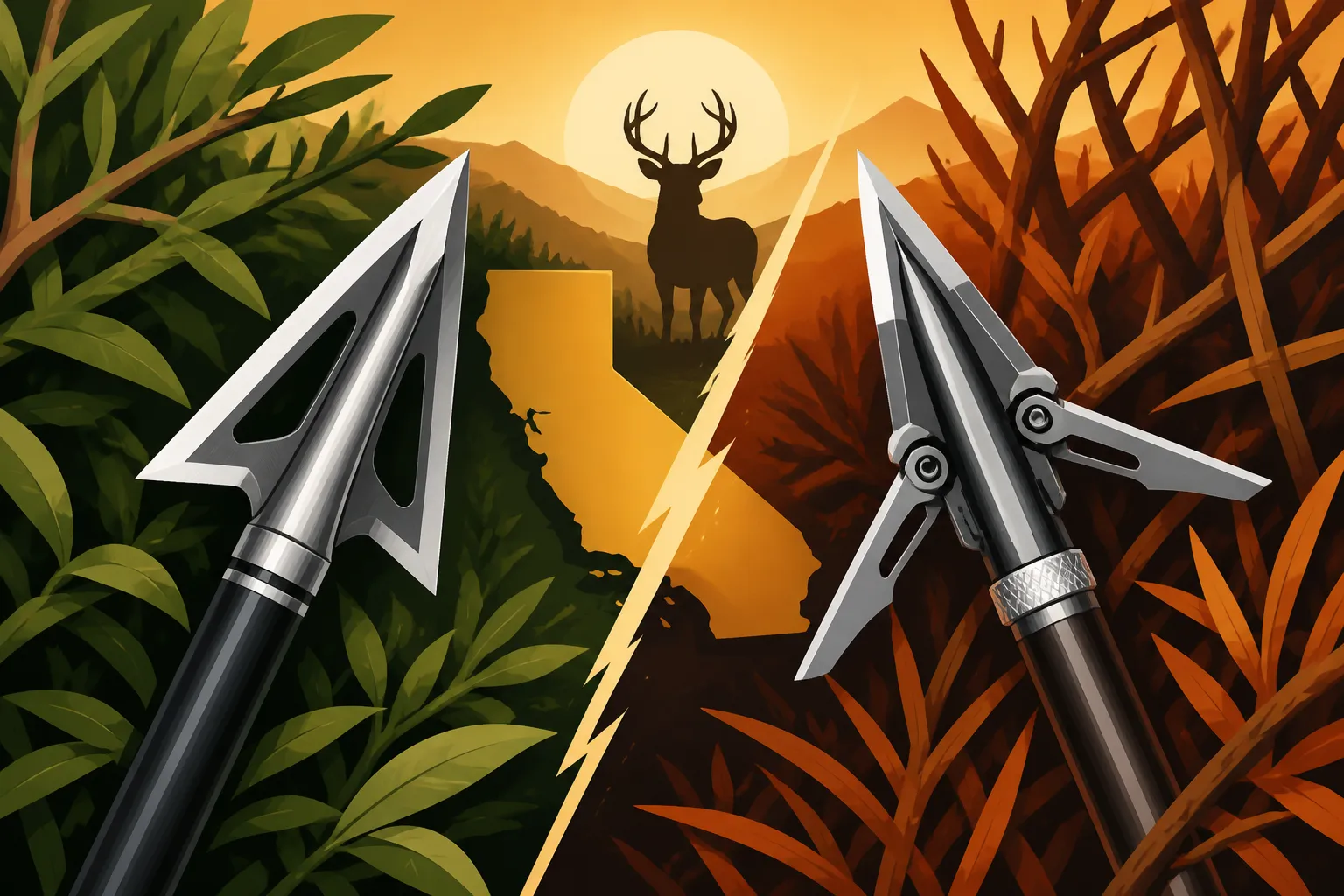
Fixed Versus Mechanical Broadheads in Brush
Anyone who's spent time hunting California's notoriously dense oak woodlands, rugged chaparral, or thick riparian corridors understands the unique challenges they present. The frustration of a perfectly aimed shot being subtly deflected by an unseen twig or a brushy branch can be infuriating, potentially leading to a lost animal. Choosing the right broadhead for these brushy conditions isn't merely a matter of preference; it's a critical decision that directly impacts ethical hunting and recovery success. This guide will meticulously explore the age-old debate between fixed-blade and mechanical broadheads, specifically analyzing their performance when navigating through unforgiving cover, helping you make a truly informed decision for your next brushy hunt in the Golden State.
The Fundamental Differences: Fixed Blade vs. Mechanical Broadheads
Before we dive into how these broadheads perform when confronted with dense vegetation, it’s essential to understand their core designs and the principles behind them. Each type offers distinct advantages, and these advantages often come with corresponding trade-offs, especially when you introduce variables like thick brush.
Fixed Blade Broadheads: Simple Durability
Fixed blade broadheads are, at their heart, elegantly simple. They consist of a ferrule and two, three, or even four blades that are permanently attached and remain in the same position throughout the shot sequence and impact. There are no moving parts, no springs, no deployment mechanisms to worry about. This straightforward design is often lauded for its robust durability and reliability.
When you nock an arrow tipped with a fixed blade, you know exactly what the leading edge will do. It's a solid, unyielding point designed to cut on contact. This simplicity translates into a certain confidence for many hunters – fewer points of failure mean less to go wrong in the field. They are often favored for their superior penetration on bone and their ability to maintain structural integrity even after hitting tough hide or gristle. However, that static design also means a fixed blade presents more surface area in flight, which can sometimes make them trickier to tune for perfect arrow flight, especially at higher arrow speeds or with bows that aren't perfectly aligned.
Mechanical Broadheads: Expanding Advantage
Mechanical broadheads, often called "expansions" or "collapsing" broadheads, represent a more modern approach to terminal ballistics. Their defining feature is that the blades are retracted or folded against the ferrule during flight, creating a smaller profile. Upon impact, a deployment mechanism — usually a spring, O-ring, or slip-cam system — causes the blades to deploy, expanding to a much wider cutting diameter than most fixed blades.
The primary appeal of mechanical broadheads lies in this expanded cutting diameter. A larger cutting surface generally translates to a wider wound channel, theoretically leading to more significant hemorrhaging and a quicker, more ethical harvest. Additionally, their sleek, smaller profile in flight means they often fly more like a field tip, simplifying bow tuning and offering exceptional accuracy, even at longer ranges. This accuracy can be a real boon when you’ve put in the time for Tuning a Bow for Broadhead Flight. However, the moving parts introduce potential points of failure. The blades must deploy correctly on impact, and if they don't, penetration can be severely compromised.
The Core Debate: Reliability vs. Cutting Diameter
The heart of the fixed versus mechanical broadhead debate, particularly when considering hunting conditions, boils down to reliability versus cutting diameter. Fixed blades offer unwavering reliability; what you see is what you get, and they are generally built like tanks, capable of busting through bone and continuing to penetrate. This makes them a solid choice for tougher game or when deep penetration is paramount.
Mechanicals, on the other hand, promise a devastating wound channel through their expanded cutting diameter, which can create a more profuse blood trail, often crucial when tracking in dense cover. For a species like the Columbia blacktail, which can quickly vanish into the thickest underbrush, a robust blood trail is invaluable. But this comes with the caveat of needing proper deployment. If a mechanical broadhead's blades don't open as intended, whether due to faulty mechanism or impact with an obstacle, its effectiveness can plummet. Choosing the Best Broadhead for California Blacktail often comes down to balancing these two critical factors.
Broadhead Performance in Dense California Brush: What to Expect
Hunting in California often means navigating through thick, unforgiving brush. Whether you’re stalking deer in a Hunting Coastal Range Oak Woodlands setting or trying to slip through the dense chaparral of the foothills, your broadhead's performance when encountering twigs, branches, or thick leaves can make or break your hunt. This is where the theoretical advantages of each broadhead type are truly tested in real-world scenarios.
Navigating Twigs and Branches: Deflection Risks
This is arguably the most critical factor when hunting in brush. A small, seemingly insignificant twig can completely alter an arrow's trajectory, turning a perfect shot into a glancing blow or a complete miss.
-
Fixed Blade Broadheads in Brush: Because fixed blades have a larger, static profile, they can be more susceptible to deflection when they hit an object head-on. A twig caught between the blades, or impacting the leading edge of a blade at an awkward angle, can cause the arrow to "kick" offline. However, their robust construction often means they can shear through smaller brush more effectively without losing integrity. If they do hit a branch, the solid construction tends to ensure the broadhead itself isn't damaged, even if the arrow's flight path is altered. The key is that they often continue to cut forward even if deflected, potentially still creating a wound, albeit not where intended.
-
Mechanical Broadheads in Brush: The streamlined profile of mechanical broadheads is often cited as an advantage here. Theoretically, with blades folded back, there's less surface area to snag or deflect. They can slip through smaller gaps more cleanly. However, this is also where a significant risk lies. If a mechanical broadhead impacts a twig or branch before it reaches the animal, there's a chance the blades could pre-deploy or become damaged. A pre-deployed mechanical broadhead will fly erratically and lose all its aerodynamic advantages, essentially becoming a poorly flying fixed blade with compromised integrity. Even worse, if the deployment mechanism is damaged, the blades might not open at all upon striking the animal, resulting in poor penetration and a severely inadequate wound channel. For this reason, some hunters who spend a lot of time in dense cover avoid mechanicals, preferring the consistent, albeit potentially more deflective, nature of fixed blades.
Penetration Through Obstacles
Beyond deflection, how a broadhead penetrates after encountering brush, and then continues into the animal, is paramount.
-
Fixed Blade Broadheads: Their inherent strength and "cut-on-contact" design mean fixed blades generally excel at punching through obstacles. If a fixed blade hits a bone, or if it has to pass through thick hide and then dense tissue, its solid design ensures that all the arrow's kinetic energy is driven directly behind the cutting edges. There's no energy wasted on deploying blades. This can be a huge advantage when you're hunting tough game or know there's a chance of hitting shoulder bone or heavy gristle, which is common in older, larger deer or wild pigs. For deeper penetration, arrow weight and Arrow Weight for Elk-Sized Game also play a significant role.
-
Mechanical Broadheads: While designed for massive cutting diameters, mechanicals have a two-step process: deployment, then penetration. If a mechanical broadhead does deploy cleanly into an animal, its large cutting diameter can create impressive trauma. However, if any brush interferes with deployment, or if the broadhead's structure is compromised by hitting an obstacle, its penetration can suffer drastically. The energy required to open the blades is subtracted from the energy available for penetration. Moreover, the larger deployed cutting surface can increase drag during penetration, requiring more energy to pass through the animal than a narrower fixed blade. In scenarios where deep penetration through heavy muscle or bone is critical, this can be a drawback.
Blood Trails and Recovery in Heavy Vegetation
The ultimate goal of any ethical shot is a quick, clean kill and a rapid recovery. When you're hunting in dense California cover, a good blood trail is your best friend, especially when a deer or hog might only run a short distance before disappearing into a jungle of manzanita.
-
Fixed Blade Broadheads: Fixed blades create a cutting channel that matches their blade diameter. While often smaller than a deployed mechanical, a sharp, well-designed fixed blade creates a consistent wound. The blood trail, if the shot is well-placed, will be adequate. The challenge sometimes comes from the arrow possibly remaining in the animal, plugging the wound, which can reduce the external blood sign. However, the integrity of the broadhead means it rarely fails to cut.
-
Mechanical Broadheads: The promise of mechanicals is a wider, more profuse blood trail due to their large cutting diameter. When they deploy perfectly, they can indeed leave a very impressive blood trail, which is a huge advantage when tracking in heavy brush. Imagine trying to follow a faint trail in thick buck brush after a deer takes off, every drop counts. However, if a mechanical fails to deploy or partially deploys, the wound channel can be significantly reduced, leading to a sparse, difficult-to-follow blood trail. This lack of clear sign can turn an already challenging recovery in thick cover into an almost impossible task. Hunters using applications like GoHunt can review satellite imagery to visualize brush density beforehand, which can influence their broadhead choice based on expected tracking conditions.
| Feature | Fixed Blade Broadhead (in Brush) | Mechanical Broadhead (in Brush) |
|---|---|---|
| Deflection Risk | Higher surface area, can kick off twigs, but often shears through. | Lower profile, can slip through, but risks pre-deployment/damage. |
| Integrity | Highly durable, less prone to damage from obstacles. | Vulnerable to blade damage or deployment mechanism failure on impact. |
| Penetration | Consistent, all energy goes to cutting, strong on bone. | Can be excellent if deployed cleanly, but compromised if deployment fails. |
| Wound Channel | Consistent, matches blade diameter. | Potentially wider, more devastating if fully deployed. |
| Blood Trail | Adequate, consistent, but can be reduced if arrow plugs hole. | Potentially profuse, but can be minimal if deployment fails. |
| Tuning Ease | Can be more challenging to achieve perfect flight. | Generally flies more like a field tip, easier to tune for accuracy. |
Tuning Your Bow and Broadhead for Brushy Encounters
Regardless of your broadhead choice, proper bow tuning is absolutely non-negotiable, especially when you anticipate shooting through or near brush. A perfectly tuned bow minimizes arrow wobble and maximizes energy transfer, giving your broadhead the best chance to perform as designed.
Achieving Perfect Flight: Tuning Fixed Blades
Tuning fixed blades is often considered a more involved process than tuning mechanicals, primarily because of their larger, fixed surface area that can react to even slight imperfections in bow setup. For hunters preparing for Bowhunting California's Zone A Season or any other archery hunt, this step cannot be skipped.
Start by ensuring your arrow rest, nocking point, and cam timing are all perfectly aligned. Paper tuning is a great way to identify tears that indicate improper arrow flight, which can be caused by anything from fletching contact to poor form. Once you achieve a clean tear, move to bare shaft tuning, where you shoot an unfletched arrow alongside a fletched one. If both hit the same point at a reasonable distance (say, 20-30 yards), you’re in excellent shape. This indicates the arrow leaves the bow cleanly, with minimal side-to-side motion, which is crucial for reducing deflection should it graze a twig. Remember, any broadhead, fixed or mechanical, will only fly as well as your bow is tuned and your form is consistent. Tools like a broadhead wrench for slight adjustments to fixed blades can be invaluable during this process.
Ensuring Deployment: Testing Mechanicals
For mechanical broadhead users, while tuning for field point accuracy is generally simpler, there's an added layer of concern: ensuring consistent deployment. It’s not enough for them to fly straight; they must open reliably upon impact.
Before heading into the field, especially for a hunt in dense cover, you should test fire at least one mechanical broadhead (some manufacturers sell specific practice heads). Shoot it into a dense foam target, a layered bag target, or even a specialized broadhead target designed to simulate animal hide. Observe how the blades deploy. Do they open fully? Is there any damage to the mechanism? This is also a good time to check the O-rings or retention clips if your broadhead uses them; ensure they are in good condition and replaced as necessary. If you’re not confident in how a specific mechanical broadhead deploys, it’s not the one to take into the thick stuff. You might even consider broadheads with a more robust deployment system, designed to resist premature opening but guarantee deployment on impact.
Arrow FOC and Its Role in Brush Penetration
Front of Center (FOC) refers to the percentage of an arrow's total weight that is located in the front half of the arrow. A higher FOC means more weight is concentrated towards the broadhead end. While often discussed in terms of long-range accuracy, a higher FOC can also play a subtle but important role in brush penetration and deflection.
An arrow with a higher FOC tends to stabilize faster in flight and recover more quickly from any slight perturbations, such as grazing a twig. This forward weight acts like the heavy end of a dart, pulling the arrow through. While it won’t prevent a major deflection, it can certainly help an arrow track truer through light brush or recover more effectively from a minor scrape. Achieving a higher FOC usually involves using a heavier broadhead or adding weight inserts to the front of your arrow shaft. This is a nuanced area, but for those hunting California's thickest country, every little bit of advantage helps. A well-tuned arrow with a decent FOC, combined with a reliable broadhead, creates the most forgiving projectile you can send through the woods.
Ethical Considerations and Shot Placement in Thick Cover
Hunting in dense California brush means accepting that clean, open shots can be rare. The ethical hunter must adapt their strategy and shot selection to these challenging conditions, recognizing that broadhead choice is just one part of a larger equation.
Minimizing Risk: Choosing Your Shot Wisely
The most critical factor in dense cover, even more so than your broadhead choice, is impeccable shot selection. It's tempting to take a marginal shot when a legal animal finally presents itself after hours of patient Still-Hunting California's Sierra Nevada Timber or crawling through chaparral. However, waiting for the clearest possible shot window is paramount for an ethical kill.
Before drawing your bow, take a moment to scan for any tiny twigs or branches in the arrow's flight path, even those you might have to shift position slightly to clear. If there’s any doubt, hold your shot. A deer standing behind a single leaf could be perfectly broadside, but that leaf could be masking a branch that deflects your arrow. Imagine hunting a mule deer in the Eastern Sierra, where the vegetation might seem sparse but still hold hidden obstacles. It's better to let an animal walk away and hunt another day than to take a risky shot that leads to a wounded, unrecoverable animal. This requires discipline, but it’s the hallmark of a responsible hunter. GoHunt mapping can often help you identify small clearings or lanes that might offer better shot opportunities in otherwise dense areas.
Post-Shot Tracking Challenges
Once an arrow is released in brushy terrain, the real work often begins. Even with a well-placed shot, tracking can be incredibly difficult. Deer and pigs often dive into the thickest cover immediately after the shot.
If using a fixed blade, its consistency means you should expect a solid, but potentially not profuse, blood trail. Pay close attention to the impact site – look for blood on both sides of the arrow if it passed through, and for any hair or tissue. If you used a mechanical broadhead and it deployed cleanly, you might find a more substantial blood trail, which can be a huge asset. However, if there's any suspicion of non-deployment or deflection, your tracking will need to be meticulous. In thick chaparral where Rattling Volume in Thick Chaparral helps locate deer, following a faint blood trail through thorny bushes becomes a test of patience and persistence. Take your time, mark every drop of blood, and use landmarks to keep track of the animal's direction of travel. Knowing your broadhead's performance characteristics in brush will help you manage your expectations for the blood trail.
Preparing for the Unexpected in the Field
Hunting in California's diverse and often challenging environments means always being prepared for the unexpected. This includes having the right gear, but also the right mindset. Always carry a reliable headlamp, even if you anticipate being out before dark; recovery can easily extend into the night, and Blood Trailing After Dark in California is an art form. A high-quality set of binoculars is useful not only for glassing but also for picking apart dense cover for signs of a downed animal. A good first aid kit, such as a Best First Aid Kit for a Remote Hunt, is also indispensable.
Consider carrying multiple broadhead options if you anticipate varying terrain. Perhaps a fixed blade for the thickest oak pockets and a mechanical for more open country if you have multiple tags or can swap them out quickly. Familiarize yourself with how to Field Dress a Deer in Hot Weather or Butchering a Deer at Camp since a successful recovery might necessitate immediate processing in the field. Ultimately, the best broadhead is the one you have the most confidence in, one that you've rigorously tested, and one that aligns with your specific hunting conditions and ethical standards. When you’re out there, stalking through the California brush, every piece of your gear needs to be a trusted ally.
Disclaimer
This article is for general informational purposes only and does not constitute professional advice. Laws, prices and regulations vary by location and change over time. Consult a qualified professional for guidance on your specific situation.