Rangefinders for California’s Sierra Canyon Country
Hunting California's vast and rugged Sierra Nevada range is an experience unlike any other, but anyone who has spent time chasing deer or elk up and down those unforgiving canyons knows the intense frustration of judging distance. The sheer scale, the steep inclines and declines, and the way light plays tricks on your eyes can make a 300-yard shot feel like 100, or vice versa, leading to missed opportunities and ethical concerns. This guide is all about equipping you with the knowledge to pick and wield the perfect rangefinder, ensuring precision and confidence when every yard counts in that challenging Sierra environment.
Why a Rangefinder is Non-Negotiable in Sierra Canyons
Let's face it, our eyes play tricks on us, especially when you're looking across a deep canyon or up a long, steep slope. What might seem like a manageable 200-yard shot when the animal is directly below you can be a whole different ballgame once you factor in the angle and bullet drop. In the Sierra, where shots can easily stretch to several hundred yards, an accurate rangefinder isn't just a convenience; it's a critical piece of safety and ethical hunting gear. Without it, you're relying on guesswork, and guesswork rarely leads to clean, swift harvests.
The Illusion of Distance in Steep Terrain
One of the biggest culprits contributing to inaccurate range estimation in the Sierra is the optical illusion created by steep angles. When you're looking downhill at a deer, your brain often perceives the distance as shorter than it actually is. Conversely, an uphill shot can appear longer. This isn't just a small deviation; it can be significant enough to cause your bullet to impact high or low, missing the vitals entirely. Imagine finally spotting that elusive blacktail buck after a grueling climb, only to misjudge the shot by 50 yards because the terrain fooled your eye. The frustration is immense, and the consequences for the animal are unacceptable.
Furthermore, the varied cover of the Sierra — from dense pine forests to scattered oak woodlands and exposed granite faces — creates a patchwork of shadows and light that further distorts our depth perception. A buck standing in the dappled shade of a thick timber patch might look closer than one silhouetted against a sunny ridge, even if they are at the same actual distance. Your rangefinder cuts through these illusions, giving you an objective, undeniable measurement that your eyes simply can't always provide. It removes the human element of optical distortion from the equation, letting you focus on the shot placement instead of second-guessing your distance judgment.
Angle Compensation: A Critical Feature
This is perhaps the single most important feature for any rangefinder destined for the Sierra Nevada. Traditional rangefinders measure the line-of-sight distance, which is the straight distance from you to the target. However, gravity only acts on the horizontal component of that distance. If you're shooting significantly uphill or downhill, a bullet will behave as if the target is closer than the line-of-sight measurement. This is where angle compensation comes into play. A good angle-compensating rangefinder calculates the "true ballistic range" or "horizontal equivalent distance," which is the distance your bullet actually "sees" from a gravitational perspective.
Think of it this way: if you're standing on a ridge and a deer is 300 yards straight downhill, your bullet will drop as if the deer were, say, 270 yards away on flat ground. If your rangefinder only gives you the 300-yard line-of-sight distance, and you hold for that, your shot will likely go high. An angle-compensating rangefinder will give you that crucial 270-yard reading, allowing you to make the correct hold or turret adjustment. Ignoring this feature in steep country is a recipe for missed shots and wounded game. For serious hunters pursuing Columbia Blacktail and Mule Deer in California in high-country zones, this feature is truly indispensable.
Key Features to Look for in a Sierra Rangefinder
When you're trying to pick out a rangefinder that can stand up to the rigors and unique demands of the Sierra Nevada, you're going to need to look beyond the basic models. This isn't your flat-field deer stand hunt; this is steep, rugged, and often unforgiving terrain. The features that make a difference here are all about consistent performance, even when conditions are tough and the distances are long.
Ranging Capability and Accuracy
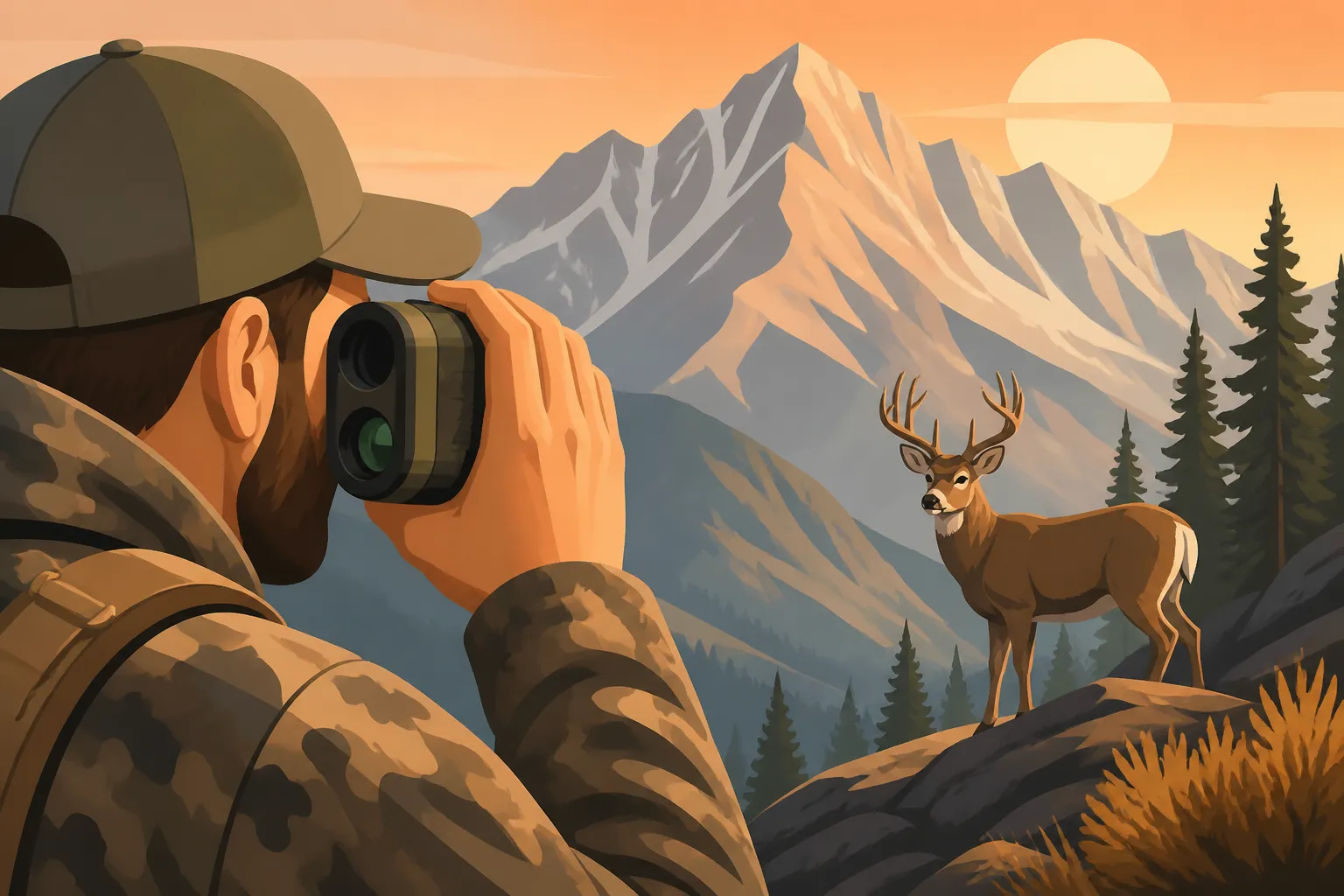
In the Sierra, you can find yourself needing to range anything from a close-quarters shot in dense timber to a wide-open basin shot across 600 yards of scrub. Therefore, your rangefinder needs a strong maximum ranging capability. While you might not often shoot deer at 800 yards, being able to reliably range reflective targets at that distance means it will pick up a deer or elk at 400-500 yards much more consistently. Look for models that boast a maximum range of at least 1,000 yards for deer-sized game, ideally pushing closer to 1,500 yards for reflective surfaces. This margin ensures you get a quick, accurate read on an animal, even if it's bedded in a shadowed ravine.
Beyond just the maximum range, accuracy is paramount. A good Sierra rangefinder should provide readings to the nearest half-yard or even tenth of a yard. Why? Because when you're dialing a turret or holding over for a shot at 400+ yards, even a 5-yard difference can mean the difference between a clean kill and a miss. Combine this with angle compensation, and you have a tool that gives you truly actionable data. Think about it: a difference of 5 yards at 500 can be enough to push a bullet outside the vital zone if you're already at the edge of your effective range. Precision matters, especially when there's Wind and Thermals in Steep Sierra Country that can further complicate trajectory.
Optics Quality and Light Gathering
You're going to be glassing a lot in the Sierra, often at first light or last light, when game is most active. That means your rangefinder's optics need to be top-notch. Don't settle for dim, cloudy glass. Look for bright, clear lenses with excellent light transmission. This is especially true if you plan on using your rangefinder for general glassing in addition to just ranging. Coatings on the lenses play a huge role here, reducing glare and enhancing contrast, which can be a lifesaver when trying to pick out a mule deer's antler tip against a granite backdrop.
Magnification is also a factor. Most rangefinders come in 6x or 8x power. While higher magnification might seem better, it can make it harder to hold steady on target, especially after a long hike up a mountain. For Sierra hunting, 6x or 7x often provides a good balance of magnification and a steady image. Paired with a decent objective lens size, this will allow you to quickly acquire and range targets in varied lighting conditions, from the deep shadows of Still-Hunting California's Sierra Nevada Timber to the bright, open expanses of a high-country burn scar.
Angle Compensation Technology
While we touched on this earlier, it's worth diving a bit deeper. Most reputable optics brands have their own proprietary names for angle compensation — you might see terms like "Equivalent Horizontal Range (EHR)," "Angle Range Compensation (ARC)," or "True Ballistic Range (TBR)." Whatever the name, ensure the rangefinder explicitly states it provides angle-compensated distance. Some models simply display the angle, leaving you to do the math, which is less ideal under pressure.
Beyond the core function, consider the display. OLED (Organic Light-Emitting Diode) displays are generally brighter and clearer, offering superior visibility in low light or against dark backgrounds compared to traditional LCDs. They often come with adjustable brightness settings, which is a huge benefit when transitioning from bright sunlight to deep shadows. Reticle options also matter: some rangefinders offer different reticle shapes or colors, allowing you to choose what stands out best for your eyes and specific hunting conditions. The goal is a display that is easy to read, precise, and provides all the necessary information at a glance, allowing you to quickly reference your Rifles and Calibers for California Big Game ballistic chart.
Durability and Weather Resistance
The Sierra Nevada is a beautiful but unforgiving place. You'll encounter dust, rain, snow, and rough terrain. Your rangefinder needs to be built like a tank. Look for models with a rugged, rubber-armored housing that can withstand drops and bumps. More importantly, it needs to be fully waterproof and fogproof. An IPX7 rating or better is a good indicator of substantial waterproofing, meaning it can handle being submerged for a short period, not just a light drizzle.
Fogproofing, often achieved by purging the unit with inert gases like nitrogen or argon, prevents internal lenses from fogging up during rapid temperature changes or high humidity. Imagine climbing to a high ridge at dawn, only to have your optics fog up as the sun hits them. That's a lost opportunity. Investing in a durable, weather-sealed unit ensures your rangefinder performs reliably when you need it most, regardless of what the unpredictable Sierra weather throws at you. You might even consider brands like GoHunt that provide extensive field tests of gear under such conditions to help make your choice.
Using Your Rangefinder Effectively in Challenging Terrain
Having a top-tier rangefinder is only half the battle; knowing how to use it effectively in the Sierra is the other. This isn't just about pushing a button; it's about understanding the nuances of how terrain impacts your shot and integrating that data into your overall hunting strategy. Mastering these techniques will significantly boost your confidence and success rate.
Uphill and Downhill Shot Practice
It sounds simple, but you'd be surprised how many hunters neglect practicing angle-compensated shots. Don't just practice on a flat range. Find a local hill or embankment and practice ranging targets at various uphill and downhill angles. Pay close attention to the difference between the line-of-sight distance and the angle-compensated distance your rangefinder provides. This hands-on experience will help ingrain the correct ballistic compensation in your mind, making it second nature when a shot opportunity arises.
Understanding your rifle's ballistic drops for various ranges is also critical. If your rangefinder gives you a true ballistic range of 320 yards, you need to know exactly where your bullet will impact at 320 yards. This means knowing your scope's holdover points or your turret adjustments. Consider creating a cheat sheet or "dope card" that you can laminate and attach to your rifle sling or pack strap. This immediate reference, combined with your rangefinder's precise reading, eliminates guesswork and ensures you make an ethical shot. Many hunters practicing for Hunting California's High-Country X-Zones spend significant time on this aspect.
Ranging Through Obstacles and Brush
The Sierra isn't always wide-open country. You'll often find deer moving through dense chaparral, manzanita thickets, or stands of timber. Getting an accurate range through these obstacles can be tricky. Many advanced rangefinders offer different targeting modes, such as "first target priority" or "last target priority."
- First Target Priority: This mode is excellent for situations where your target might be partially obscured by light brush or branches in the foreground. It will read the closest object, helping you avoid ranging a leaf in front of your deer.
- Last Target Priority: This mode is ideal for ranging targets behind a fence, tall grass, or in a light rain/snowfall. It ignores closer distractions and tries to pick up the farthest object in the beam.
Learn to use these modes effectively. Sometimes, you'll need to range around the target, finding a clear path to a tree or rock near the animal and then estimating the final few yards. Practice scanning with your rangefinder, getting multiple readings to confirm accuracy. Don't just hit the button once and trust it; take several readings from different angles if possible, especially when a buck is partially obscured in the shadow of a ridge. This technique is often key when Glassing Mule Deer in Open California Country where they might be partially hidden.
Integrating with Your Ballistics
Modern hunting technology really shines when you integrate your rangefinder data with ballistic information. Many hunters use ballistic apps on their smartphones or dedicated ballistic calculators. These tools take into account factors like bullet type (especially critical with Choosing Non-Lead Rifle Ammunition in California), muzzle velocity, atmospheric conditions (temperature, altitude, humidity), and, crucially, the angle-compensated range from your rangefinder.
Some high-end rangefinders even have built-in ballistic calculators that can display holdover solutions directly in the reticle or provide a custom dope card for your specific cartridge. While these can be fantastic, always verify their readings with your own known ballistic data from actual shooting. Resources like GoHunt often publish reviews of integrated systems and tips for calibrating your gear. The goal is to streamline the process from ranging to shooting, reducing the time spent fumbling with equipment and increasing your focus on the shot. This integration is particularly useful when planning a multi-day trip for Packs and Gear for a Backcountry Elk Hunt, where every piece of equipment needs to pull its weight.
Top Considerations for Sierra Hunters
Beyond the core functionality, there are several practical considerations that can make or break your rangefinder experience in the Sierra. These are the "little things" that often become big frustrations if not thought about beforehand.
Size, Weight, and Ergonomics
When you're packing into the Sierra Nevada backcountry, every ounce counts. A bulky, heavy rangefinder can quickly become a burden. Look for compact, lightweight models that fit comfortably in your hand or a bino harness. One-handed operation is a huge plus, allowing you to quickly range a target without setting down your trekking poles or risking dropping other gear.
Consider the grip: textured rubber armor provides a secure hold, even with wet hands or gloves. Button placement should be intuitive and easy to access without fumbling, especially when your hands are cold or you're wearing heavier gloves during a late-season hunt. A rangefinder that is ergonomically designed for ease of use in the field will be one you actually want to carry and use consistently, rather than leaving it in your pack because it's a hassle. Remember, you'll be spending a lot of time on your feet, so light and convenient gear is paramount when Hunting California's Sierra Nevada Backcountry.
Battery Life and Type
There's nothing worse than your rangefinder dying on you when that trophy buck steps out. Pay attention to battery life specifications. Cold weather can significantly reduce battery performance, so if you're hunting during a Late-Season Food Sources for California Deer period, plan accordingly. Most rangefinders use common CR2 or CR123A lithium batteries, which are readily available.
Always carry at least one spare battery, ideally two, stored in a waterproof bag in your pack. Check your battery level before each hunt and swap out old batteries at the beginning of the season. Some models have a battery indicator, which is a useful feature. If you have a cellular trail camera or another device that uses the same battery type, you might consider standardizing to reduce the number of different spares you need to carry.
Brand Reputation and Warranty
In the world of optics, you generally get what you pay for. Investing in a reputable brand often means better glass, more reliable electronics, and superior customer service if something goes wrong. While you don't necessarily need the absolute most expensive model, avoiding the cheapest options is usually a good idea for Sierra hunting. Brands that specialize in hunting optics often understand the specific needs of hunters, like angle compensation and rugged construction.
Check the warranty information. A strong, transferable warranty speaks volumes about a manufacturer's confidence in their product. A lifetime warranty on optics can be a huge peace of mind, especially for gear that will be subjected to harsh conditions. Reading reviews from experienced hunters on platforms like GoHunt can provide real-world insights into a rangefinder's performance and durability. You want a rangefinder that will be a reliable partner for many seasons to come, not a disposable gadget.
Field Maintenance and Troubleshooting
Even the best gear needs a little love to keep performing its best. In the rough-and-tumble environment of the Sierra Nevada, a little preventative maintenance and knowing how to handle common issues can save your hunt.
Keeping Your Optics Clear
Dust, dirt, rain, and fingerprints are the enemies of clear glass. Always carry a lens pen or a microfiber cloth specifically designed for optics. Resist the urge to wipe lenses with your shirt, as this can scratch the delicate coatings. If there's mud or grit, gently blow it off first, or use a lens brush, before using a cloth. For tougher grime, a breath fogging the lens followed by a gentle wipe can sometimes work, but avoid harsh chemicals.
When not in use, keep your rangefinder in a protective case or a dedicated pocket in your bino harness. Many hunters use an Best Optics Harness for a Spot-and-Stalk Hunt to protect their binos and rangefinder from bumps and scrapes while also keeping them readily accessible. Avoiding direct contact with sharp objects in your pack will also prevent scratches to the housing and lenses. The clearer your glass, the faster and more accurately you can range that deer silhouetted against a distant ridge.
Basic Troubleshooting in the Field
Sometimes, your rangefinder might seem to malfunction, but it could be a simple fix. Here's a quick checklist:
- No Readout/Dim Display: Check the battery! This is the most common issue. Swap in a fresh spare. If using an OLED, ensure the brightness setting isn't too low for current conditions.
- Inconsistent Readings:
- User Error: Are you holding it steady? Even a slight wobble can throw off the laser. Use two hands or brace against a tree.
- Target Interference: Are you ranging through brush? Switch to "last target priority" if available, or try ranging an object directly next to your target.
- Reflective Surface: Is the target too reflective (e.g., wet rock, still water)? Sometimes these surfaces can confuse the laser. Try ranging a less reflective spot nearby.
- Environmental Factors: Dense fog, heavy rain, or snow can impede the laser's performance. In extreme conditions, even the best rangefinders can struggle.
- Lens Fogging: If internal, it might be a seal issue (warranty time!). If external, wipe with a clean cloth. Moving the unit into a different temperature or wiping it with an anti-fog cloth can help.
Knowing these quick fixes can prevent unnecessary frustration and keep you in the hunt. Don't let a minor technical glitch derail your hard-earned time chasing Hunting a D-Zone That Opens in August or a high-country elk.
| Feature | Basic Rangefinder (Typical) | Sierra Canyon Rangefinder (Recommended) |
|---|---|---|
| Max Ranging (Deer-sized) | 400-600 yards | 800-1000+ yards |
| Accuracy | +/- 1 yard | +/- 0.5 yard (or better) |
| Angle Compensation | Often absent, or provides angle only (no compensated distance) | Essential: provides true horizontal/ballistic distance |
| Optics Quality | Decent, but can be dim in low light | High-quality glass, multi-coated, excellent light transmission |
| Display Type | LCD (can be harder to see in low light or against dark backgrounds) | OLED (bright, clear, adjustable brightness, excellent for all conditions) |
| Durability/Weathering | Splash-resistant, light housing | Fully waterproof (IPX7+), fogproof (nitrogen/argon purged), rubber armor |
| Targeting Modes | Single target mode | Multiple modes (first/last target priority) for varied terrain |
| Ergonomics | Varies, sometimes bulky | Compact, lightweight, ergonomic for one-handed use, secure grip |
Ultimately, investing in a high-quality, angle-compensating rangefinder designed for rugged conditions is one of the smartest decisions a California hunter can make, especially when venturing into the Sierra Nevada. It's more than just a piece of gear; it's an ethical tool that ensures you have the most accurate information available to make a responsible shot, every single time. Good luck out there, and range responsibly!
Disclaimer
This article is for general informational purposes only and does not constitute professional advice. Laws, prices and regulations vary by location and change over time. Consult a qualified professional for guidance on your specific situation.