Setting Decoys on a Farm Pond
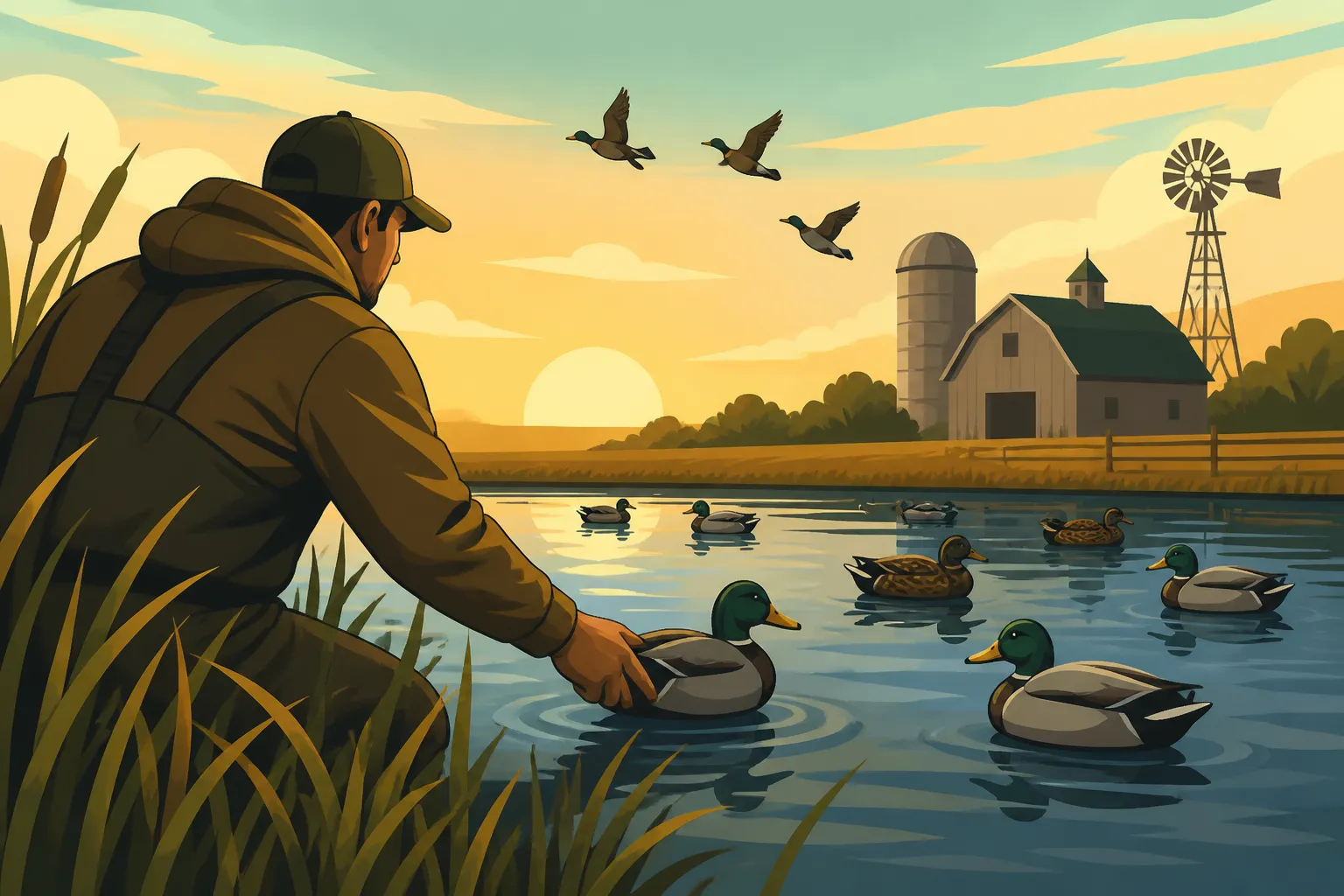
Hunting ducks and geese on a small farm pond can feel like a whole different ballgame compared to the expansive flooded rice fields or vast wildlife refuges of California's Central Valley. These intimate waters, often nestled amongst ranch land or agricultural fields, present unique challenges and opportunities that require a specific approach to decoy placement. This guide will walk you through the nuances of setting decoys on California farm ponds to maximize your chances of bringing birds into range, even when they're wary.
Understanding Farm Pond Dynamics for Waterfowl
Farm ponds, whether they’re stock ponds, irrigation reservoirs, or old gravel pits, are magnets for waterfowl in California, especially during the fall and winter migration. However, what draws birds to them also makes hunting them a precise art. Unlike vast public areas, farm ponds are often smaller, more exposed, and birds quickly learn where it's safe and where it's not.
Why Ducks and Geese Utilize Small Ponds
Think about it from a bird's perspective. After flying hundreds or thousands of miles, or simply navigating daily from a larger roost, a farm pond offers several vital resources. Firstly, it's a critical loafing area. Waterfowl need safe, quiet places to rest, preen, and digest their food. A small pond, especially one with good cover on the edges, provides this sanctuary. Secondly, many farm ponds offer readily available food sources. This might be waste grain from nearby agricultural fields washing into the pond, emergent vegetation, or aquatic invertebrates. Geese, in particular, will often graze adjacent green fields and then retreat to a pond for water and safety. Thirdly, these ponds often serve as thermal regulators. On a frigid morning, sheltered water can be warmer than open fields, and on a hot, sunny afternoon, the water provides a cool respite.
California sees a huge variety of waterfowl, from abundant mallards and pintails to various species of geese like specklebellies and Canada geese. Each species has slightly different habits, but all appreciate a safe haven. For instance, dabbling ducks like mallards and pintails will actively feed in shallow areas, while diving ducks might favor deeper sections. Geese, on the other hand, are often just looking for a secure loafing spot near a good food source. Understanding these basic needs is the first step in effective decoying.
The Impact of Hunting Pressure on Pond Birds
Let's be real, California's ducks and geese are smart. They get educated quickly, especially on smaller, more accessible bodies of water. A farm pond that gets hunted regularly will have birds that flair at the slightest hint of danger—a flicker of an eye, a poorly hidden hunter, or a decoy spread that looks "off." This isn't like the first week of the season when birds are naive; by mid-season, those local birds have seen it all.
This sustained pressure means you can't just throw out a dozen decoys in a random blob and expect success. You need to be incredibly mindful of how your spread appears from above, the subtle signals it sends, and the overall impression of safety and natural behavior it conveys. Birds that have been shot at extensively will often circle high, scrutinizing every detail before committing. Your decoy spread needs to convince them that your pond is the safest, most inviting spot for a quick break or a meal.
Key Considerations for Decoy Spreads on Farm Ponds
When you’re staring at a small body of water, perhaps only a couple of acres, the sheer scale is different from a flooded field. Every decoy placement matters, and details you might overlook in a larger spread become critical here.
Pond Size and Water Depth
The physical dimensions of your farm pond are paramount. A truly small pond, say less than an acre, might only warrant a dozen or two decoys, carefully placed. Too many decoys, and the pond can look overcrowded, unnatural, and even intimidating to incoming birds. Conversely, a larger farm pond, perhaps five acres or more, might handle a larger spread, mimicking a bustling safe zone.
Water depth also dictates what kind of ducks will use certain areas. Dabbling ducks prefer shallower water where they can tip up to feed, so place their decoys in those zones. If the pond has a deeper section, consider adding a few diving duck decoys if those species frequent the area, but remember, the core appeal of many farm ponds is their relative shallowness. You'll want your decoys to look like they're feeding or loafing comfortably, not struggling in water that's too deep.
Wind Direction: The Invisible Hand
Wind is arguably the most crucial factor in waterfowl decoying, and it's no different on a farm pond. Ducks and geese almost always land and take off into the wind. This fundamental principle must dictate your decoy spread. Your primary goal is to create a realistic, inviting landing zone directly in front of your blind, with the wind at the birds' backs.
Imagine the birds approaching. They'll circle, get into the wind, and cup their wings to descend. You want them to finish their flight path directly over your shooting lane. This means your decoys should be positioned downwind of your blind, with an open "pocket" or landing strip upwind of the bulk of your spread. Birds will naturally try to land into that pocket, putting them right where you want them. Always check the wind before you start setting decoys, and be prepared to adjust your setup if the wind shifts throughout the morning.
Species Focus: Ducks, Geese, or Both?
While some farm ponds are strictly duck haunts, others attract both ducks and geese. Your decoy strategy should reflect the primary target species, or a balanced approach if you're hoping for both.
- Duck-focused spreads: These generally involve a tighter cluster of decoys, often with a "feeding" or "loafing" look. Mix in active feeders (head down) with preeners and sleepers (head tucked). Consider adding a few species-specific decoys if you know certain ducks are prevalent, like pintails or wigeon, but mallard decoys are always a safe bet as they represent a universal "all clear" signal.
- Goose-focused spreads: Geese are larger birds and often feel safer in more open areas. A goose spread usually requires fewer decoys, spread out more generously to simulate a relaxed flock. Full-body or shell decoys work best for geese, making them visible from a distance. If you're targeting specklebellies, having a few Canada goose decoys can act as "confidence" decoys, as specks often associate with them.
- Mixed spreads: When hunting both, ensure your duck and goose decoys are somewhat separated. Ducks tend to congregate tighter, while geese keep more space. A common strategy is to have a group of goose decoys on the edge of the pond or even on the bank, acting as sentinels, while the duck decoys are in the water, closer to your shooting zone.
It’s always a good idea to scout before you hunt, even if it’s just a quick drive-by the day before, to see what kind of birds are using the pond. Tools like Scouting California Public Land Before Season can help you understand general waterfowl movements in your area, and applying that to private ponds is just as effective. You can also use a platform like GoHunt to look at satellite imagery of the pond and surrounding fields, giving you a better idea of potential food sources and bird patterns.
Localized Conditions and Confidence Decoys
Every farm pond has its quirks. Is there an old log in the water? A small island? A section of cattails that always seems to hold birds? Incorporate these natural elements into your setup. Place decoys near the log as if they're resting, or around the island as if it's a safe haven. These localized features add immense realism.
Confidence decoys are also crucial, especially on pressured ponds. These aren't necessarily your target species but rather birds that ducks and geese associate with safety and undisturbed habitat. For example, a few coot or even swan decoys (where legal and appropriate) can make an area look completely natural and unmolested to incoming birds. Even something as simple as a few Canada goose decoys mixed into a duck spread can boost confidence, making the pond look like a bustling, safe haven.
Practical Decoy Strategies for Different Pond Types
Alright, let's get down to the brass tacks of setting up those decoys. It's not just about throwing them out there; it's about crafting an illusion that screams "safe landing strip" to wary waterfowl.
Small, Secluded Ponds: Less is Often More
On a truly tiny, secluded farm pond – the kind nestled deep in an oak woodland or tucked behind a stand of willows – overcrowding is your biggest enemy. These ponds often feel like intimate little hideaways to birds, and a huge, boisterous spread of 50 decoys can actually scare them off.
For these spots, think minimalist and natural.
- Small, tight clusters: A dozen or so decoys, primarily mallards, arranged in a couple of tight groups. Ducks are social, but in a small pond, they huddle.
- Focus on the edges: Place some decoys very close to the natural cover on the banks, making it look like birds are seeking shelter and security.
- "Feeding" posture: Have a good number of decoys with their heads down, as if actively feeding. This signals contentment and safety.
- Motion (subtle): A jerk string can be incredibly effective here. One or two decoys gently bobbing and creating ripples can bring a static spread to life without being overtly aggressive. You want subtle, natural movement, not a flashing disco ball.
- Concealment is key: Your blind, whether it's a natural brush blind or a ground blind, needs to be perfectly camouflaged. Birds on small ponds often get a much closer look at your setup.
Larger, Open Ponds: The Classic Landing Strip
If your farm pond is more expansive, perhaps in the middle of a cut cornfield or a large pasture, you have room for a more ambitious spread. Here, the "landing strip" concept truly shines.
- The "J" or "U" spread: This is a classic for a reason. Place the bulk of your decoys downwind of your blind, forming either a J-shape or a U-shape, with the open part of the letter facing upwind towards your blind. This creates a clear, inviting pocket for birds to land into.
- Feeder and Loafing groups: Within your J or U, create distinct groups. A larger group of feeders (heads down) at the "bottom" of the J/U, and a smaller "loafing" group (preeners, sleepers) further upwind. This portrays a natural, undisturbed flock.
- Species separation: If you're mixing ducks and geese, keep the goose decoys further out or on the bank, acting as confidence birds. The duck decoys should be closer to your landing zone.
- Consider a "corner pocket": If the pond has an L-shape or a natural corner, use that to your advantage. Set your blind in the corner, and spread your decoys out into the open water, leaving a landing zone right in front of you. This can naturally funnel birds.
- Motion (more active): On larger ponds, a spinning wing decoy (like a Mojo Decoy) can be incredibly effective for attracting attention from a distance, especially on calm days. Just be mindful of over-using them if birds are very pressured; sometimes less is more even here.
Ponds with Emergent Vegetation or Islands
Many California farm ponds aren't just open water; they have patches of cattails, bulrushes, or even small islands. These features are gold for decoying.
- Utilize the cover: Place decoys along the edges of the emergent vegetation or around small islands. Ducks love to loaf and hide in these areas. It makes your spread look incredibly natural.
- Create "pockets" in the weeds: If you can clear a small opening in a patch of reeds, place a few decoys there. It looks like a secret, safe spot within the vegetation, and birds will be drawn to investigate.
- Channels and bottlenecks: If the vegetation forms natural channels or narrows the pond, use your decoys to guide birds into those tighter spaces, effectively funneling them towards your shooting position.
- Island as a hub: If there's an island, consider setting a few decoys on it, mimicking birds resting on dry ground. This adds a crucial layer of realism. You can then spread your water decoys around the island, creating a safe zone in its lee, especially if the wind is blowing across it.
Here's a quick table to summarize common farm pond scenarios and corresponding decoy strategies:
| Pond Scenario | Decoy Count (Approx.) | Placement Strategy | Key Focus |
|---|---|---|---|
| Small, Secluded ( < 1 acre) | 6-18 decoys | Two or three tight clusters along cover, leaving a small open landing zone upwind of the blind. Focus on "feeding" postures. | Naturalism, subtle motion, perfect concealment. |
| Larger, Open (1-5+ acres) | 24-48+ decoys | "J" or "U" spread downwind of blind, with a generous open landing pocket upwind. Distinct feeding and loafing groups. Goose decoys on bank or far side. | Clear landing zone, visibility from distance, active-looking groups. |
| Vegetated Edges/Islands | Variable | Utilize vegetation edges as natural cover. Place decoys inside cleared pockets within weeds. If an island, place some on the island and arrange water decoys around it, creating sheltered landing zones. | Mimicking natural loafing/feeding in protected areas. Funneling birds along natural channels. |
| High Pressure | Minimal to Moderate | Focus on ultra-realistic postures, subtle motion (jerk strings), and excellent concealment. Less is often more. Avoid spinning wing decoys if birds are flaring from them. | Building confidence, appearing completely undisturbed. |
| Cold Weather | Moderate | Tighten up decoy groups as birds huddle for warmth. Place decoys in the most sheltered, sunny spots on the pond. Consider adding ice-eaters if water is freezing. | Conveying warmth, security, and a comfortable resting spot. |
Remember, the goal is always to create an inviting, safe, and natural-looking scene. Always ask yourself: "If I were a duck, would I want to land there?"
Advanced Tips and Gear for Farm Pond Success
Once you've got the basics down, there are always ways to refine your farm pond hunting strategy. These extra layers of detail and preparation can often make the difference between a frustrating morning and a successful one.
The Art of Concealment
On smaller waters, waterfowl are often approaching from a lower altitude and get a much clearer view of your setup. This means your concealment needs to be absolute perfection. A poorly hidden hunter is a dead giveaway.
- Natural blinds: Whenever possible, use existing cover like cattails, willows, oaks, or even a rise in the bank. Enhance it with natural vegetation gathered from the immediate area. Don't bring in foreign materials that look out of place.
- Ground blinds: If you're using a commercial ground blind, ensure it's brushed in meticulously. Think about the sky-lining effect; if your blind stands out against the horizon, birds will spot it instantly. You might even consider digging a shallow pit for your blind if allowed by the landowner.
- Wear the right camo: Choose patterns that blend with the specific vegetation around your pond. In California, this could mean anything from marsh grass patterns for lowland ponds to oak woodland patterns for foothill stock ponds.
- Shadows are your friend: Set up your blind so that you are in the deepest shadow possible, especially when the sun is low. Early mornings often cast long shadows, which can be an excellent natural hiding place.
- Stillness: This is perhaps the hardest part. Any movement, even just a head poke or shifting in your seat, can flair birds. Stay absolutely still until it's time to shoot. This is especially true for wary geese.
Calling Strategy: Subtle vs. Aggressive
California birds get called at a lot. While a cacophony of loud calling might work on opening day in a vast refuge, it can be a red flag on a farm pond by mid-season.
- Less is often more: Start with subtle quacks and clucks. A soft "hail call" if birds are distant, followed by quiet feeding calls once they turn.
- Read the birds: If birds are locked on and heading your way, stop calling. Let the decoys do the work. If they start to drift or look hesitant, a few soft, reassuring clucks can pull them back in.
- Species-specific: Use goose calls for geese, duck calls for ducks. Don't mix them indiscriminately. For example, a sharp, clean hail call can draw distant snow geese, but follow up with soft murmurs as they get closer.
- Use different calls: Have a variety of calls (e.g., a short reed and a long reed goose call, or a single-reed and double-reed duck call) to produce different tones and mimic a larger, more diverse flock.
The Importance of Scent Control
While waterfowl might not have the keenest noses compared to, say, a deer or a bear, they can still pick up on unusual smells. Your campfire smoke, gasoline fumes from your ATV, or even strong cologne can potentially alert wary birds.
- Cleanliness: Keep your waders, jackets, and decoys clean. Store them in scent-free containers if possible.
- Wind direction: Always be mindful of your scent cone, even for waterfowl. Try to set up so your scent is blowing away from the birds' approach path.
- Consider a 'no scent' approach: Avoid using strong-smelling products (cologne, aftershave, strongly scented detergents) on your hunting clothes.
Pre-Season Scouting and Observation
You can't just show up on opening morning and expect to be successful. Pre-season scouting is crucial, especially for farm ponds.
- Observe patterns: Drive by the pond at different times of day (dawn, mid-morning, dusk) to see what species are using it, how many, and where they prefer to sit or land. Notice their flight paths. You can use mapping tools like those from GoHunt to analyze access points and potential hiding spots without stepping foot on the property.
- Talk to the landowner: If you have permission to hunt, ask the landowner about bird activity. They often know the pond's nuances better than anyone.
- Look for sign: Feathers on the bank, droppings, and feeding activity can tell you a lot about recent bird use.
- Check regulations: Ensure you're up-to-date on all California duck and goose bag limits and other waterfowl rules. You'll also need a valid California migratory bird certification.
Gear Up for Success: Motion, Calls, and Apparel
Having the right gear makes a difference.
- Motion Decoys: As mentioned, jerk strings are subtle and effective. Spinning wing decoys like Mojos can draw distant birds but use them judiciously on pressured ponds. Consider a swim-n-hunt decoy for realistic swimming motion.
- Waders and Blinds: Good quality, comfortable waders are essential if you're setting decoys in cold water or moving through mud. A well-built ground blind or layout blind can provide the concealment you need. For specifics on choosing the right gear, check out guides on Choosing Waders for Flooded Rice Fields or Decoying Ducks in California's Central Valley Flooded Rice.
- Calls: Carry a range of calls and practice them. Mastering subtle calls is often more important than being able to blow a loud hail call.
- Mapping Apps: Tools like onX Hunt are invaluable for understanding property lines, topography, and potential access routes on and around the pond, even if it's private land.
- Good Game Bags: In California's often warm early season, having quality game bags to protect your harvest from flies and heat can be crucial.
- Thermos and Snacks: A long morning in the blind is always better with a hot drink and some sustenance.
Hunting farm ponds in California is a rewarding challenge. It requires patience, keen observation, and an understanding of waterfowl behavior in close quarters. By carefully considering your decoy placement, perfecting your concealment, and adapting to the specific conditions of each pond, you can enjoy some truly memorable hunts. Remember, the goal is not just to shoot birds, but to engage in a respectful and strategic interaction with nature, creating an experience that's both challenging and deeply satisfying.
Disclaimer
Hunting is an inherently dangerous activity. Always prioritize safety, understand and follow all local, state, and federal hunting regulations, and obtain proper licenses and permits. Be aware of your surroundings and ensure ethical hunting practices at all times. The information provided here is for educational purposes only and should not replace professional guidance or official regulations.