California Antler Point Restriction Status
It can feel like navigating a legal labyrinth when you’re trying to understand California’s deer hunting regulations, especially when it comes to antler restrictions. Many hunters, particularly those new to the state or coming from areas with very specific point minimums, find themselves scratching their heads, wondering if they need to count every tine. This guide is here to untangle that confusion, explaining California's approach to antler point restrictions so you can confidently head into the field.
Understanding California's Deer Hunting Regulations
California's deer hunting regulations, at first glance, might seem a bit different from what hunters experience in many other states. Instead of the typical "3 points on one side" or "minimum 15-inch spread" rules you might be used to, California tends to simplify things, often focusing on broader categories. This distinction is crucial for understanding what's legal to harvest here.
The "Any-Deer" and "Forked-Horn or Better" Distinction
The primary source of confusion for many often comes down to two key terms you’ll see scattered throughout the California Department of Fish and Wildlife (CDFW) regulations: "forked-horn or better" and the much rarer "any-deer." Forget what you might know from hunting whitetails back East or even mule deer in other Western states for a moment, because California operates on its own unique system.
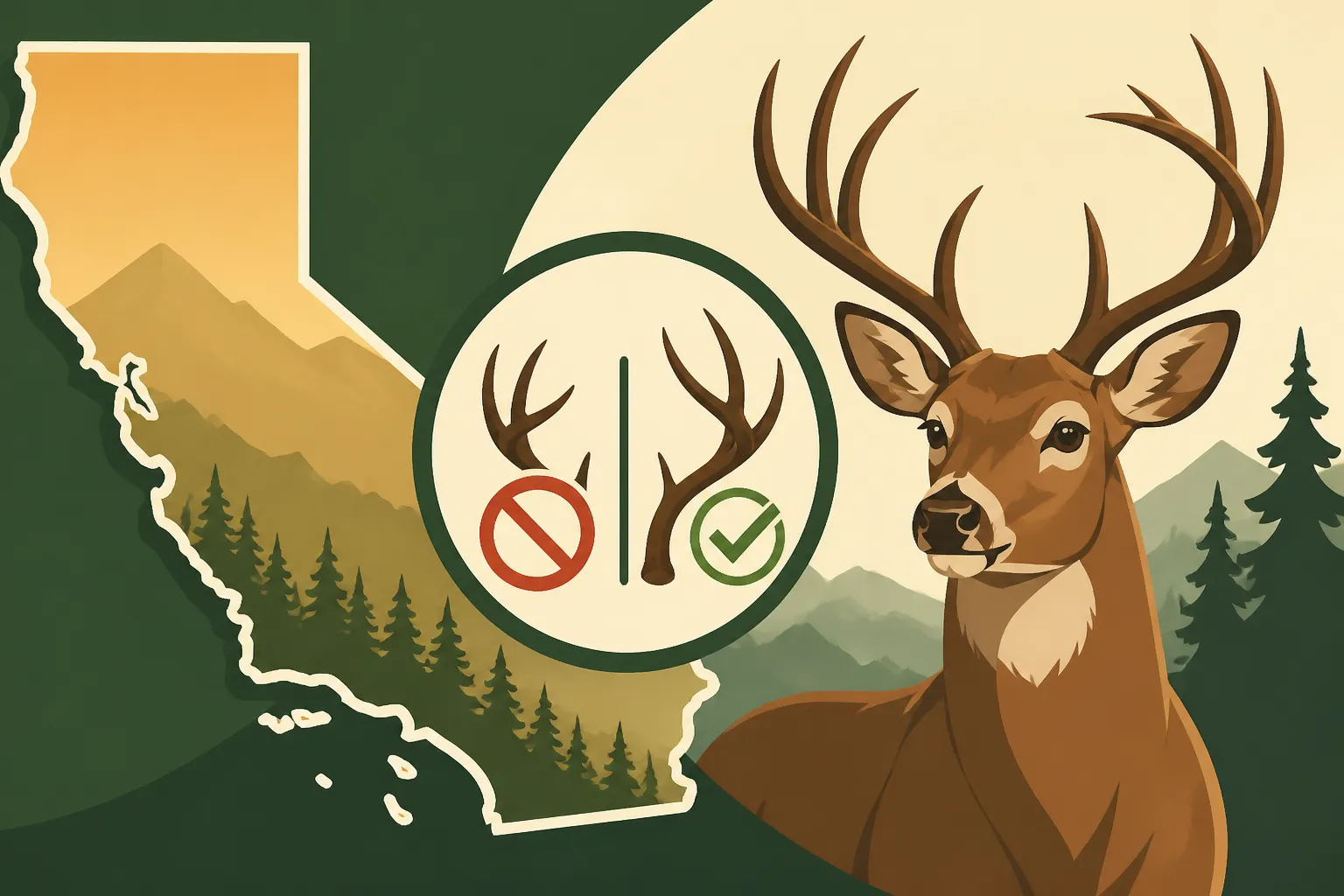
When the regulations state "forked-horn or better," they are very specifically defining the minimum legal antler configuration for a buck. This means the deer must have at least one antler with a branch or fork. To be absolutely clear, a main beam with a single point extending from it, creating a "fork" or "Y" shape, qualifies. A spike buck, which is a buck with antlers that are simply single, unbranched points, no matter how long, is not a legal "forked-horn or better" buck. It’s a common mistake, but an important one to avoid. This isn't about counting individual points on each side; it’s about the presence of a fork. So, a buck with a small fork on one side and a spike on the other is legal. A buck with a fork on one side and nothing but a broken off stub on the other is still legal, as long as that one antler has a fork.
The term "any-deer," on the other hand, is exactly what it sounds like: any deer. This means you can harvest a buck of any antler configuration (including a spike), or even an antlerless deer (doe or fawn). These tags are significantly less common in California and are usually associated with special hunts or specific herd management units where population control of does or removal of certain buck age classes is a specific objective. Don't assume your general season tag is "any-deer"; it almost certainly isn't.
Why California Deer Tags Focus on General Buck Types
California's approach to deer tags, with its emphasis on "forked-horn or better," is rooted in a management philosophy that balances hunter opportunity with herd health. The state generally aims to provide a reasonable chance for hunters to harvest a buck, while also protecting the youngest age classes of bucks (spikes) to allow them to mature and contribute to the breeding population. This system is less about growing "trophy" deer with specific point counts and more about maintaining a healthy, viable deer population across the diverse landscapes of California.
By allowing hunters to take any buck that has at least one fork, the regulations simplify field judging compared to more complex point-counting systems. This reduces the pressure on hunters to make split-second, intricate decisions about antler configuration, which can be particularly challenging in thick timber or at varying distances. It helps ensure that a greater number of young bucks survive their first year to potentially grow larger antlers in subsequent seasons, which can contribute to a more robust gene pool over time. While trophy-sized deer are definitely out there in California, particularly in the premium draw zones, the general season regulations aren't primarily designed to produce them through strict antler criteria.
This strategy also acknowledges the significant habitat diversity and varying deer populations across California. What works for the dense brush of the coastal ranges might not be practical for the expansive, open country of the eastern Sierra. The "forked-horn or better" rule provides a consistent, understandable standard that can be applied broadly, giving game managers flexibility to adjust tag numbers rather than constantly tweaking complex antler restrictions for each small subunit.
Specific Zones and Their Antler Restrictions
California's deer hunting zones are vast and varied, but when it comes to antler restrictions, there's a pretty consistent theme for most general season tags. However, it's crucial to understand where the nuances and exceptions lie, as these can be the difference between a legal harvest and a citation.
General Season Tags and "Forked-Horn or Better"
For the vast majority of general season deer tags across California, you'll be looking for a "forked-horn or better" buck. This includes many of the popular D-zones, as well as the coastal Zone A and the northern Zone C. If you've drawn a general season tag, whether it's for the early Hunting California's Zone A General Season Dates along the coast or a D-zone that opens in August, this is almost certainly the rule you need to abide by.
For instance, if you're hunting in a D-zone that opens in August or a D-zone that opens in November, your tag will specify "forked-horn or better." This consistency helps hunters plan, but it doesn't diminish the need to confirm your specific tag. When you finally get that buck in your crosshairs, or in your archery sight, take that extra moment to verify there's a clear fork. It can be easy to get excited, but ensuring legality is paramount. The intent here is to give a good number of hunters access to a buck, provided it meets this basic maturity threshold. This also means you don't need to stress about exact point counts, just the presence of that tell-tale fork.
The Rare "Any-Deer" Tags and Their Purpose
While "forked-horn or better" rules dominate, California does issue "any-deer" tags, though they are far less common and typically reserved for specific, highly managed hunts. These coveted tags mean you can harvest any deer, regardless of its antler configuration or sex. A spike buck, a fork-horn, a doe, or even a fawn are all fair game with an "any-deer" tag.
These tags are almost exclusively obtained through the annual California Big Game Drawing Explained, often for premium X-zones in the high country or other special hunts where specific herd management objectives are in place. For example, a limited number of "any-deer" tags might be issued in an area where managers are trying to reduce overall deer numbers due to habitat concerns, or to bring buck-to-doe ratios into a desired range. If you're lucky enough to draw one of these tags for zones like the Hunting California's High-Country X-Zones, it's a huge opportunity, but still requires careful scouting and understanding of the local deer movements. It’s worth noting that the odds for these tags can be incredibly low, making them a true once-in-a-lifetime opportunity for many. Hunters utilizing tools like GoHunt can often analyze draw odds for these specific tags, helping them make informed application choices.
Exceptions and Special Hunts to Be Aware Of
Beyond the general "forked-horn or better" and the rare "any-deer" tags, there are a few other exceptions and special hunts that might have unique antler requirements. These are usually highly localized or specific to certain hunter groups.
Some premium draw-only zones, particularly certain X-zones, might have their own specific antler rules, although many of these are "any-deer" as mentioned. It’s always critical to double-check the regulations for the specific hunt code on your tag. Additionally, junior hunters sometimes have access to special hunts or permits with different antler rules, sometimes even allowing "either-sex" deer where adult tags might not. These special windows are designed to introduce youth to hunting and foster conservation. For example, a specific junior hunt might allow the harvest of an antlerless deer or a spike buck, which might not be legal on a general adult tag in the same zone. These are explicitly detailed in the annual regulations. Always consult the current year's CDFW Big Game Hunting Regulations booklet, as these specific rules can change.
| California Deer Zone Category | Typical Antler Restriction | What it Means in Practice | Common Examples |
|---|---|---|---|
| General Season Tags | Forked-Horn or Better | Must have at least one antler with a distinct fork. Spike bucks are NOT legal. | Zone A, Zone C, most D-zones (e.g., D3, D5, D7) |
| Premium Draw Tags | Any-Deer (sometimes) | Any deer, regardless of antler configuration or sex (buck, doe, fawn). | Specific X-zones, late-season antlerless hunts |
| Special Youth Hunts | Varies (often "Any-Deer") | Can be "Any-Deer" or other specific rules to provide opportunity for junior hunters. | Designated junior hunt areas |
Navigating CDFW Regulations and Avoiding Violations
Successfully hunting in California isn't just about finding game; it's also about understanding and strictly adhering to the regulations. With the nuances of antler restrictions, particularly, it's easy to get confused. Don't let a moment of uncertainty turn into a frustrating violation.
The Importance of Checking Your Tag and Zone Booklet
This cannot be stressed enough: the official CDFW Big Game Hunting Regulations booklet and the specific details printed on your deer tag are the absolute final authority. Relying on what your buddy heard, what you read on a forum from last year, or even a general overview of zones can lead to serious trouble. Every hunt code is distinct, and while many D-zones share the "forked-horn or better" rule, there can be subtle differences. The California hunting landscape is incredibly diverse, and regulations reflect that.
Before you even step foot in the woods, make it a ritual to review the regulations for your specific zone and hunt code. California's Zones open on different dates, and even within the D-zones, you'll find variety, with some D-zones that open in August and others that open in November. Knowing the precise dates, boundaries, and, most importantly for this topic, the antler restriction for your tag is non-negotiable. Don't just skim it; read it thoroughly, paying attention to the details of legal game. The CDFW website also has digital versions that you can access on your phone, but it’s always smart to have a physical copy or a downloaded PDF in case you lose service. Planning your hunt using mapping apps like GoHunt can help visualize your zone boundaries against public land, further preventing accidental violations.
Field Judging Deer in California
Even with the relatively simpler "forked-horn or better" rule, confidently field judging a buck can be tricky, especially in the thick chaparral of the coastal ranges or the dense timber of the Sierra Nevada. Here's a quick guide to help you make that call without hesitation.
A "forked-horn" buck means that at least one of its antlers must have a point that branches off the main beam, creating a Y-shape. This secondary point (or "tine") must be at least one inch long. A "spike" buck, which is illegal for most general season tags, has antlers that are single, unbranched points, no matter how long they are. It’s not about how many points total, it's about the branching. If a buck has a broken antler on one side, but the other side clearly shows a fork with at least a one-inch tine, it's a legal "forked-horn or better" buck. If you're struggling to make the call, it's always best to pass. The thrill of the hunt shouldn't override ethical and legal responsibilities. Practice with binoculars and a spotting scope throughout the year to get better at judging antlers at a distance. If you're looking for more details on this, you can check out tips on Judging a Blacktail's Fork Versus a Forked Horn.
Resources for Clarification
The CDFW website is your primary resource for all official regulations, maps, and updates. They often publish an annual Big Game Hunting Digest that is indispensable. However, if you find yourself with a specific question that isn't clearly addressed, don't hesitate to reach out to CDFW directly. Their regional offices can provide clarification.
Beyond official channels, online communities, forums, and reputable hunting resources like GoHunt can offer additional insights, particularly on practical applications of regulations or local conditions. While these aren't official sources, they can be helpful for understanding common interpretations or finding local knowledge. Just remember to always cross-reference any advice with the official regulations. GoHunt, for example, often integrates regulation summaries directly into its mapping features, helping you understand the rules for specific zones as you scout. Using their platform to research the California Big Game Drawing Application Window or even specific hunt units can save a lot of guesswork.
The Impact of "Forked-Horn or Better" on California Deer Management
California's decision to mostly utilize a "forked-horn or better" antler restriction is not arbitrary; it's a deliberate management strategy that has specific ecological and social impacts on the state's deer populations and hunting culture. Understanding this rationale helps us appreciate the system we operate within.
Herd Health and Buck-to-Doe Ratios
One of the primary goals of the "forked-horn or better" rule is to contribute to a healthy deer population structure, particularly by influencing buck-to-doe ratios. By protecting spike bucks, which are typically yearling deer, the regulation allows more young males to survive their first hunting season. This means these bucks get another year to mature, grow larger antlers, and, critically, contribute to the breeding population. A balanced buck-to-doe ratio is vital for genetic diversity and robust fawn recruitment, ensuring the long-term sustainability of the herd.
If spike bucks were legal to harvest across all general seasons, there would be a much higher harvest pressure on the youngest age class of males. This could potentially skew the buck-to-doe ratio too heavily towards does, leading to less efficient breeding and potentially impacting fawn survival rates. While California's deer populations face various challenges, from habitat loss to drought, the "forked-horn or better" rule is one tool in the CDFW's arsenal to maintain stability. It's a pragmatic approach that acknowledges the realities of hunting pressure and aims to foster a healthy demographic profile among the deer, as detailed in reports on the California Buck-to-Doe Ratio by Zone.
Hunter Opportunity Versus Trophy Management
California's antler restriction philosophy generally leans more towards providing widespread hunter opportunity rather than strict trophy management. Many states with very rigid point restrictions (e.g., a "four-on-one-side" rule) are explicitly trying to manage for older, larger-antlered bucks. While such systems can produce impressive trophies, they often come at the cost of reduced hunter success rates and fewer opportunities to harvest a buck each year.
In contrast, California's "forked-horn or better" rule provides a more achievable standard for hunters. It allows for the harvest of bucks that are mature enough to have begun antler development beyond a simple spike, while still making a legal buck reasonably accessible for many hunters. This balances the desire for hunters to put venison in the freezer with the biological need to protect younger animals. While true trophy bucks are undoubtedly harvested in California every year—especially in the premium X-zones—they are more a product of good genetics, ample forage, and challenging, less-pressured terrain, rather than direct antler-based management across the board. The goal is often to provide a positive and successful hunting experience for as many license holders as possible, without over-complicating the rules or creating unreasonable expectations for antler size.
Disclaimer
Please remember that hunting regulations can change. While this guide provides comprehensive information, it is crucial to consult the most current California Department of Fish and Wildlife (CDFW) Big Game Hunting Regulations booklet and your specific deer tag details before heading into the field. This article is for informational purposes only and should not be considered legal advice.