Choosing a Scope Magnification for Blacktail Country
Hunting blacktail deer in California is an experience unlike any other, often throwing hunters into dense, tangled chaparral one moment and wide-open timber stands the next. This dramatic shift in terrain can make choosing the right scope magnification feel like a puzzle, leaving many hunters over-magnified for the close shots or under-powered for the long ones. This guide will walk you through the nuances of selecting a scope magnification that truly suits the varied and often challenging blacktail country, helping you make confident shots no matter what the Golden State throws your way.
Understanding the Blacktail Deer's World and Your Shot Opportunities
Blacktail deer are masters of cover, making their homes in some of California's thickest and most unforgiving landscapes. This means that a significant portion of your hunting will likely occur in dense brush, dark timber, and steep canyons, where shot distances are often measured in yards, not hundreds of yards. However, it’s not all close-quarters combat. California's diverse terrain also offers opportunities in more open country, such as clear-cuts, burn scars, and ridge lines, where a longer shot might present itself. The trick is preparing for both without compromising your effectiveness in either scenario.
Navigating Dense Cover and Close Encounters
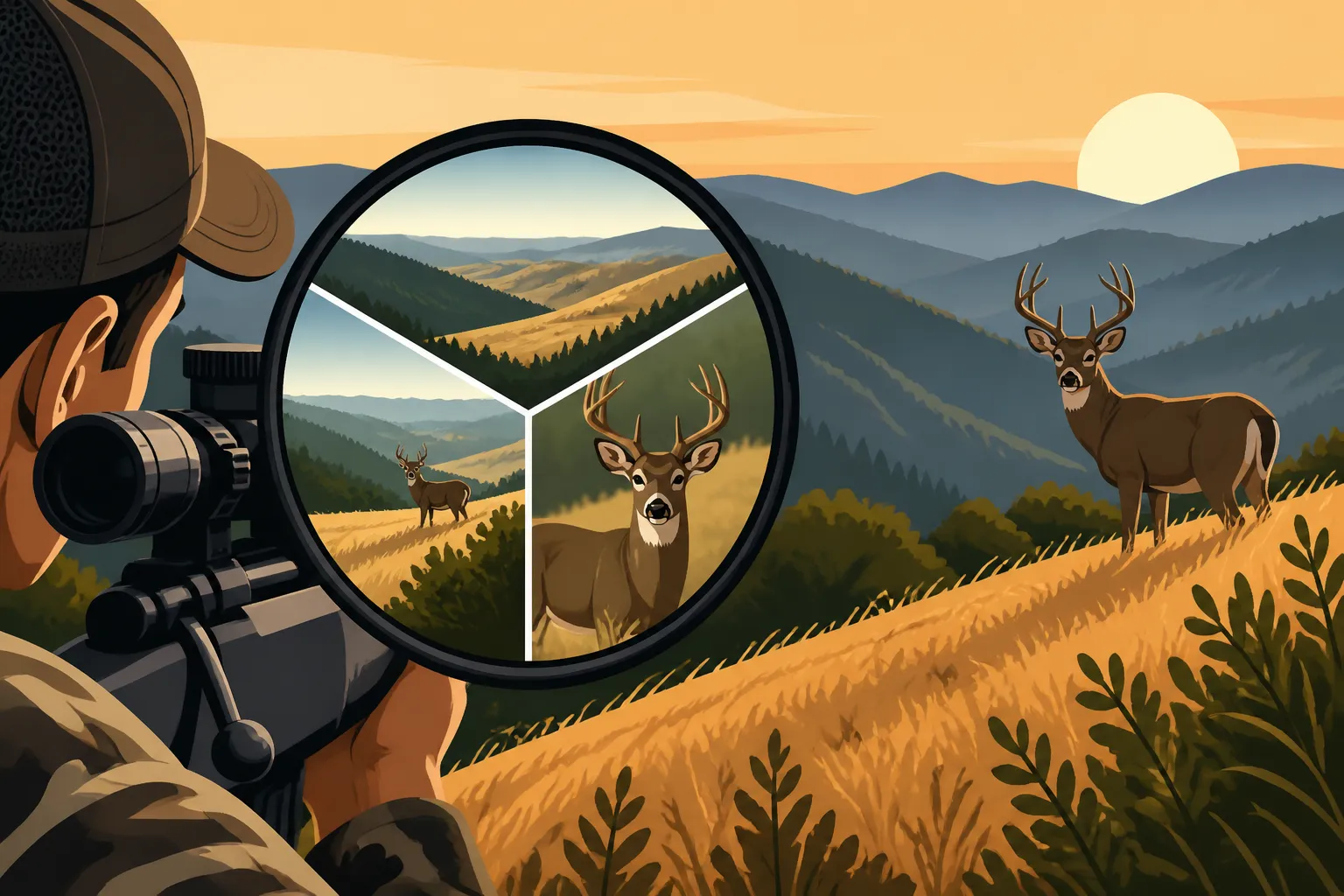
Let's face it, if you're hunting blacktail in the Coast Range or the Sierra foothills, you're going to spend a lot of time in thick stuff. Think about those moments when a buck busts out of a manzanita thicket at 30 yards, or you're still-hunting through a stand of oaks and one steps out from behind a trunk at 75. In these situations, speed and target acquisition are paramount. A scope dialed up to 9x or 12x magnification becomes a hindrance, not a help. Your field of view shrinks, making it difficult to find the deer, track its movement, and get a clear, quick shot. It’s like trying to drink water from a firehose with a tiny straw.
Many seasoned blacktail hunters swear by keeping their scope on the lowest magnification setting while still-hunting or moving through dense areas. This gives them the widest possible field of view, making it much easier to pick up a deer moving through the trees or reacting quickly to a sudden appearance. Imagine that feeling of a buck bolting, and you're just trying to find it in your scope—it's a frustrating situation that often leads to missed opportunities. For many, Where California Blacktail Bucks Bed is often in these tight spots, demanding a fast response.
Scouting Openings and Anticipating Longer Shots
While dense cover defines much of blacktail habitat, opportunities for longer shots do exist. Picture yourself glassing a clear-cut across a canyon on a crisp autumn morning, or watching a powerline cut at last light. A bedded buck at 200-300 yards might be a distinct possibility. Along the edges of meadows, or on a high ridge overlooking a vast expanse of chaparral, you might need a bit more magnification to properly identify an animal, confirm it's a legal buck, and place your shot precisely. This is where the dilemma truly sets in for many hunters. The desire to cover all bases with one optic is strong, but a balance must be struck. A good resource for researching areas like this, and what gear is commonly used, can be found on platforms like GoHunt, which often feature gear reviews and tips tailored for specific hunting scenarios.
It's tempting to think, "Well, I'll just get a high-power scope and keep it on the lowest setting for close shots." The problem is, a 3-15x or 4-20x scope, even on its lowest setting, might still offer a narrower field of view and feel less "forgiving" than a true low-power variable. The size, weight, and sometimes even the eye box of higher-magnification optics can also be a trade-off in dense, steep terrain. You might find yourself hiking Hunting a Ridge-Top Saddle at First Light and regretting the extra ounces or bulk.
Finding the "Goldilocks Zone": Ideal Magnification Ranges for Blacktail
When it comes to scope magnification for blacktail, you're aiming for that "just right" balance. It's about having enough power for those longer, more deliberate shots, but not so much that you're fumbling when a buck jumps up from under your nose. The key is understanding that blacktail hunting is typically a medium-range endeavor, with a heavy emphasis on quick, close-range action.
Low Power for Fast Acquisition and Wide Field of View
For many blacktail hunters, especially those who prefer still-hunting or hunting thick timber, a scope with a true 1x or 2x on the low end is a game-changer. Optics like a 1-4x, 1-6x, or even a 2-7x variable scope excel in these environments.
- 1-4x or 1-6x: These scopes are incredibly versatile. At 1x, you can shoot with both eyes open, giving you an almost holographic sight picture with the speed of iron sights, but with the precision of a red dot. This is phenomenal for close-range, fast-moving deer in heavy brush. When a blacktail busts out of cover, you're on target instantly. Crank it up to 4x or 6x, and you have plenty of magnification for shots out to 150-200 yards, which covers the vast majority of blacktail encounters. The wider field of view at lower magnifications makes tracking moving game much easier, allowing you to follow the deer through openings in the brush and anticipate its next move.
- 2-7x: This is another fantastic option for blacktail. The 2x low end still provides a generous field of view and quick target acquisition, though perhaps not as fast as a true 1x. The 7x on the high end offers more than enough magnification for shots out to 250 yards or even a bit further for a confident shooter. These scopes are often lighter and more compact than their higher-magnification counterparts, which is a real bonus when you're navigating challenging terrain.
Mid-Range Versatility: The All-Around Workhorses
For the hunter who wants a bit more reach without sacrificing too much close-range capability, the classic mid-range variable scopes are excellent choices.
- 2.5-10x: This magnification range is often considered the sweet spot for many general-purpose hunting scenarios, and blacktail hunting is no exception. At 2.5x, you still get a decent field of view for those closer shots, and 10x is ample power for precise shot placement out to 300-400 yards, which is typically the outer limit for blacktail in anything but exceptionally open country. Many popular rifles for Rifles and Calibers for California Big Game are paired with optics in this range. It’s a versatile setup that can handle both the jump-shooting opportunities in thick brush and the more deliberate shots across a ravine.
- 3-9x: This is perhaps the most common and proven magnification range for deer hunting across North America, and it performs admirably in blacktail country. The 3x low end is still very manageable for picking up deer quickly in cover, and 9x offers plenty of zoom for all but the most extreme long-range scenarios. These scopes are usually robust, reliable, and come in a wide array of price points. They strike an excellent balance between speed and precision.
When Higher Magnification Might Be Justified
While often overkill for the typical blacktail hunt, there are specific situations where a higher magnification scope (e.g., 4-16x, 4.5-18x) could be considered.
- Dedicated Glassing from a Perch: If your hunting strategy revolves almost entirely around finding deer by glassing vast, open areas from a stationary position, such as a high ridgeline overlooking a sprawling canyon, then a higher-power scope can certainly help. This is less common for blacktail compared to mule deer in more arid, open environments, but not entirely unheard of in specific zones. In these cases, you might be using a spotting scope or high-powered binoculars like those used for Glassing a Canyon for a Bedded Buck and then using your rifle scope for confirmation and the shot.
- Mixed Bag Hunting: If you're hunting in an area that holds both blacktail (in the timber) and mule deer (in the open sagebrush), you might lean towards a slightly higher magnification to be prepared for the longer shots at mule deer, understanding that it's a compromise for the blacktail. However, for a dedicated blacktail hunt, the added bulk and reduced field of view often outweigh the benefits.
Remember, the vast majority of blacktail are taken at under 150 yards. While a 300-yard shot is possible, it's rare to have that kind of open country for extended periods in prime blacktail habitat.
| Magnification Range | Low End | High End | Blacktail Application | Pros | Cons |
|---|---|---|---|---|---|
| 1-4x / 1-6x | 1x | 4x/6x | Thick timber, brush, still-hunting, fast shots | Extremely fast target acquisition, wide field of view, lightweight | Limited reach for very long shots (though rare for blacktail), less precision at extreme range |
| 2-7x | 2x | 7x | Varied terrain, combo of still-hunting and short sits | Good balance, decent field of view, still quick | Not as fast as 1x for extreme close quarters, less precision than higher powers at max range |
| 2.5-10x / 3-9x | 2.5x/3x | 10x/9x | All-around, mixed habitat, most common blacktail hunts | Excellent versatility, sufficient power for most shots, widely available | Can be slow on lowest setting in extremely dense cover if buck jumps close, slightly heavier/bulkier |
| 4-16x / 4.5-18x | 4x/4.5x | 16x/18x | Open country, long-range glassing from static positions | Superior precision for long shots, detailed target identification | Poor for close, fast shots, narrow field of view, heavier, bulkier, more prone to parallax issues |
Practical Considerations Beyond Magnification
Choosing a scope for blacktail is about more than just the numbers on the magnification ring. Several other factors play a crucial role in how effective your optic will be in the field.
Objective Lens Size and Light Gathering
The objective lens is the front lens of your scope, and its diameter directly impacts how much light the scope can gather. A larger objective (e.g., 50mm, 56mm) can let in more light, which theoretically helps in low-light conditions like dawn and dusk when blacktail are often most active. However, a larger objective also means a heavier, bulkier scope that sits higher on your rifle. In steep, brushy blacktail country, this extra size can be a liability, snagging on branches and adding unnecessary weight when you're already doing a lot of hiking.
For most blacktail hunting, a 40mm or 42mm objective lens is perfectly adequate. Modern optics with high-quality glass and coatings are incredibly efficient at gathering light, making a massive objective lens less critical than it once was. Prioritizing compact size and weight over a marginal gain in low-light performance is often the smarter move.
Reticle Choice and Illumination
Your reticle is what you use to aim, and the right one can make a big difference. For blacktail hunting, simplicity often wins. A basic duplex reticle is excellent for quick target acquisition. However, if you anticipate shots at varying ranges and want to hold over accurately, a BDC (Bullet Drop Compensator) reticle or a simple hash-mark reticle can be very useful, especially when paired with Choosing Non-Lead Rifle Ammunition in California, as different bullet types may have different trajectories.
An illuminated reticle is another feature worth considering. In the dark timber or at last light, a fine black reticle can disappear against a dark animal or background. An illuminated dot or crosshair provides a clear aiming point without obscuring the target. Just make sure the illumination can be turned down low enough not to "bloom" and overpower your vision in truly dim conditions.
Durability and Weight
Blacktail country is tough on gear. You'll be pushing through brush, scrambling over rocks, and potentially slipping on wet leaves. Your scope needs to be able to take a beating and maintain zero. Look for scopes known for their robust construction, waterproof and fog-proof performance. Reviews and field tests, often found through platforms like GoHunt, can offer insights into how different brands hold up to real-world abuse. A scope that holds zero even after a fall is invaluable.
Weight is another critical factor. When you're hiking for miles up and down steep grades, every ounce counts. A lighter scope can make a noticeable difference in your stamina and comfort. Combine a lighter scope with good footwear like Best Boots for Steep Wet-Season Sierra Trails, and your hunt becomes much more enjoyable. Avoid the temptation to add a massive, heavy scope to a lightweight rifle unless your hunting style genuinely demands it. The goal is a balanced rifle system that handles well in the field.
Eye Relief and Exit Pupil
These technical terms are important for comfortable and fast shooting.
- Eye Relief: This is the distance your eye needs to be from the ocular lens (the one closest to your eye) to get a full, clear sight picture. Generous eye relief (typically 3.5-4 inches or more) is crucial, especially when shooting from awkward positions or wearing thick clothing. It also helps prevent "scope bite" – where the recoil brings the scope back to hit you in the eyebrow. For quick shots on blacktail, you want a forgiving eye box that allows you to get behind the scope quickly without having to perfectly align your eye every time.
- Exit Pupil: This refers to the diameter of the light beam that leaves the ocular lens. A larger exit pupil makes it easier to find the sight picture quickly, which is a huge advantage when a deer suddenly appears. At night, your pupil dilates significantly, so a larger exit pupil (e.g., 5mm or more) will appear brighter and more comfortable to look through. As you increase magnification, the exit pupil shrinks, which is another reason why lower magnification is preferred for fast target acquisition in challenging light or close quarters.
Making Your Final Decision for Blacktail Country
Ultimately, the best scope magnification for blacktail country is a personal choice, but one that should be informed by the realities of the hunt. There's no single "perfect" scope, but rather a spectrum of excellent options depending on your specific hunting style and the terrain you frequent.
Assessing Your Hunting Style and Locale
Before you buy, sit down and honestly evaluate how and where you typically hunt blacktail.
- Are you a still-hunter who slowly stalks through dense timber and chaparral? If so, prioritize a wide field of view and fast target acquisition with a scope that starts at 1x or 2x. You’re likely taking shots under 100 yards, and speed is key.
- Do you spend more time glassing clear-cuts, burn scars, or open ridge lines? While still common to encounter deer close, if your primary method involves spotting at distance and making a more deliberate approach or shot, a scope with a higher top end (e.g., 2.5-10x) might serve you better, offering more power to assess potential targets. Remember, even in open country, blacktail often use the smallest bits of cover, so you might be Hunting a National Forest Burn Scar but still need to find that buck in a patch of standing timber.
- Are you hunting private land where shots might be consistently longer across fields? If you have access to large private tracts with open fields or vineyards, where shots can stretch to 300+ yards, you might lean towards a 3-12x or 3-15x, understanding the trade-offs in weight and close-range performance. This is less typical for public land blacktail hunting.
Balancing Trade-Offs
Every scope choice involves trade-offs. You rarely get extreme low-light performance, maximum magnification, and feather-light weight all in one affordable package. For blacktail hunting, the sweet spot generally lies in sacrificing some of the extreme long-range magnification for better performance in the close to medium range. Speed, durability, and a forgiving eye box are often more valuable than raw magnification power.
Think about the conditions you're most likely to encounter: fast-moving deer, tight windows in the brush, steep climbs, and potentially wet weather. A reliable 2-7x or 3-9x scope with good glass and a simple, illuminated reticle will serve most blacktail hunters incredibly well. It’s a workhorse that won’t let you down whether you’re making a quick shot at 50 yards or picking off a buck at 200. Planning your gear, including optics, can be streamlined using platforms like GoHunt, which provide a wealth of information to help make informed decisions.
Hands-On Experience
If possible, try out different scopes on your rifle or at least handle them in a store. Mount them on a rifle, shoulder it, and try to acquire targets quickly. Look through them in varying light conditions. Pay attention to how the scope feels, its balance on the rifle, and how easily you can get a full sight picture. This hands-on experience is invaluable and can confirm whether a particular magnification range truly fits your natural shooting style. Don't be afraid to ask friends to try their setups or visit a local range that allows testing. You'll thank yourself later when that moment of truth arrives in the blacktail woods.
The quest for the ideal scope magnification for blacktail isn't about finding the biggest numbers; it's about finding the perfect partner for your hunting style and the unique challenges of California's diverse terrain. Choose wisely, and you'll be ready for whatever the blacktail season brings.
Disclaimer
This article is for general informational purposes only and does not constitute professional advice. Laws, prices and regulations vary by location and change over time. Consult a qualified professional for guidance on your specific situation.