Decoying Mallards on Flooded Rice Ground
Hunting ducks on California's flooded rice ground can be incredibly frustrating when those wary mallards just won't commit, circling high overhead before flaring off into the distance. It feels like you've done everything right, but they see something, or hear something, or just know it's not quite right. This guide is here to walk you through the nuances of setting up a successful decoy spread specifically for mallards on these unique Central Valley landscapes, helping you bring those greenheads into range.
Understanding the Flooded Rice Environment
The Central Valley's flooded rice fields are a magnet for wintering waterfowl, offering a smorgasbord of food and relatively safe roosting areas. But it's not as simple as just showing up; these birds are smart, and understanding their behavior in this specific habitat is key to consistent success.
Why Mallards Love Flooded Rice
Mallards are opportunistic feeders, and flooded rice fields provide an abundant source of residual rice grains, waste material, and invertebrates that thrive in the shallow water. After the harvest, farmers intentionally flood these fields for a variety of reasons, including decomposition of rice straw, weed control, and providing crucial wetland habitat for waterfowl. This makes them a prime feeding and loafing area, drawing in thousands of ducks. However, it also means these birds are under constant pressure from hunters, making them incredibly wary. You’re not just hunting a duck; you’re hunting a duck that has seen every trick in the book.
The shallow water depth in most flooded rice fields is perfect for mallards to dabble and tip-up, accessing the submerged food sources without expending too much energy. They'll gorge themselves in these fields, especially during colder snaps when they need extra calories. Understanding this basic ecological pull is your first step; it tells you why they are there and what they are doing. If you see fields being pumped and flooded in late summer or early fall, you know the ducks will be following shortly.
Beyond food, these fields often provide refuge. Many rice fields are adjacent to large wildlife refuges or private lands where hunting pressure is minimized, allowing ducks a safe place to rest and recover. When birds leave these safe havens to feed, they are acutely aware of their surroundings. This awareness means your setup needs to be flawless, truly mimicking a natural feeding scenario.
Reading the Landscape: Access and Water Depth
Before you even think about setting out decoys, you need to understand the specific field you're hunting. Access can be a real challenge in flooded rice. Are there levees you can use for concealment? Are the roads muddy and impassable without a four-wheel drive? Many fields require a decent hike in, often through knee-deep mud and water, so planning your gear and approach is critical. For insights on navigating these challenging environments, check out our guide on Choosing Waders for Flooded Rice Fields.
Water depth is another crucial factor. While mallards prefer shallow water for feeding, the depth can vary significantly across a single field. Some areas might be only ankle-deep, perfect for full-body feeding decoys, while others could be waist-deep, requiring deeper keeled decoys or even a boat to deploy effectively. Knowing the terrain under the water, often by scouting or using a reliable mapping app like GoHunt, will save you a lot of time and effort in the dark before shooting hours. Shallow spots are often where ducks want to land, so keep an eye out for slight rises or high spots in the field.
Also, pay attention to any subtle features in the field: patches of emergent vegetation, small islands, or even changes in the rice stubble density. These can all influence where ducks prefer to land or loaf. A slight rise that's just a few inches shallower might be the sweet spot, indicating where ducks feel most comfortable. Don't be afraid to get out there and walk the field (when permitted) to understand its contours.
The Impact of Hunting Pressure
Mallards in California's Central Valley are arguably some of the most educated waterfowl in North America. They face continuous hunting pressure throughout the season, from the early openers right through the late winter hunts. This makes them incredibly sensitive to anything unnatural: a glint of sunlight off a gun barrel, a perfectly straight decoy line, or a poorly brushed blind.
Birds that have been shot at for weeks on end develop an uncanny ability to spot inconsistencies. They'll circle higher, study your spread longer, and often flare at the slightest sign of danger. This means your setup needs to be as natural and inconspicuous as possible. Forget the flashy, over-the-top spreads you might see on TV; subtlety and realism are your best friends here. For general strategies to improve your concealment, consider reading up on Brushing In a Blind on a Field Edge.
This constant pressure also means that the time of day and weather conditions play a huge role. Early morning flights might be less wary, but as the sun climbs and more shots are fired, birds become much tougher. Overcast days or foggy conditions can work to your advantage, keeping birds lower and more apt to decoy. It’s a constant chess match, and adapting to the birds' wariness is crucial.
Crafting Your Decoy Spread
Designing an effective decoy spread for pressured mallards on flooded rice is an art form. It's not about having the most decoys, but about having the right decoys in the right places, creating a scene that screams "safe and full of food" to approaching birds.
Mallard Decoy Numbers and Types
For flooded rice, you often don't need hundreds of decoys, especially when hunting highly pressured birds. A spread of 2-4 dozen high-quality mallard decoys, mixed with a few pintails or wigeon, can be more effective than a massive spread of cheap, unnatural-looking plastics. Focus on realism and variety. Full-body decoys on stands or shallow bases, if the water allows, offer a more natural profile than standard floaters, especially when ducks are standing on slight rises. Otherwise, opt for standard floaters with realistic paint schemes.
Consider adding a few "sleeper" or "resting" decoys. Mallards often loaf and sleep in flooded fields, especially mid-morning. These relaxed postures indicate safety and can be very inviting. Mix in some active "feeder" decoys as well, with their heads dipped down. These are powerful confidence builders, signaling that other ducks are actively and safely feeding. For ideas on maximizing your setup, our guide on Best Duck Decoy Spread for Flooded Rice offers more specific advice.
Don't forget the importance of contrast. A few dark-colored mallard drakes mixed with lighter hens will stand out better from above than an all-dark spread. Variety in posture and color will create a more lifelike scene. GoHunt often features articles on the latest advancements in decoy technology, and while price isn't everything, investing in realistic, durable decoys pays off over time.
Motion Decoys: Spinners and Ripplers
Motion is absolutely critical when hunting flooded rice. Still decoys in calm water can look lifeless and unnatural. Spinning-wing decoys (like the popular Mojo Decoys for Central Valley Mallards) are incredibly effective at grabbing attention from a distance, mimicking a landing bird. Place these on the downwind side of your spread, often at the landing hole, to draw birds in. However, beware of overuse; overly aggressive spinning can sometimes flare highly pressured birds, especially on bright, calm days. Sometimes, less is more.
Water motion decoys, like "flapper" decoys that create ripples or jerk-string setups, are excellent for adding subtle, natural movement closer to your blind. Ripples on the water's surface suggest contented, active ducks. A well-placed jerk string can bring your spread to life with minimal effort, making your decoys appear to be swimming or feeding. This subtle movement is often what seals the deal for wary birds that are scrutinizing your spread from above.
Experiment with different types and amounts of motion. Some days, a single spinner is all you need; other days, a combination of spinners and water motion works best. Pay attention to how the birds react. If they consistently flare short, try reducing your motion; if they're not even looking, add more. The conditions, such as wind and sunlight, will also dictate how much motion is appropriate.
Strategic Placement: The "J" Hook or "U" Shape
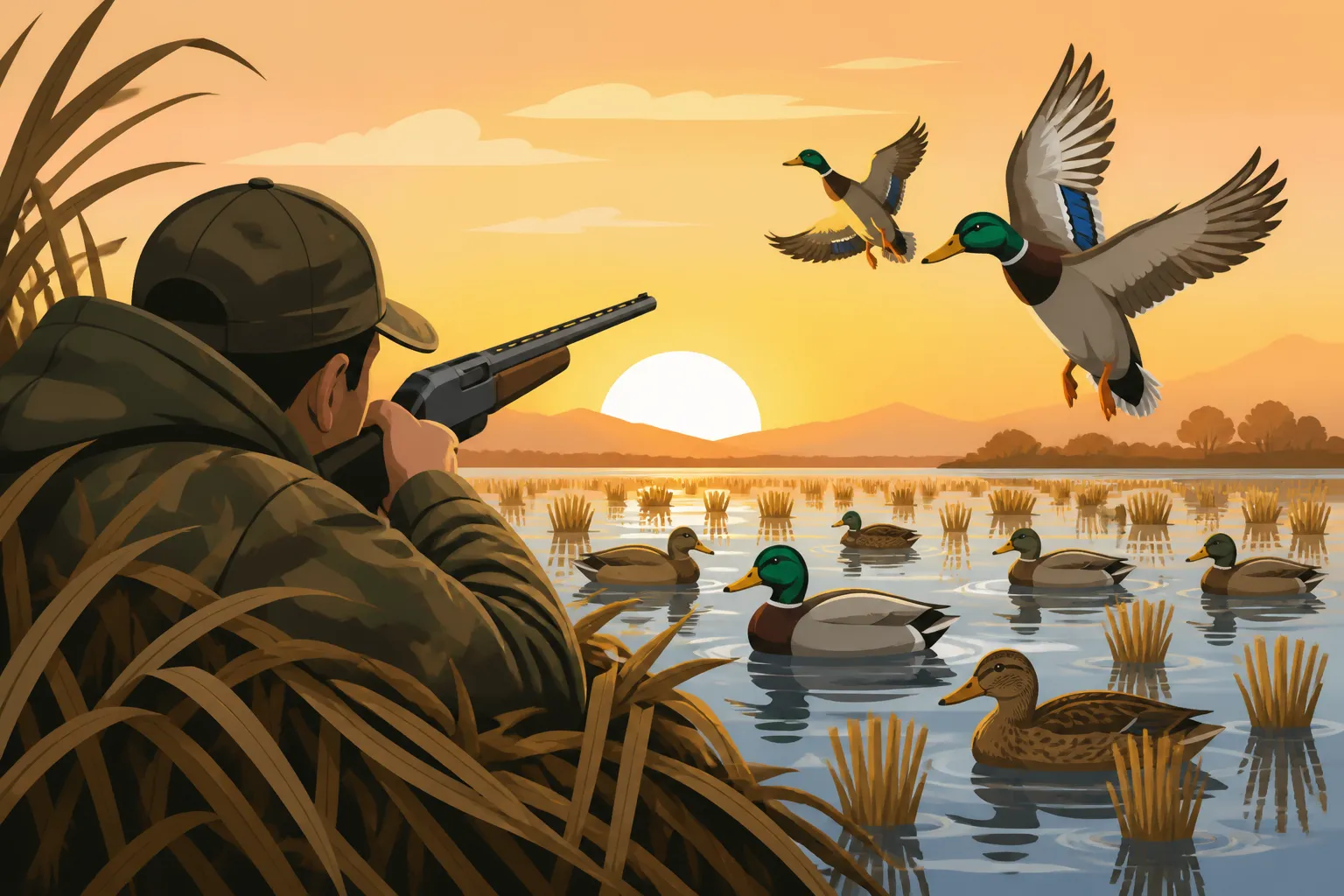
The goal of your decoy spread is to create a safe, inviting landing zone directly in front of your blind, ideally within shooting range. The classic "J" hook or "U" shape is incredibly effective for mallards on flooded rice. Imagine your blind at the base of the "J" or the closed end of the "U." The open end of the shape should face into the wind, as ducks almost always land into the wind.
The "body" of the "J" or "U" is made up of your main group of feeding and loafing mallards, with a few diverse species mixed in. Leave a clear, open "landing strip" in the middle of the "J" or "U" – this is your kill zone. Ducks want to land in this open water, feeling safe and having plenty of space. Place your spinning-wing decoys at the far end of this landing zone, drawing their eyes directly to it. Our detailed guide on Layout Blind Hunting a Flooded Field can help visualize these setups.
Consider the sun's position. You want the sun at your back, if possible, to put approaching birds in silhouette against the sky, making it harder for them to see you. Also, think about the flight path. Are ducks coming from a specific roost or flight corridor? Position your spread to intercept them naturally. A common mistake is to place decoys too close to the blind, making birds land short or directly over your head, where they can easily spot you. Give them room to work and commit.
Setting Up Your Blind and Staying Concealed
Your decoy spread can be perfect, but if your concealment is lacking, those wary mallards will spot you every time. Blending into the flooded rice environment is paramount.
Layout Blinds and Natural Cover
Layout blinds are a hunter's best friend in open flooded rice fields. They offer a low profile and allow you to hide directly in the field, becoming part of the landscape. However, simply placing a layout blind in the open isn't enough. The blind itself, with its manufactured shape and color, can stick out like a sore thumb.
The key is to integrate your blind seamlessly into the existing environment. Look for natural depressions, small changes in elevation, or even thicker clumps of stubble where you can tuck your blind away. If you can't find natural cover, you'll need to create it. This is where brushing in comes into play. Always remember that ducks have incredible eyesight from above, so what looks good from your perspective on the ground might be obvious from 100 feet up.
It's also essential to match the color and texture of your blind to the surroundings. Many layout blinds come in generic camo patterns, but if the rice stubble is golden brown and your blind is dark green, you'll be busted. Many blinds have stubble straps; use them liberally to attach local vegetation, making your blind disappear.
Brushing In Your Setup Effectively
Brushing in your blind isn't just an option; it's a non-negotiable step for hunting pressured mallards. You need to gather natural materials from around the field – rice stubble, weeds, mud, anything that matches the local vegetation. Start by breaking up the outline of your blind, especially the sharp angles. Ducks see lines and unnatural shapes. Pile stubble around the edges, on top, and even a bit in front of your shooting hole.
The goal is to make your blind look like just another clump of rice stubble or a small levee. Don't be shy; over-brushing is almost always better than under-brushing. Think about it from a bird's perspective high above: does it look like a natural part of the field? For detailed guidance, consult our post on Brushing In a Blind on a Field Edge. Don't forget to brush your face and hands as well, or wear a face mask and gloves that blend with your environment.
Another crucial aspect is leaving no trash or unnatural objects around your blind. Shell casings, coffee cups, bright coolers – these are all red flags to circling birds. Pack in what you pack out, and ensure your entire area looks undisturbed. A single piece of stray plastic can ruin an otherwise perfect setup.
Managing Your Dog in a Flooded Field
Hunting waterfowl without a good retriever is a lot harder, but managing your dog in a flooded rice field requires special consideration. First and foremost, your dog needs to be rock-solid steady in the blind. A dog that moves, whines, or pops out early will flare more ducks than any poorly placed decoy. Training for steadiness is paramount.
When it comes to concealment, your dog needs to be hidden just as well as you are. Many layout blinds have dog doors or compartments, but you still need to brush them in. If your dog is in a separate dog blind, ensure it's equally well-brushed and that the dog stays low until commanded to retrieve. Dark-colored dogs can be especially visible against a light-colored rice stubble background, so pay extra attention to their concealment.
Consider the water depth for your dog as well. Constantly wading in deep, cold water can quickly lead to hypothermia, especially for smaller breeds. Ensure your dog has a comfortable, dry platform or a blind that keeps them out of the coldest water. And always provide fresh water, especially if they’re retrieving in salty or muddy field water. Organizations like GoHunt often share valuable tips for dog care during cold weather hunts.
Calling and Reading the Birds
Calling is a powerful tool, but like decoys, it's about nuance and timing, especially with pressured mallards. Over-calling or making unrealistic sounds will do more harm than good.
Mallard Calling Techniques for Rice Fields
In flooded rice fields, aggressive, loud calling is rarely necessary for working birds that are already in the area. Instead, focus on soft, inviting calls that mimic contented feeding birds. A soft greeting call, a few clucks, and subtle quacks are often more effective than a highball that might scare off wary birds. The goal is to reassure, not to alert. Our guide on the Best Duck Call for Flooded Rice Ground provides specifics on the types of calls to use.
Use a feed call sparingly, mimicking ducks happily dabbling. When birds are circling high, a series of short, choppy quacks, sometimes called a "comeback call," can get their attention. But once they turn and start working the spread, back off the calling. Let the decoys and the natural sound of the wind through their wings do the work. Over-calling can make them suspicious.
Pay attention to what the birds are telling you. If they're cupping their wings and coming in, stop calling. If they seem hesitant, offer a soft reassurance. This is where patience and observation pay off.
Adjusting to Bird Behavior
Reading the birds is arguably the most critical skill in duck hunting. Their flight patterns, their hesitation, their calls – all of these are signals. Are they circling wide, avoiding your landing zone? Perhaps your spread is too dense, or your motion decoys are too aggressive. Are they flaring at a certain point in their approach? Look for what might be spooking them – a glint, a shadow, or a poorly concealed hunter.
Weather conditions also dictate bird behavior. On windy days, ducks will often fly lower and commit harder, trying to get out of the wind. On calm, sunny days, they'll often circle high and inspect everything with extreme scrutiny. Adjust your calling and concealment strategy accordingly. In foggy conditions, birds might appear out of nowhere, so be ready. For more on interpreting natural cues, consider our article on Reading a Wetland for a Morning Flight.
Remember that Duck Migration Timing Through California can also affect how birds behave. Early season birds might be less wary, while late-season birds have seen it all. Always be willing to adapt. If what you're doing isn't working, change it. Move a decoy, adjust your blind, or try different calls. The birds will tell you what they like and don't like if you listen.
Decoying Ethics and Best Practices
Responsible hunting practices ensure the longevity of our sport and respect for the game we pursue. Always adhere to California's hunting regulations, including California Duck Daily Bag Limit and possession limits. Make sure your shotgun is plugged to hold no more than three shells.
It's also imperative to purchase your California Federal Duck Stamp Requirement and California Migratory Bird Hunting Validation. These funds directly support wetland conservation, which benefits all waterfowl and other wetland species. GoHunt and similar organizations often advocate for these conservation efforts.
Regarding decoying, ensure you're not crowding other hunters. Flooded rice fields can attract many people, so be mindful of property lines and other groups. If someone else is working birds, give them space. A cooperative hunting environment benefits everyone and makes for a more enjoyable experience for all involved. Ethical shots are also paramount; only take shots at birds within your effective range to minimize crippling and ensure clean kills.
Decoy Spreads for California Flooded Rice
Here's a quick reference for common decoy spread types and when to use them on California's flooded rice grounds.
| Spread Type | Description | Ideal Conditions | Notes |
|---|---|---|---|
| "J" Hook/ "U" Shape | Decoys form a J or U, with the open end facing into the wind. Blind at the closed end. | Most conditions, especially light to moderate wind. | Creates a clear landing zone in front of the blind. Place spinners at the far end of the open water. Good for working birds from various directions. Mix in feeders. |
| Loafing Pod | A tight cluster of decoys, often with sleeper/resters, away from the blind. | Calm, mid-day, or sunny conditions. | Acts as a confidence builder, suggesting a safe, relaxed zone. Good for wary birds. Combine with a small "J" closer to the blind for landing. Less aggressive calling needed. |
| Feeding Frenzy | Spread out feeders, some active motion, creating a busy look. | Moderate wind, cloudy conditions, early morning. | Mimics active feeding. Use jerk strings and subtle ripples. Can include more decoys if conditions are favorable and birds aren't too pressured. Avoid over-calling, let the visual do the work. |
| Small & Subtle | 1-2 dozen realistic decoys, minimal motion. | High pressure, bright sun, calm days. | When birds are exceptionally wary, less is often more. Focus on realism, perfect concealment, and soft calling. Don't give them anything to pick apart. |
Remember, these are starting points. The most successful hunters are those who are willing to adapt and experiment based on what the birds are telling them on any given day.
Disclaimer
Please be aware that hunting regulations, license requirements, and season dates in California can change. It is every hunter's responsibility to check the latest California Department of Fish and Wildlife (CDFW) regulations before heading afield. This guide is for informational purposes only and should not be considered a substitute for official legal guidance.