Recovering a Deer From a Steep Canyon
Oh, the stomach-dropping feeling when you make that perfect shot, only to see your hard-earned buck take its last few bounds and then tumble out of sight into a canyon that looks like it was carved by a vengeful god. We’ve all been there, or at least dreaded being there. California’s beautiful, rugged terrain often means that a successful hunt isn't over until that deer is back at the truck. This guide is all about tackling that exact challenge – recovering a deer from a steep, unforgiving canyon, offering practical strategies, essential gear advice, and critical safety considerations to help you get your venison home safely.
Assessing the Situation and Planning Your Recovery
Before you even think about scrambling down into the abyss, taking a step back, taking a breath, and truly assessing the situation is paramount. The initial rush of adrenaline can make you overlook dangers, and California's diverse landscapes, from the loose scree of the Eastern Sierra to the slick, brushy slopes of the Coast Range, present their own unique hazards.
Safety First: Before You Even Start Down
Your safety, and that of anyone you’re with, always comes first. No deer is worth a broken bone or worse. When you're staring down a steep canyon, it's easy to get tunnel vision, focused solely on your animal. But you need to consciously pull yourself out of that mindset and observe your surroundings. Is the ground stable? Are there any obvious rockfalls or unstable ledges? What about thick, thorny brush that could snag you or hide hazards?
Think about the time of day. Are you working with dwindling daylight? Pushing into a steep, unfamiliar canyon as the sun sets is a recipe for disaster. It’s always better to mark the location, hike out, and return at first light with the proper gear and a fresh mind. Even if it means potentially losing some meat to spoilage in warm weather, a human life is infinitely more valuable. Always let someone know exactly where you are and what your plan is, especially if you're hunting alone. A satellite messenger, like a Garmin inReach or Zoleo, can be a lifesaver in areas with no cell service.
Evaluating the Canyon and Your Route
Once you've ensured your immediate safety, it's time to become a strategist. From your vantage point, carefully evaluate the canyon. Where did the deer go down? Can you see it? If not, use your binoculars or spotting scope to pick apart the terrain below. Look for the path of least resistance – a game trail, a less steep draw, or a series of benches that might offer a more gradual descent. Avoid direct, head-on assaults down the steepest face.
Consider the vegetation. Dense chaparral can be nearly impenetrable, while open timber might offer better footing but hide unseen drops. Pay close attention to the slope angle and any changes in terrain. Modern mapping apps, like those offered by GoHunt, are incredibly valuable here. You can use their topographic layers to visualize contour lines, identify drainages, and even mark potential routes down and back up. Drop a pin precisely where you last saw the deer or where you suspect it landed. This digital breadcrumb trail can save you hours of searching and keep you oriented in confusing terrain. Remember that when scouting California public land before season, you should also be looking for potential recovery routes in case a situation like this arises.
Time of Day and Weather Considerations
California’s climate can be notoriously unforgiving, and these factors play a huge role in your recovery strategy. If you're hunting California's Zone A season in August, you could be dealing with daytime temperatures soaring into the 90s or even 100s. This heat is not just grueling for you; it's a ticking clock for your venison. Gutting the animal immediately to promote cooling is critical, but even then, meat can spoil rapidly. In these situations, speed and efficiency are paramount.
Conversely, if you're hunting a late-opening high-country zone in the Sierra Nevada, a clear, crisp morning can quickly turn into a full-blown blizzard. Understanding the local weather patterns, including how wind and thermals in steep Sierra country can change dramatically with elevation and time of day, is vital. A sudden rain or snowstorm can turn stable ground into a muddy, treacherous slide. Always pack extra layers, a quality rain shell, and be prepared to hunker down or abort if conditions become too dangerous. Don't let the thought of losing a deer compromise your judgment in the face of bad weather.
Essential Gear for Steep Canyon Deer Recovery
Having the right tools for the job can make the difference between a successful, albeit exhausting, recovery and a dangerous, frustrating ordeal. You’re essentially preparing for a mini-expedition, even if the distance isn't vast. The challenge is the terrain itself.
Personal Safety and Navigation Gear
Your personal safety equipment is non-negotiable. First and foremost, a reliable headlamp is essential, even if you don't plan on being out after dark. Things can go wrong quickly, and you don't want to be fumbling around in a canyon in pitch black. Pack a high-quality first-aid kit that includes essentials for cuts, scrapes, sprains, and blisters. A satellite communicator, as mentioned earlier, isn't just for emergencies but also for checking in with loved ones or coordinating with a hunting partner.
Your footwear is critical. Forget those worn-out sneakers; you need sturdy boots with excellent ankle support and aggressive traction. Brands like Kuiu and Schnee's are popular among Western hunters for a reason – they're built for this kind of steep, rocky, and often unpredictable terrain. Ensure they are broken in, comfortable, and waterproof if there's any chance of moisture. Good quality gloves will protect your hands from sharp rocks, thorny brush, and rope burns. Don't forget ample water and high-energy snacks; recovering a deer from a steep canyon will likely be one of the most physically demanding tasks you undertake all season. If you're thinking about a pre-dawn Sierra climb, remember that having a reliable headlamp is crucial.
Quartering and Hauling Equipment
This is where the real work begins. A super sharp knife is your best friend. Many hunters prefer a replaceable blade knife, like a Havalon or Outdoor Edge, which ensures you always have a razor-sharp edge for the entire field dressing and quartering process without needing to stop and sharpen. A small, lightweight bone saw can also be incredibly useful for cutting through sternum or pelvic bones, or even sawing off antler bases if you're taking just the head and cape.
Game bags are absolutely essential. Don't just toss pieces of meat into your pack; use breathable, lightweight synthetic game bags (like those from Caribou Gear or Kifaru). These bags protect the meat from dirt, flies, and debris while allowing it to cool. This is especially vital when packing game bags for field care in August heat.
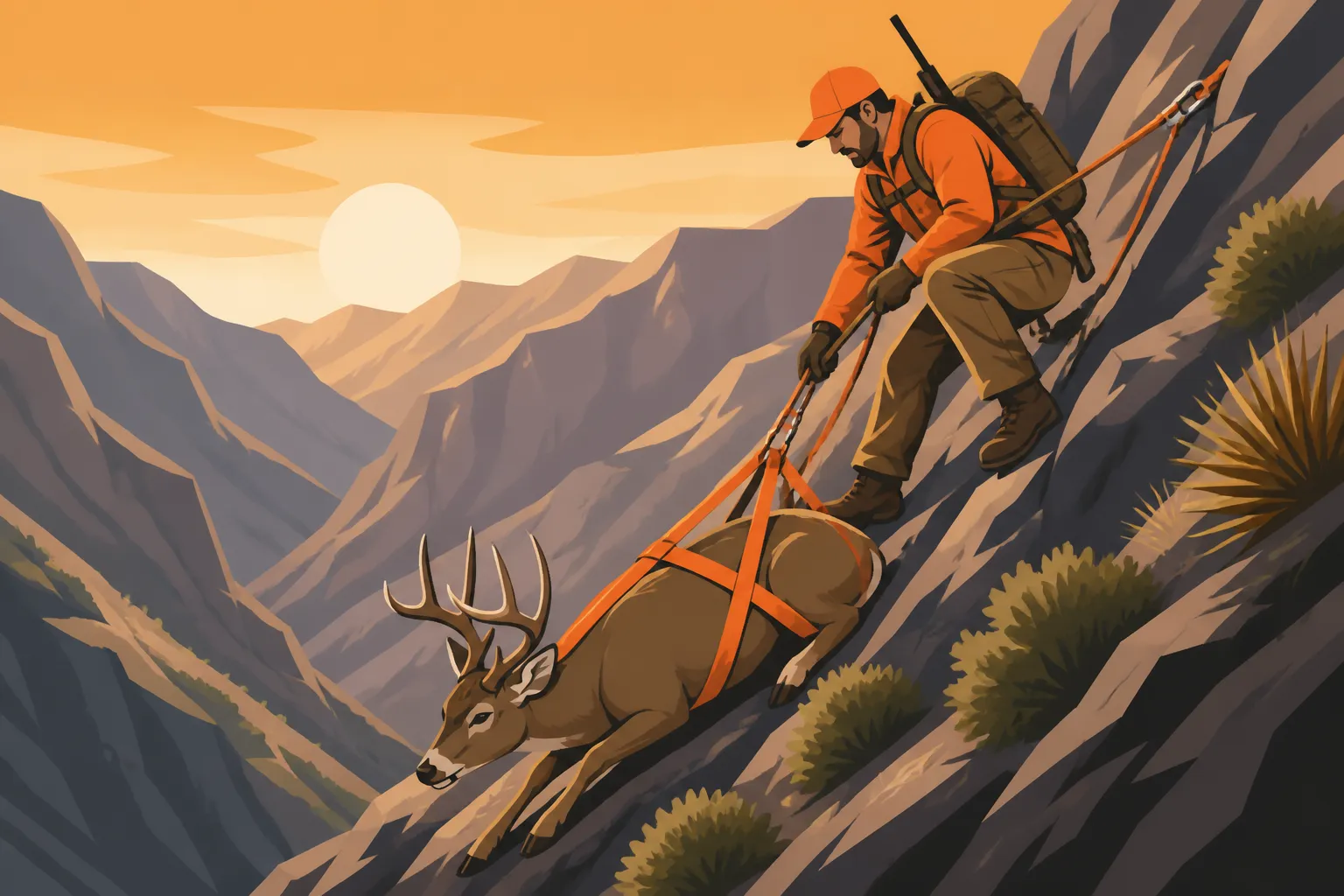
For hauling, a heavy-duty rope is a must-have. A 50-100 foot section of static climbing rope or strong utility cord can be used to lower quarters down steep sections, pull a loaded pack up an incline (if you have a partner), or even as a handline for yourself.
Finally, your pack. For steep, rugged terrain, an external frame pack or a heavy-duty internal frame pack with a load shelf is indispensable. Brands like Kifaru, Mystery Ranch, and Stone Glacier specialize in packs designed to carry heavy, awkward loads of meat. These packs distribute weight efficiently and can handle the bulk of several deer quarters. While a game cart might be tempting, in truly steep and broken canyon country, they are often more of a hindrance than a help. However, for less severe slopes or once you reach a more traversable area, specific types of game carts, like those with a single wheel, can be invaluable for dragging a deer out of a steep canyon on the more forgiving stretches.
Communication and Contingency Tools
Beyond your primary gear, a few other items can save the day. A fully charged cell phone is great for navigation or emergencies, but don't rely on it entirely for communication in remote California backcountry. A satellite messenger provides guaranteed two-way communication outside of cell service. A whistle can be used for signaling a partner if you get separated or need to alert rescue personnel. Extra layers of clothing are always a good idea, as temperatures can drop quickly, especially in the mountains or after the sun goes down. Keeping a small repair kit for your pack or other gear can also prevent minor issues from becoming major problems. If you're relying on a GPS app for California public land, make sure you've downloaded offline maps before heading out.
Executing the Recovery: Step-by-Step
You’ve made it to the animal. Now the real physical and mental grind begins. This phase requires deliberate action, methodical execution, and a healthy dose of grit.
Reaching the Animal and Initial Field Dressing
The moment you reach the downed deer, pause and confirm it's expired. Approach cautiously from behind, and poke the eye or touch the rump with a stick to be absolutely sure. Once confirmed, your immediate priority is to start the cooling process. This means field dressing, and quickly, especially if the weather is warm.
For animals in steep, awkward positions, traditional gutting can be a real challenge, as gravity works against you. This is where the "gutless method" shines. It involves skinning the deer on one side, removing the front and hindquarters, backstraps, and tenderloins, then flipping the deer (or letting gravity help you roll it) and repeating the process on the other side. The guts remain largely undisturbed within the carcass. This method significantly reduces the weight you're working with, minimizes mess in tight spaces, and can be faster than traditional gutting when dealing with difficult terrain. It's an excellent technique to master for recovering a deer from a steep canyon. However, for those who prefer the traditional approach, remember the importance of getting the internal organs out quickly to promote cooling, especially when field dressing a deer in hot weather.
Quartering and Preparing for Transport
Whether you chose the gutless method or traditional gutting, the next step is breaking the deer down into manageable pieces. For most hunters in steep country, this means quartering. Take your time and make clean cuts. Separate the four quarters, remove the backstraps (the long muscles along the spine), and retrieve the tenderloins (the small, delicate muscles inside the body cavity). If you want the neck meat, you can bone that out as well.
As each piece of meat is removed, immediately place it into a game bag. This protects the meat from contamination and allows for proper air circulation, which is crucial for cooling. Don't stack hot meat directly on top of each other; try to keep pieces separate if possible, especially during transport.
Here’s a quick comparison of gutting methods for steep terrain:
| Feature | Traditional Gutting | Gutless Method |
|---|---|---|
| Primary Goal | Remove all internal organs from the body cavity | Extract primary meat sections without opening cavity |
| Suitability for Steep Terrain | Can be messy, challenging due to gravity, more internal handling | Excellent, cleaner, less manipulation of entire carcass |
| Weight Reduction | Significant, but requires removing entire viscera | Significant, focuses on high-value meat, leaves viscera in carcass |
| Time | Can be slower and more difficult in awkward positions | Often faster in difficult terrain once mastered |
| Meat Protection | Requires careful handling to avoid contamination | Meat remains cleaner, protected by hide until bagged |
| Effort | More body manipulation, dealing with slippery organs | Less body manipulation, focused cutting and boning |
Strategies for Moving Meat Uphill
This is the most physically demanding part. If you have a hunting partner, the "buddy system" is your strongest asset. One person can pull or stabilize the loaded pack from above while the other guides it from below. You can also use your rope to lower individual quarters down a particularly steep or dangerous section to a more accessible spot.
If you're solo, you'll need to rely on your pack frame and good old-fashioned grit. Make multiple trips if necessary. It’s far safer and often quicker in the long run to carry smaller, manageable loads than to overload yourself and risk a fall or injury. Look for natural terrain features to aid your ascent. Game trails, even faint ones, often follow the path of least resistance up and down a slope. Use switchbacks, even if you have to create your own, rather than trying to climb straight up a steep incline. Focus on placing your feet deliberately, maintaining three points of contact whenever possible.
Take frequent, short breaks. Hydrate. Replenish your energy with snacks. Don't be afraid to take five or ten minutes to just sit and breathe. Pushing yourself past exhaustion increases your risk of injury. Remember, you’ve already tracked the deer in fresh Sierra snow or scouted for sign; now it's about making smart, safe choices to get the meat out.
Post-Recovery: Care and Reporting
You’ve made it back to the truck, exhausted but victorious. The work isn't quite done yet. Proper meat care and fulfilling your reporting obligations are the final crucial steps.
Proper Meat Care After Extraction
Once the meat is out of the canyon, your immediate goal is to get it cooled down as quickly as possible. If you’re in camp, hang the game bags in a shady, breezy spot. If temperatures are still warm, you'll want to get the meat on ice. Large coolers are invaluable here. Avoid submerging the meat directly in water; instead, use block ice or frozen water bottles to keep the meat chilled without making it soggy. Ensure there’s good air circulation around the bags. This prevents bacterial growth and improves the quality of your venison. For those planning to butcher a deer at camp, having a dedicated meat processing kit is a huge plus.
Reporting Your Harvest
California has mandatory deer reporting requirements. It’s crucial to report your harvest promptly, typically within 30 days of taking the deer, or immediately upon returning from a multi-day hunt. You can usually do this through the California Department of Fish and Wildlife (CDFW) website or their mobile app. This data is vital for wildlife management, helping the CDFW track herd health and population trends. Be prepared to provide your tag number, the date and county of harvest, and the zone you hunted. Failing to report your deer can result in fines and could impact your ability to draw tags in future years. Always check the current California deer reporting requirements as they can sometimes change.
Disclaimer
Please note: Hunting regulations and safety protocols can change. Always consult the latest California Department of Fish and Wildlife (CDFW) regulations before engaging in any hunting activities. This guide is for informational purposes only and does not supersede official regulations or professional safety advice.