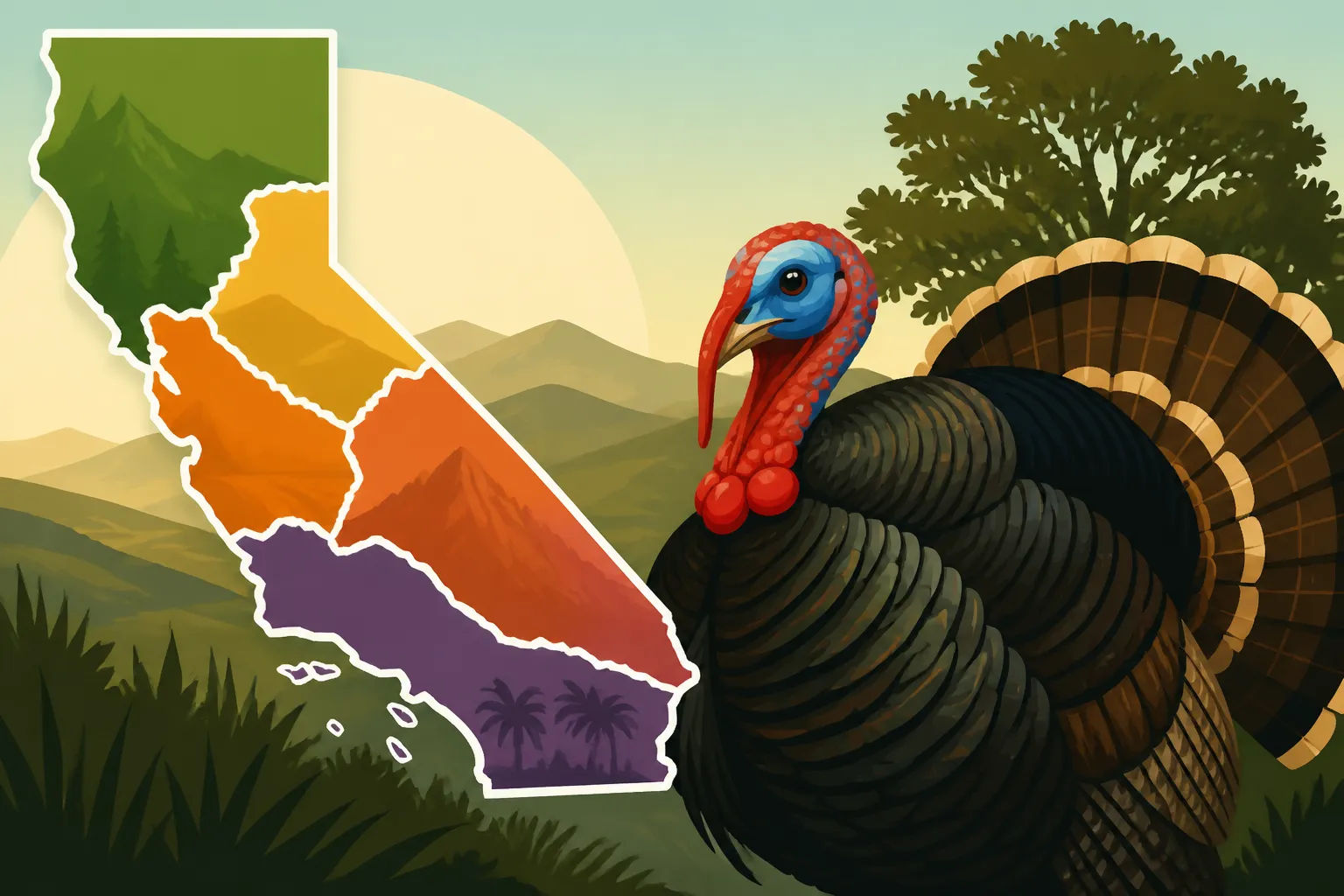
California Turkey Population by Region
For many hunters in California, the elusive gobble of a wild turkey is a sound that sets the heart racing, yet finding consistent action can feel like a guessing game. It's frustrating to drive hours only to find birds that seem to have vanished, or worse, to realize you've been hunting an area known for sparse populations. This guide is here to shed light on California's wild turkey populations, breaking down where these birds thrive regionally, what influences their numbers, and how you can use this knowledge to become a more successful hunter in our diverse state.
The Story of California's Wild Turkeys
It's easy to assume that wild turkeys have always been a fixture of California's wildlands, especially with how common they seem in some areas now. But the truth is, the state's robust turkey population is a testament to incredible conservation efforts. For a long time, California had no native wild turkeys. The turkeys we chase today are the result of introductions and transplantations, transforming our landscapes into prime turkey habitat.
A Phoenix from the Ashes: How Turkeys Returned
Believe it or not, our wild turkeys were intentionally introduced. Starting in the early to mid-20th century, various turkey subspecies were brought into California, primarily the Rio Grande and Merriam's, with some Eastern subspecies also contributing to the genetic mix in certain areas. These initial introductions faced challenges, but by the 1950s and 60s, more focused efforts led to successful establishments. The birds found a haven in our oak woodlands and foothills, where abundant food sources and suitable roosting trees allowed them to flourish. If you're curious about the specifics, there's a fascinating history behind exactly How Turkeys Were Introduced to California.
Over decades, these initial pockets expanded, and today, you can find turkeys in nearly every county with suitable habitat. It's a true conservation success story, illustrating how dedicated efforts can re-establish game species, providing fantastic hunting opportunities for current and future generations. The challenges, of course, moved from introduction to management and understanding how these resilient birds adapt to our varied terrain.
The Different Subspecies Calling California Home
While the "wild turkey" might seem like one species, California hosts a mix, primarily Rio Grande and Merriam's turkeys, and often hybrids of the two.
-
Rio Grande Turkeys: These birds are the most widespread in California. They are typically found in the central and coastal regions, thriving in open oak woodlands, riparian corridors, and agricultural areas. They're known for their lighter tail feather bands, often a buff or yellowish color, distinguishing them from their Eastern cousins. Their adaptability to diverse landscapes, including drier environments, has allowed them to colonize a vast swath of the state. When you're hearing a gobble from a distant canyon in the Central Valley foothills, chances are it's a Rio Grande.
-
Merriam's Turkeys: More at home in higher elevations and ponderosa pine forests, Merriam's turkeys are often found in the Sierra Nevada and Cascade ranges, particularly in the northern and eastern parts of the state. They tend to have more prominent white bands on their tail feathers. These birds are often sought after for their striking appearance and can be found in some of the state's most scenic hunting grounds. Their preference for timbered country means hunting them often involves different strategies compared to the more open habitats favored by Rio Grandes.
-
Hybrids and Local Adaptations: Due to the various introductions and expansions, many populations are a mix of these subspecies, making precise identification a fun challenge. What's more important than the exact subspecies is understanding that turkeys have adapted to regional nuances. A gobbler in a dense coastal redwood forest will behave differently than one in an open eastern Sierra ponderosa stand. This adaptation highlights the importance of regional population analysis when planning your hunts.
Key Turkey Regions in California: Where the Birds Roam
California is a massive state with incredibly diverse ecosystems, and the distribution of wild turkeys reflects this. While you might find scattered populations, certain regions consistently hold higher densities, offering better prospects for hunters. Understanding these strongholds is crucial for anyone planning a spring or fall turkey hunt.
Northern California: Oak Woodlands and Foothills
Northern California, particularly the vast expanses of oak woodlands and rolling foothills, represents a significant portion of the state's prime turkey habitat. Counties like Tehama, Shasta, and Butte are well-known hotspots. Here, the mix of blue oaks, live oaks, and scattered pines provides ideal roosting trees, foraging areas, and cover. This region is home to robust populations, often Rio Grandes or their hybrids.
Hunting here can involve diverse terrain, from accessible public lands along Bureau of Land Management (BLM) holdings and National Forests to extensive private ranches. The key to success often lies in scouting these areas for fresh sign, like tracks and droppings, and understanding Why Turkeys Thrive in California Oak Woodland. Access can sometimes be a challenge on private lands, but perseverance and knocking on doors often pay off. Expect to cover ground, listening for those early morning gobbles and being prepared for birds that might come in silently.
Central Coast and Southern California: Challenging Yet Rewarding
When you move south into the Central Coast and even parts of Southern California, turkey hunting takes on a different flavor. Populations here can be more fragmented and often require more diligent scouting. Counties like San Luis Obispo, Monterey, and even some foothill areas in Riverside and San Diego counties hold turkeys, but often in smaller, more isolated pockets. These regions can be drier, and birds might concentrate around water sources or irrigated agricultural lands.
The terrain here can be rugged, with dense chaparral and steep canyons, making glassing and long-range scouting essential. While the overall California Turkey Population Estimate might show good numbers statewide, individual pockets in these regions can be feast or famine. However, the reward of harvesting a gobbler from these challenging landscapes is incredibly satisfying. Don't overlook the opportunity to secure access to private lands, as many of these birds reside on large ranches. With tools like GoHunt's mapping features, you can often identify potential habitat even in lesser-known areas, giving you an edge.
Sierra Nevada Foothills: The Heart of Turkey Country
If there's one region that often comes to mind when talking about California turkeys, it's the Sierra Nevada foothills. From Mariposa up through El Dorado, Placer, and Nevada counties, this belt of oak-studded hills is arguably the densest turkey habitat in the state. The rolling terrain, combined with ample water, diverse vegetation, and a strong mast crop from various oak species, creates an ideal environment for turkeys to flourish. This is where you'll find some of the most consistent action and often larger flocks.
Public land access exists in the lower elevations of the Sierra National Forest and other federal lands, but pressure can be high. However, diligent scouting can still yield results. Many hunters find success here by focusing on overlooked pockets, especially on weekdays. The abundance of birds here also means opportunities on smaller private parcels if you can secure permission. The early morning hills come alive with gobbles, and you'll often find yourself calling to multiple birds throughout the day. For those looking for consistent action, this region truly stands out as some of the Best California Counties for Turkeys.
Here's a quick overview of how turkey populations generally stack up across these primary regions:
| Region | Primary Subspecies | Typical Habitat | Population Density | Hunting Pressure | Key Challenges |
|---|---|---|---|---|---|
| Northern California | Rio Grande/Hybrid | Oak Woodlands, Foothills, Pines | High | Moderate-High | Access, Wide-ranging Birds |
| Central Coast/SoCal | Rio Grande | Oak Savanna, Chaparral, Riparian | Moderate-Low | Moderate | Fragmented Habitat, Drier Conditions |
| Sierra Nevada Foothills | Rio Grande/Hybrid | Oak Woodlands, Mixed Conifer | Very High | High | Public Land Crowding, Steep Terrain |
Factors Influencing Regional Turkey Populations
Wild turkey populations are dynamic, always ebbing and flowing based on a variety of factors. It's not just about having the right trees; it's about a complex interplay of environmental conditions, food availability, and human activity. Understanding these influences can help hunters predict where birds might be concentrated in any given season.
Habitat Quality and Mast Crops
The foundation of any healthy turkey population is excellent habitat. Turkeys need a specific blend of open areas for foraging, dense cover for nesting, and tall trees for roosting. Oak woodlands, with their consistent mast crops of acorns, are paramount in California. Acorns are a critical food source, especially in the fall and winter, providing essential energy for birds to survive lean months. A poor acorn year can significantly impact turkey health and distribution.
Beyond acorns, turkeys rely on a variety of other foods: insects, grasses, seeds, and berries. Regions with diverse vegetation, offering a seasonal smorgasbord, tend to support higher turkey densities. For instance, areas with riparian zones often provide different food sources and water, attracting birds even in drier periods. When scouting, pay close attention to the abundance of mast crops and other food sources. If the local oaks are loaded, you can bet the turkeys won't be far.
Weather Patterns and Reproduction Success
Mother Nature plays a massive role in turkey population success, primarily through weather. Mild winters are generally beneficial, allowing birds to conserve energy and enter the breeding season in good condition. However, the most critical weather events often occur during nesting and brood-rearing.
A wet, cold spring can decimate turkey poult survival. Young turkeys are highly susceptible to hypothermia and drowning. Prolonged periods of rain during the hatch can lead to high poult mortality, resulting in fewer birds later in the year. Conversely, a warm, relatively dry spring, especially after a good mast crop, often leads to a boom in poult numbers, which translates to a healthier, larger population a year or two down the line. Drought conditions, a recurring theme in California, can also impact turkey reproduction by reducing insect populations (a vital food source for young poults) and limiting water availability. This is why knowing the historical weather patterns for your chosen hunting region is just as important as knowing the lay of the land.
Hunting Pressure and Public Land Access
While California's overall turkey population is healthy, hunting pressure can significantly impact local populations, especially on easily accessible public lands. Just like deer, turkeys learn quickly. Heavily hunted birds become "call shy" and wary, making them much harder to approach. This is a common frustration for hunters trying to find success on Public Hunting Land in California.
Many hunters secure California Spring Turkey Permit Rules for a variety of different zones. Areas with abundant public access, such as portions of the Mendocino National Forest or the Sierra foothills, often see concentrated hunting efforts. This doesn't mean you can't find birds, but it often requires getting further off the beaten path or employing different tactics. Private land, where pressure is often much lower, can hold more birds and present different hunting scenarios. When planning your hunt, consider the season dates and potential pressure. Sometimes, hunting mid-week or in less popular, harder-to-access spots can make all the difference.
Scouting and Strategy for Regional Turkey Hunts
Hunting California's wild turkeys successfully means doing your homework and being adaptable. The tactics that work in the thick timber of the Sierra might fall flat in the open oak savannas of the Central Coast. Understanding regional nuances and adjusting your approach is key to filling your tag.
Pre-Season Reconnaissance and E-Scouting
Before you even set foot in the woods, the best turkey hunters are already "hunting" from their desks. Pre-season reconnaissance is critical, especially when targeting specific regional populations. Start by studying aerial maps and topographic features. Look for oak ridges, creek bottoms, and areas with a mix of open ground and dense cover. Identifying potential roosting sites (tall, mature trees, often near water) and travel corridors between feeding and roosting areas is paramount. Many hunters use tools like the GoHunt app for this purpose, layering satellite imagery with public land boundaries to identify promising spots.
Once you've narrowed down some areas, a physical scout is invaluable. Look for fresh turkey sign: tracks in dusty roads or creek beds, droppings, strut marks, and shed feathers. Listen for gobbles at dawn or fly-up calls at dusk. Even during the off-season, you can learn a tremendous amount about bird patterns, which will directly inform your strategy for Spring Turkey Hunting in California. Pay attention to areas where you might find a flock of birds consistently, as these birds often return to the same general locations year after year.
Adapting Calling Techniques to Local Conditions
Turkey calling is an art, and the most successful callers understand that different regions and different birds demand different approaches. What works for a Merriam's in the high country might be too aggressive for a pressured Rio Grande in the foothills.
-
Loud and Assertive for Open Country: In the more open oak savannas or foothill environments, especially where birds might be spread out, a louder, more assertive series of yelps and cutts can be effective. You need to reach out and grab their attention across longer distances. However, be ready for birds to come in quickly and silently after an initial response. When Calling a Gobbler in Oak Woodland, subtle clucks and purrs might be all it takes once he's committed.
-
Subtle and Patient for Pressured Birds: In areas with high hunting pressure, especially on public land, less is often more. Over-calling can make wary gobblers shy away. Start with soft tree yelps, clucks, and purrs, mimicking a contented hen. Be patient, waiting for long intervals between calls. If a gobbler is hesitant, consider moving to a new setup or trying a different call type, like a diaphragm or pot call, to change the sound. Sometimes, a well-placed decoy, as discussed in Decoy Placement for Pressured California Birds, can make the difference for these tougher birds.
-
Elevation and Terrain: In steep, broken country, sound doesn't travel as predictably. Turkeys might be above or below you, and calls can be muffled by ridges and canyons. Adjust your calling volume and direction, thinking about how sound will carry. Often, birds will travel along contour lines rather than directly up or down steep slopes. Understanding the acoustics of your chosen area is a critical, but often overlooked, aspect of calling.
Understanding Roosting and Feeding Patterns
Successful turkey hunting often hinges on knowing where birds sleep and where they eat. Turkeys have predictable daily patterns, and understanding these regional habits is a major advantage.
-
Roosting Habits: Turkeys will typically fly up to roost in tall trees before dark and fly down around dawn. Identifying primary roosting areas is crucial. In the Sierra foothills, large valley oaks or sycamores along creek bottoms are common roost trees. In more timbered areas, large pines or cedars might be preferred. Knowing where to start your morning — within earshot of a roost but far enough not to spook birds — is often the difference between success and failure. Consider the internal link about Calling a Gobbler Off an Oak Ridge Roost for specific tips.
-
Feeding Habits: After flying down, turkeys will quickly move to feeding areas. These can vary regionally and seasonally. In spring, they often seek out green grasses, insects, and new growth. In fall, acorns, seeds, and residual grains in agricultural fields are key. Pay attention to fields bordering oak woodlands, open grassy slopes, or clearings in timber. These feeding areas might change throughout the day, and turkeys can cover significant ground. If birds are going quiet in late spring, as mentioned in When California Gobblers Go Quiet in Late Spring, it's often because they've transitioned from breeding to foraging patterns, and you'll need to adjust your setup to their feeding routes. When you're Setting Up Against a Big Valley Oak, think about the approach path a gobbler might take from his roost to a nearby food source.
Conservation Efforts and Future Outlook for California Turkeys
The story of California's wild turkeys is a conservation triumph, but it's not a static picture. Ongoing management, research, and responsible hunting practices are vital to ensuring these magnificent birds continue to thrive across the state. The future outlook for California's wild turkey populations appears generally positive, though challenges persist.
Monitoring and Management by CDFW
The California Department of Fish and Wildlife (CDFW) plays a crucial role in managing the state's wild turkey populations. This includes annual surveys to estimate population sizes, monitoring harvest data, and conducting research on turkey habitat use, reproduction, and survival rates. By tracking these metrics, CDFW can make informed decisions about season lengths, bag limits, and conservation efforts.
CDFW also actively manages public lands, including Wildlife Areas and National Forests, to improve habitat for turkeys. This might involve prescribed burns to enhance foraging areas, planting beneficial forage, or protecting critical roosting sites. Hunter participation in harvest reporting is essential for CDFW's data collection, helping to ensure accurate population assessments and sustainable hunting opportunities. Staying informed about California Turkey Season Rules is part of being a responsible hunter and helps contribute to these management efforts.
Challenges to Sustainable Turkey Populations
While turkeys are resilient, they face several challenges in California.
- Habitat Loss and Fragmentation: Urbanization and agricultural development continue to encroach upon prime turkey habitat, particularly in the Central Valley and coastal foothills. This loss of contiguous habitat can isolate populations, making them more vulnerable to disease and reducing genetic diversity. Preserving key corridors and promoting wildlife-friendly land management practices on private lands are critical.
- Drought and Wildfire: California's recurring droughts can severely impact turkey populations by reducing food sources, particularly insects for poults, and limiting water availability. Large-scale wildfires, while sometimes creating beneficial new growth, can also destroy significant portions of roosting and nesting habitat, leading to temporary population declines in affected areas.
- Disease: Like all wild animals, turkeys are susceptible to various diseases, which can sometimes lead to localized population impacts. CDFW monitors for disease outbreaks and implements measures to minimize their spread.
The Role of Hunters in Conservation
Hunters are, and always have been, key conservationists. Our license fees and tag purchases directly fund CDFW's wildlife management programs, including those benefiting wild turkeys. Beyond financial contributions, ethical hunting practices are paramount. This includes adhering to regulations, ensuring clean harvests, and respecting the resource.
Organizations like the National Wild Turkey Federation (NWTF) also play a significant role, working with landowners, government agencies, and volunteers to improve habitat, educate the public, and advocate for sound turkey management. By participating in these efforts, hunters ensure that the gobble of a wild turkey will continue to echo through California's landscapes for generations to come. Responsible hunting ensures we have turkeys to chase year after year.
Disclaimer
Please remember that hunting regulations, season dates, and specific rules for public and private lands in California are subject to change. Always consult the most current California Department of Fish and Wildlife (CDFW) regulations before planning any hunting trip. This guide is for informational purposes only and does not supersede official CDFW guidelines.